PDA

View Full Version : Three charges/electric field problem


FlipStyle1308
Sep2-06, 12:09 AM
Here is the problem which I need to solve:

The following picture shows a system consisting of three charges, q1 = +4.07 μC, q2 = +4.07 μC, and q3 = -4.07 μC, at the vertices of an equilateral triangle of side d = 2.29 cm. Find the magnitude of the electric field at a point halfway between the charges q1 and q2. Also find the magnitude of the electric field at the point halfway between the charges q2 and q3.
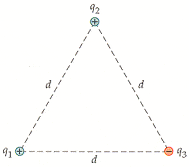
http://www.webassign.net/walker/19-32.gif

I am not too sure on how to solve this, so a little help would be good. Nothing is listed in my textbook about how to approach this. I was thinking of using the distance formula from mat, but I don't know how to incorporate the charges into the problem.

Päällikkö
Sep2-06, 01:06 AM
Please show your own work. You must at least know some equations you think are related to this problem?

FlipStyle1308
Sep2-06, 11:48 AM
For the first part of the problem, I used F21 = (k lq1l lq2l)/r^2, and got 2.8397 x 10^26N. How do I change this to get my answer into N/C?

Or was I supposed to use E= k(lql/r^2)? If so, how do I solve with this equation?

neutrino
Sep2-06, 12:28 PM
Go through this for basic definitions and examples.
http://hyperphysics.phy-astr.gsu.edu/hbase/electric/elefie.html#c1

neutrino
Sep2-06, 12:31 PM
Or was I supposed to use E= k(lql/r^2)? If so, how do I solve with this equation?
That's correct. Well, almost. That's the magnitude of the elctric field due to one charge q. The question asks you to find the field due to three charges. So you solve them vectorially, and then find the magnitude of the resultant.

FlipStyle1308
Sep2-06, 12:35 PM
Is this the correct equation:
http://hyperphysics.phy-astr.gsu.edu/hbase/electric/imgele/elefie2.gif

neutrino
Sep2-06, 12:39 PM
Still, that's just the magnitude. Go the 'Multiple Point Charges' section in the link I provided.

FlipStyle1308
Sep2-06, 12:47 PM
Okay, so I use http://hyperphysics.phy-astr.gsu.edu/hbase/electric/imgele/epoint3.gif. I still do not know how to incorporate the problem into the equation.

neutrino
Sep2-06, 12:55 PM
Do you know how to find the components of a given vector along the axes? If you don't, then I would ask you to go through this
http://www.sparknotes.com/testprep/books/sat2/physics/chapter4section5.rhtml

You will need this quite often.

FlipStyle1308
Sep2-06, 01:04 PM
I do know how to calculate components along axes, but I don't know how to incorporate the sides of the equilateral triangle into the problem. Since the distance between two points is given (one side of the equilateral triangle), shouldn't that mean I don't have to find x and y components?

neutrino
Sep2-06, 01:13 PM
Since the distance between two points is given (one side of the equilateral triangle), shouldn't that mean I don't have to find x and y components?
I'm not sure I understand what you're saying. The quesiton asks for the field at the midpoints of the line q1q2 and q1q3. These points are not the at same distance away from all the charges.

FlipStyle1308
Sep2-06, 01:18 PM
Okay, I know, but I'm just confused on how to set this up. Would you be able to give me a starting equation (with values), and then I can try to work my way from there?

neutrino
Sep2-06, 01:35 PM
E_1_x = k\frac{q_1}{(d/2)^2}\cos60
E_1_y = k\frac{q_1}{(d/2)^2}\sin60


For the first problem, those are the components of the field due to the first charge, q1. Do keep in mind that signs of the charges play an important role.

FlipStyle1308
Sep2-06, 01:47 PM
Okay, thanks. So I found E1x = 139,544,631.1N/C and E1y = 241,698,391N/C, so E1net = 279,087,799.8N/C. Is this correct? What about for E2?

neutrino
Sep2-06, 01:59 PM
You don't find E1net. Add the x components of all the fields (with the sign), and then y components, seperately. This will give you components of the resultant field. Then find the magnitude. For reference, have a look at the diagrams in that link.

What about for E2?
You've got to find it out. :)

FlipStyle1308
Sep2-06, 02:02 PM
I kinda worked ahead while waiting for your response, and I realized I don't need E1net. For E2x should my answer be the same as E1y and my answer for E2y should be the same as E1x?

neutrino
Sep2-06, 02:17 PM
Nope. What do you think would happen to the field at a point midway between two equal charges?

FlipStyle1308
Sep2-06, 02:19 PM
Would it balance out to zero?

neutrino
Sep2-06, 02:23 PM
Exactly. Now, what does that tell you about E2's components?

FlipStyle1308
Sep2-06, 02:25 PM
E2x = -E1y and E2y = -E1x? Is that right? Do I need to calculate anything for E3?

neutrino
Sep2-06, 02:33 PM
E2x = -E1y and E2y = -E1x? Is that right?
No. That wouldn't add up to a zero vector, would it?
Do I need to calculate anything for E3?
Yes, for the first problem, the resultant field is the same as the field due to E3 alone.

Btw, I've got a big download ahead of me now, and browsing will slow down. I'm sure the others will be able help you in case you have any questions. Try doing the second problem on the same principles. Good luck.

FlipStyle1308
Sep2-06, 02:35 PM
Okay, thanks for your help! Is anyone able to help me find E3 (x and y components)? I pretty much just need the equation set up for E3, and then I'll be able to solve the whole problem (I hope).