How Do Drag and Gravity Affect Projectile Motion?

Click For Summary
SUMMARY

The discussion focuses on the effects of drag and gravity on projectile motion, specifically analyzing the equations governing the motion of a projectile ejected into a fluid. The acceleration due to drag is represented as a_d = -kv, where k is a constant. The x-component of velocity is derived as v_x = v_{x0}e^{-kt}, while the y-component incorporates gravitational acceleration, yielding v_y = -(gt)e^{-kt}. The terminal velocity is reached when the drag force balances the gravitational force, resulting in v_y = g/k.

PREREQUISITES
  • Understanding of differential equations
  • Familiarity with projectile motion concepts
  • Knowledge of drag force dynamics
  • Basic principles of gravitational acceleration
NEXT STEPS
  • Study the derivation of terminal velocity in fluid dynamics
  • Learn about the impact of varying drag coefficients on projectile motion
  • Explore numerical methods for solving differential equations
  • Investigate the application of dynamics versus statics in physics problems
USEFUL FOR

Students studying physics, particularly those focusing on mechanics and fluid dynamics, as well as educators seeking to enhance their understanding of projectile motion under drag forces.

Warr
Messages
119
Reaction score
0
A projectile is ejected into an experimental fluid at time t = 0. The initial speed is v0 and the angle to the horizontal is theta. The drag in the projectile results in an acceleration term a_d=-kv, where k is a constant and v is the velocity of the projectile. Determine the x- and y-components of both the velocity and displacement as functions of time. What is the terminal velocity? Include the effects of gravitational acceleration.

here's a diagram:
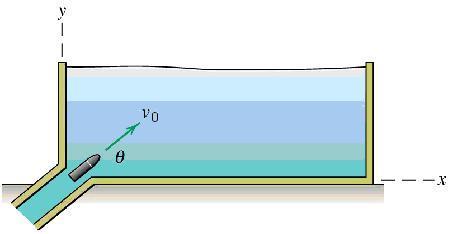
attachment.php?attachmentid=4891&stc=1.jpg


I don't really know what I'm doing here.

What I tried was splitting it into components and solving the dif eqs. I didn't know what 'constants' of integration would do so I just left them out.

a_x = -kv_x
v_x = e^(-kt)

a_y = -kv_y - g
v_y = -(gt)e^(-k*t)

let me just say I seriously do not know what I'm doing. Thus far we hadn't had any dif. eqs in the examples in class. No drag forces with gravity or anything. Btw this has to be solved with dynamics not statics I believe. I'm probably going in the completely wrong direction..
 

Attachments

  • yah.JPG
    yah.JPG
    7.2 KB · Views: 880
Last edited:
Physics news on Phys.org
Warr said:
A projectile is ejected into an experimental fluid at time t = 0. The initial speed is v0 and the angle to the horizontal is theta. The drag in the projectile results in an acceleration term a_d=-kv, where k is a constant and v is the velocity of the projectile. Determine the x- and y-components of both the velocity and displacement as functions of time. What is the terminal velocity? Include the effects of gravitational acceleration.

I don't really know what I'm doing here.

What I tried was splitting it into components and solving the dif eqs. I didn't know what 'constants' of integration would do so I just left them out.

a_x = -kv_x
v_x = e^(-kt)

a_y = -kv_y - g
v_y = -(gt)e^(-k*t)

let me just say I seriously do not know what I'm doing. Thus far we hadn't had any dif. eqs in the examples in class. No drag forces with gravity or anything. Btw this has to be solved with dynamics not statics I believe. I'm probably going in the completely wrong direction..
Resolving into components:

[tex]k\dot s_x + \ddot s_x = 0[/tex] the solution of which is:

[tex]v_x = v_{x0}e^{-kt}[/tex]

and:

[tex]k\dot s_y + \ddot s_y = g[/tex]

You can work out that solution, but you can also see that when kt is large, [itex]v_x = 0[/tex] and when kv<sub>y</sub> = g or v<sub>y</sub> = g/k there is zero acceleration and the object reaches terminal velocity. <br /> <br /> AM[/itex]
 

Similar threads

  • · Replies 7 ·
Replies
7
Views
1K
  • · Replies 8 ·
Replies
8
Views
1K
Replies
10
Views
2K
  • · Replies 1 ·
Replies
1
Views
2K
Replies
11
Views
2K
  • · Replies 2 ·
Replies
2
Views
1K
  • · Replies 13 ·
Replies
13
Views
3K
  • · Replies 13 ·
Replies
13
Views
5K
  • · Replies 6 ·
Replies
6
Views
3K
  • · Replies 1 ·
Replies
1
Views
2K