Antepolleo
- 40
- 0
I can't for the life of me figure out what I'm doing wrong here. Here's the problem:
A 5.40 kg counterweight is attached to a light cord, which is wound around a spool (refer to Fig. 10.20). The spool is a uniform solid cylinder of radius 7.00 cm and mass 2.00 kg.
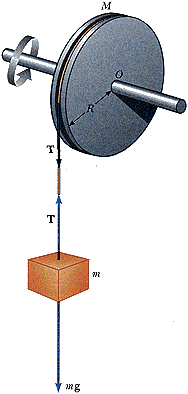
Ok... the first question is:
What is the net torque on the system about the point O?
Here's my take on the situation... the only torque being applied to the system is from the tension T of the string.
T = tension of string
m = mass of counterweight
a = acceleration of counterweight
R = radius of wheel in meters
M = mass of pulley
[tex]T - mg = -ma[/tex]
[tex]T = m(g - a)[/tex]
[tex] \begin{equation*}<br /> \begin{split}<br /> \sum\tau &= TR \\<br /> &= mR(g - a)<br /> \end{split}<br /> \end{equation*}[/tex]
Also...
[tex] \begin{equation*}<br /> \begin{split}<br /> \tau &= I\alpha\\<br /> TR &= \frac{1}{2}MR^2\alpha\\<br /> \alpha &= \frac{2T}{MR}<br /> \end{split}<br /> \end{equation*}[/tex]
Now we know that:
[tex] \begin{equation*}<br /> \begin{split}<br /> a &= R\alpha\\<br /> <br /> a &= R(\frac{2T}{MR}) \\<br /> a &= \frac{2T}{M}<br /> <br /> \end{split}<br /> \end{equation*}[/tex]
So...
[tex] \begin{equation*}<br /> \begin{split}<br /> T &= m(g - \frac{2T}{M})\\<br /> T &= mg(\frac{M}{M + 2m})<br /> \end{split}<br /> \end{equation*}[/tex]
So am I right in saying that the net torque on the system is
[tex]\tau_{net} = [mg(\frac{M}{M + 2m})]R[/tex]
A 5.40 kg counterweight is attached to a light cord, which is wound around a spool (refer to Fig. 10.20). The spool is a uniform solid cylinder of radius 7.00 cm and mass 2.00 kg.
Ok... the first question is:
What is the net torque on the system about the point O?
Here's my take on the situation... the only torque being applied to the system is from the tension T of the string.
T = tension of string
m = mass of counterweight
a = acceleration of counterweight
R = radius of wheel in meters
M = mass of pulley
[tex]T - mg = -ma[/tex]
[tex]T = m(g - a)[/tex]
[tex] \begin{equation*}<br /> \begin{split}<br /> \sum\tau &= TR \\<br /> &= mR(g - a)<br /> \end{split}<br /> \end{equation*}[/tex]
Also...
[tex] \begin{equation*}<br /> \begin{split}<br /> \tau &= I\alpha\\<br /> TR &= \frac{1}{2}MR^2\alpha\\<br /> \alpha &= \frac{2T}{MR}<br /> \end{split}<br /> \end{equation*}[/tex]
Now we know that:
[tex] \begin{equation*}<br /> \begin{split}<br /> a &= R\alpha\\<br /> <br /> a &= R(\frac{2T}{MR}) \\<br /> a &= \frac{2T}{M}<br /> <br /> \end{split}<br /> \end{equation*}[/tex]
So...
[tex] \begin{equation*}<br /> \begin{split}<br /> T &= m(g - \frac{2T}{M})\\<br /> T &= mg(\frac{M}{M + 2m})<br /> \end{split}<br /> \end{equation*}[/tex]
So am I right in saying that the net torque on the system is
[tex]\tau_{net} = [mg(\frac{M}{M + 2m})]R[/tex]
 )
)