ASidd
- 72
- 0
How does it interact with the magnetic and electric fields of the radio waves while receiving them?
The discussion revolves around the functioning of dipole antennas, particularly how they interact with the electric and magnetic fields of radio waves during reception. Participants explore various aspects of electromagnetic wave behavior, antenna orientation, and the implications of polarization on signal reception.
Participants express varying interpretations of antenna behavior and the interaction of electromagnetic fields, with no clear consensus on certain technical aspects. Some participants agree on the importance of polarization, while others challenge the clarity of terminology and conceptual understanding.
Participants note limitations in understanding due to the complexity of electromagnetic theory and the nuances of antenna design. There are unresolved questions about the precise mechanics of signal reception and the implications of different interpretations.
This discussion may be of interest to those studying antenna theory, electromagnetic wave behavior, and radio communication, particularly individuals seeking to understand the technical details of dipole antennas and their operation.
mfb said:If you put a conductor parallel to the direction of the electric field
mfb said:This thread is more than 1 month old.
I cannot see multiple ways to interpret that line, can you show me some?
webberfolds said:Well the direction of the electric field is at a right angle to the direction the light would be going. ...
davenn said:what light ??
we are talking about radio wave E-M field
Dave
mfb said:What do you mean by "over" or "under" the electric field? In planar waves (or waves similar to them), the electric field is the same everywhere in the plane perpendicular to the propagation direction of the wave.
davenn said:try the ARRL Radio Handbook
it gives a very good background to radio transmission and reception including antenna theory
cheers
Dave
mfb said:Parallel
As examples:
If the polarization of light is vertical, the electric field is vertical, and your antenna has to be vertical to pick up the signal (at least with some vertical component).
With a circular polarization, the electric field is vertical->horizontal->vertical->..., and your antenna direction does not matter unless it is orthogonal to the direction of propagation of the wave (or has some orthogonal component).
davenn said:Even with the antenna and the electric field being at 90 degrees to each other there will still be some signal induced into the antenna ... just not very efficiently
In the field, in pratical situations, we see a 25 to 30 dB difference in signal strength when the polarisation is out by 90 deg
Dave
I think you have something like that in mind. Forget it. Light does not work that way. That is not a 3-dimensional picture! Imagine those fields everywhere in the (z,y)-plane, and it gets better. While it is possible to emit directed electromagnetic waves, you cannot really "miss" an antenna in the way you imagine it.webberfolds said:So if the antenna is vertical and the electric field is vertical and the photon moves by the antenna but is a bit too far left to hit it directly, could the magnetic field induce current in the antenna?
webberfolds said:If the polarization of the signal is vertical and the photon meets the vertical antenna straight on, will that generate the most current? I hope this has to do with dipole antennas.
sophiecentaur said:Photons are not like little bullets and they don't "meet and antenna" in the conventional sense. It is really not helpful to look at it this way. How could you even start to consider how this single photon (dimensions / extent totally unspecified) will interact with a piece of metal, which consists of a distribution of charges all over it? Stick to waves if you want to understand most non-QM phenomena. There is nothing wrong with ( you are not making any compromises) using the wave approach.
webberfolds said:When a radio photon goes through an antenna it induces current.
jtbell said:When a photon gets absorbed by an atom or (presumably) an antenna, it does something. When a photon "goes through" or "past" an atom or antenna, nothing happens. Photons interact destructively, in an "all or nothing" fashion.
mfb said:I think you have something like that in mind. Forget it. Light does not work that way. That is not a 3-dimensional picture! Imagine those fields everywhere in the (z,y)-plane, and it gets better. While it is possible to emit directed electromagnetic waves, you cannot really "miss" an antenna in the way you imagine it.
This is just not an accepted model. I can't think where you would have read it. To get into this subject you really have to ditch conventional ideas. Photons can be treated as particles under some circumstances - the appear to transfer momentum to a particle with mass, for instance - but when you say "surrounding the photon" you are implying that it has a size (for it to be surrounded). You can lay that one to rest for yourself if you ask yourself just what 'size' a photon could have. Is it related to the wavelength of the particular radiation? That would make it in the order of kilometers in extent for an LF radio signal. How would something of that size be expected to interact with a tiny whip antenna (10cm) that you could find on a hand held receiver? The 'size' thing just gets you going round and round in circles and leads you nowhere. Just stick to the universally accepted idea that a photon is an amount of energy which is transferred when EM energy is emitted or absorbed by a 'system'.webberfolds said:The EM fields surrounding the photon induce the current, right? That's what I meant. Once again I'm a beginner and don't really know much about this subject. Thanks for the help!
 ) obsess about using photons to explain straightforward classical phenomena? I'll tell you why. It's because schoolteachers (those who teach at elementary levels) know so little about the real message of QM that, when required to 'teach it', at a time which is way too early for kids to grasp, they teach the 'little bullets' model. Most people never manage to leave that model behind, unfortunately.
sophiecentaur said:Photons can be treated as particles under some circumstances - the appear to transfer momentum to a particle with mass, for instance - but when you say "surrounding the photon" you are implying that it has a size (for it to be surrounded). Just stick to the universally accepted idea that a photon is an amount of energy which is transferred when EM energy is emitted or absorbed by a 'system'.
Stick to waves, fields, Volts and Current - that's a hard enough way to explain most electromagnetic phenomena.
davenn said:As far as an antenna goes here is where the Voltage and Current are peaking...
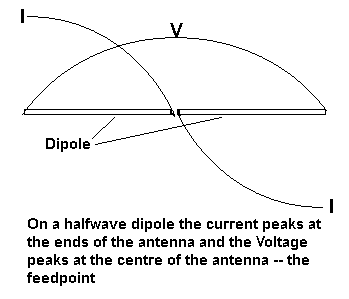
Dave
webberfolds said:What does "peaks" mean here, thanks for helping answer more about dipoles and congratulations on making it to 1000 posts! I realize now that some of my posts on this thread don't have much to do with dipoles, sorry, how do I fix that? I don't want to be rude and seem selfish.
