New Reply

batteries in series

 
Share Thread Thread Tools
Oct17-12, 03:57 PM   #1
 

batteries in series


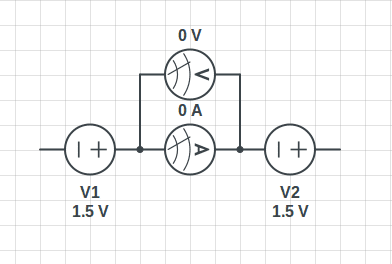
Hello, I can't image what is the exact path of electrons in two or more batteries conncted in series... if electrodes are immersed into the electrolytes and chemical reactions should continously happen why the circuit in the picture down here has no activity ?

PhysOrg.com
PhysOrg
engineering news on PhysOrg.com

>> Army ground combat systems adopts tool for choosing future warfighting vehicles
>> Company pioneering new types of material for 3-D printer 'ink'
>> Student-built innovations to help improve and save lives
Oct17-12, 04:06 PM   #2
 
Mentor
Quote by scientifico View Post
Hello, I can't image what is the exact path of electrons in two or more batteries conncted in series... if electrodes are immersed into the electrolytes and chemical reactions should continously happen why the circuit in the picture down here has no activity ?

Connect the two outside points with a resistor so current can flow. Your ammeter will then show that current, which is V/R.

The resistance of an ideal ammeter is zero, so your voltmeter will not register anything, even if a current is flowing. A real ammeter has a small resistnce, so the voltmeter will measure a small voltage across it when a current is flowing through it.
Oct17-12, 08:57 PM   #3
 
Recognitions:
Gold Membership Gold Member
Science Advisor Science Advisor
scientifico

The chemical reaction in the electrolyte doesnt start till the circuit between the positive and negative terminals of the battery are connected ( ignoring the small loss caused by the internal resistance of the battery .... which of course gives it a limited shelf life)

look again at the drawing I did for you in the other forum and I post again here
for how to connect up meters correctly to measure voltage and current


there MUST be a complete circuit path external to the battery(ies) before current will flow

Dave
Attached Thumbnails
Meter connections.GIF  
Oct18-12, 07:58 AM   #4
 

batteries in series


what prevents chemical reactions to happen since electrodes and electrolyte are in contact ?
Oct19-12, 06:56 AM   #5
 
Recognitions:
Gold Membership Gold Member
Science Advisor Science Advisor
Quote by scientifico View Post
what prevents chemical reactions to happen since electrodes and electrolyte are in contact ?
read the first sentance of my previous post :)


Dave
Oct19-12, 09:50 AM   #6
 
Actually it is an ELECTRO-Chemical reaction and it does "start" as soon as the battery is assembled, but immediately reaches equilibrium with no current (typically) 1.5v per cell, and no current.

As a circuit is completed the, outside of the battery, electrons flow out of the negative side and into the positive terminal and offset the equilibrium in the call and the electro-chemical reaction can continue.
Oct19-12, 05:02 PM   #7
 
Recognitions:
Gold Membership Gold Member
Science Advisor Science Advisor
one quote ....

When a load completes the circuit between the two terminals, the battery produces electricity through a series of electro-chemical reactions between the anode, cathode and electrolyte. The anode experiences an oxidation reaction in which two or more ions (electrically charged atoms or molecules) from the electrolyte combine with the anode, producing a compound and releasing one or more electrons. At the same time, the cathode goes through a reduction reaction in which the cathode substance, ions and free electrons also combine to form compounds. While this action may sound complicated, it's actually very simple: The reaction in the anode creates electrons, and the reaction in the cathode absorbs them. The net product is electricity. The battery will continue to produce electricity until one or both of the electrodes run out of the substance necessary for the reactions to occur.
another quote....

Here is how the lead-acid battery in a car works:

The anode of each cell is metallic lead, Pb. The cathode is solid lead oxide, PbO2. The electrolyte is sulfuric acid, H2SO4 (which is dissociated into hydrogen (H+) ions and hydrogen sulfate (HSO4-) ions in solution.)

When electrons are allowed to flow (when the battery is under load) this reaction takes place at the anode (- side):

Lead metal is oxidized to bivalent Pb(II), giving up 2 electrons, and reacts with sulfate ion (SO42-) to form lead sulfate and a hydrogen ion:

Pb + SO4²¯ → PbSO4 + 2e- + H+

The reduction potential of this reaction is +0.356 Volts.
Simultaneously at the cathode (+ side):

The lead in lead oxide is reduced from tetravalent Pb(IV) to bivalent Pb(II) when the lead oxide reacts with sulfate ions in the electrolyte and hydrogen ions, accepting electrons to form lead sulfate and water:

PbO2 + SO4²¯ + 4 H+ + 2 e- → PbSO4 + H2O

The potential of this reaction is 1.685 volts.
Combined, these two half reactions make up the redox reaction

Pb + PbO2 + 2H2SO4 → 2 PbSO4 + 2 H2O

Two electrons were liberated at the anode and flowed through the external circuit to the cathode. The total potential of the reaction is about +2 volts. A 12-volt car battery therefore has six cells in series, each contributing two volts for a total electric potential of 12 volts.
neither example ( and a couple of others I looked at) talks about any reaction initially reaching equilibrium
Do you have a www site that explains that initial equilibrium reaction you speak of ?
Am always willing to learn more

cheers
Dave
New Reply
Thread Tools


Similar Threads for: batteries in series
Thread Forum Replies
How many batteries can run in series Electrical Engineering 6
Batteries in Series Electrical Engineering 5
Batteries and Capacitors in Series Electrical Engineering 11
What are the main differences between batteries in parallel vs. batteries in series? Introductory Physics Homework 1
Batteries in parallel instead of series Electrical Engineering 11