Solving Algebra Problem on Electrodynamics of Moving Bodies

  • Context: Graduate 
  • Thread starter Thread starter Daminc
  • Start date Start date
  • Tags Tags
    Algebra
Click For Summary

Discussion Overview

The discussion revolves around solving an algebra problem related to the electrodynamics of moving bodies, specifically focusing on the manipulation of equations involving the speed of light and relative velocities. Participants are examining their calculations and attempting to identify errors in their algebraic steps.

Discussion Character

  • Technical explanation
  • Debate/contested
  • Mathematical reasoning

Main Points Raised

  • One participant expresses confusion over a sign discrepancy in their calculations, specifically between fractions in an equation.
  • Another participant provides a detailed breakdown of the algebraic steps leading to a common denominator, suggesting that the error may lie in the movement of fractions across the equation.
  • A different participant mentions a PDF that may provide an alternative approach to the problem, indicating that it might help clarify the issue.
  • One participant acknowledges a mistake in their own PDF, noting a typographical error in the equations presented, which they believe contributed to the confusion.
  • Another participant confirms they are experiencing the same issue and plans to review the material to identify the source of the problem.
  • One participant expresses relief upon discovering the error was not theirs, indicating a shared sense of confusion among participants.
  • A later reply indicates that the PDF has been corrected and now reflects the accurate equations as discussed in the thread.

Areas of Agreement / Disagreement

Participants generally agree that there was a misunderstanding or error in the equations being discussed, but the specific nature of the errors and their resolutions remain contested. Some participants have identified their own mistakes, while others continue to seek clarity on the algebra involved.

Contextual Notes

There are unresolved mathematical steps and dependencies on the accuracy of the equations presented in the PDF. The discussion highlights the challenges of tracking errors in complex algebraic manipulations.

Daminc
Messages
39
Reaction score
0
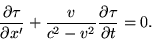
Hi following a link on another thread I began to read On The Electrodynamics Of Moving Bodies

img23.gif


should equal

img24.gif


but I end up with a minus instead of a plus between the two fractions(in the last equation).

I've gone through my calculations but I cannot see where I've gone wrong.

I could post my working out if necessary but it might be hard to read in this format
 
Mathematics news on Phys.org
I assume you got this far on the coefficient of [pard]&tau/[pard]t

(1/2) * (1/(c-v) - (1/c+v))

Collecting fractions:

(1/2) * ((c+v) - (c-v)) / ((c-v)*(c+v))
(1/2) * (2v) / (c^2 - v^2)
v / (c^2 - v^2)

Hurkyl

(edit: fixed tags)
 
Last edited:
It's almost impossible to catch your own error and the sillier the error is the harder it is to find it!

In the first formula you have 1/(c-v)+ 1/(c+v) on one side. You get common denominators, of course, and have ((c+v)+(c-v))/(c^2- v^2)= 2c/(c^2- v^2) which is then multiplied by 1/2: c/(c^2- v^2)

On the other side of the same formula you have 1/(c-v). Subtracting c/(c^2- v^2) from both sides: 1/(c-v)-c/(c^2- v^2)= c/(c^2-v^2)- (c+v)/(c^2-v^2)= v/(c^2- v^2).

Did you move the fraction to the wrong side?
 
After I got c/(c^2- v^2) on left side I moved the
1/(c-v)over to isolate [pard]T/[pard]x over on the right then
removed [pard]T/[pard]t from the brackets to get the fraction v/(c^2- v^2).

I them moved the whole lot across to put it equal to zero
 
I am not sure if http://home.attbi.com/~rossgr1/Specialrel.PDF addresses you exact problem, but you may find it smooths your way to the final DE.
 
Last edited by a moderator:
Ok that PDF works it out a different way but, even now, things don't look right

From the bottom of the second page

We have "Now recombining the RHS and LHS we have:"

1/2 ((1/c+v)+(1/c-v))[pard]T/[pard]t = [pard]T/[pard]x +(1/c+v)([pard]T/[pard]t)

Right, fine and dandy

BUT, when I collate the terms I get:

1/2((1/c-v)-(1/c-v)([pard]T/[pard]t)=[pard]T/[pard]x

NOT

1/2((1/c+v)-(1/c-v)([pard]T/[pard]t)=[pard]T/[pard]x

So when it comes to multiple both sides with -1 I still get a sign discrepancy :frown:

I'm going to start to cry real soon...
 
I am getting the same result as you, let me look at this to see if I can sort out what happened. It has been a year since I wrote that PDF up, so I need to take some time to get back into the material.
 
Well, since I could not find an obvious error in my PDF, I went back to the source. There is where I found MY error. Compare my RHS to Einstein's in my starting equaition. You will see that I have a 1/(c+v) where he has a 1/(c-v). If you replace my RHS term with the correct one it all comes out in the end. Since I worked all this out on paper then transcriped to MS Word editor and PDF, I will claim it as a typo.

My apology, and thanks all at the same time. I have posted that PDF several times, here and other places over the past year. It looks like someone finally read it!
 
Alleluia

I thought I was going mad.

It's a good paper, I bet lots of people read it but I bet they rarely actually follow the math.

Thanks again.
 
  • #10
I have posted a corrected PDF, the link above should now connect to a PDF that does not have the error discovered in this thread.
 

Similar threads

  • · Replies 35 ·
2
Replies
35
Views
6K
  • · Replies 11 ·
Replies
11
Views
3K
  • · Replies 3 ·
Replies
3
Views
2K
  • · Replies 1 ·
Replies
1
Views
2K
  • · Replies 2 ·
Replies
2
Views
3K
Replies
2
Views
2K
  • · Replies 1 ·
Replies
1
Views
3K
  • · Replies 7 ·
Replies
7
Views
2K
  • · Replies 22 ·
Replies
22
Views
2K
  • · Replies 3 ·
Replies
3
Views
2K