Electric potential in regions of concentric thin, conducing, spherical shells

Click For Summary

Homework Help Overview

The discussion revolves around calculating the electric potential in regions defined by two concentric thin conducting spherical shells, with specific charges and radii provided. The context involves applying principles from electrostatics, particularly related to spherical charge distributions.

Discussion Character

  • Conceptual clarification, Assumption checking, Mathematical reasoning

Approaches and Questions Raised

  • Participants explore the expression for electric potential due to spherical shells, with some referencing Gauss' law to argue about the potential inside and outside the shells. Questions arise regarding the validity of certain equations and assumptions about the behavior of potential within the shells.

Discussion Status

The discussion is active, with differing views on the equations for potential and the implications of Gauss' law. Some participants offer insights into the superposition principle for combining potentials from multiple shells, while others challenge the assumptions made about potential inside the shells.

Contextual Notes

There appears to be a debate over the interpretation of potential inside a conducting shell, with references to gravitational analogies and the implications of being "inside" versus "outside" the shell affecting the discussion.
yanyin
Messages
20
Reaction score
0
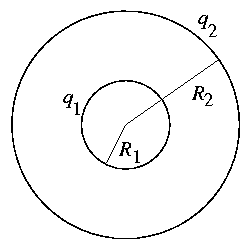
two thin conducting spherical shells as shown below. the inner shell has a radius of r1=15.0cm and a charge of 10.0nC. the outer shell has a radius r2 = 30.0cm and a charge of -15.0nC. find the electric potential V in regions R1, R2, and outside the outer shell, with V = 0 at r = infinite.
s0219.gif
 
Physics news on Phys.org
What is the expression for Potential due to a Spherical shell

In General

[tex]V=\frac{Q}{4\pi \epsilon_0 R} **&\mbox{for}** r \leq R[/tex]

AND

[tex]V=\frac{Q}{4\pi \epsilon_0 r} **&\mbox{for}** r \geq R[/tex]
 
Last edited:
I disagree with the above equations. From Gauss' law, a spherical shell does not contribute at all to the potential inside it--it's easier to think about with gravity: if the Earth were hollow, you could float around in it; you wouldn't be attracted to any point on the shell.

So if you're inside the shell, you don't see it; if you're outside the shell then (again by an application of Gauss' law) it affects you in the same way that a concentric point charge of the same total charge would, i.e., a one over R potential.

That should get you started; you treat two shells with the superposition principle (i.e., add the two potentials together.)

P
 
WHY it is not true

so if you're inside the shell, you don't see it
=> 0 which is not true.
 

Similar threads

Replies
5
Views
2K
Replies
1
Views
1K
  • · Replies 19 ·
Replies
19
Views
3K
  • · Replies 17 ·
Replies
17
Views
3K
  • · Replies 2 ·
Replies
2
Views
2K
  • · Replies 7 ·
Replies
7
Views
1K
Replies
7
Views
2K
  • · Replies 17 ·
Replies
17
Views
4K
  • · Replies 19 ·
Replies
19
Views
4K
  • · Replies 23 ·
Replies
23
Views
2K