| Thread Closed |
Finding diameter of pins from allowable shear stress |
Share Thread | Thread Tools |
| Feb2-08, 08:55 PM | #1 |
|
|
Finding diameter of pins from allowable shear stress
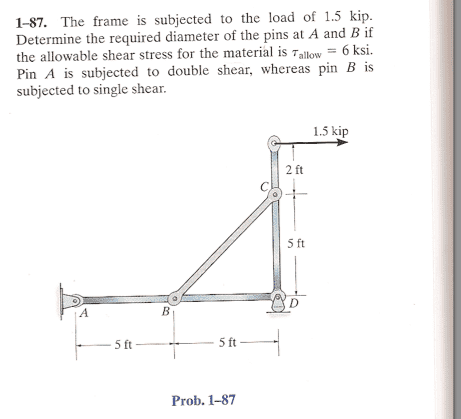
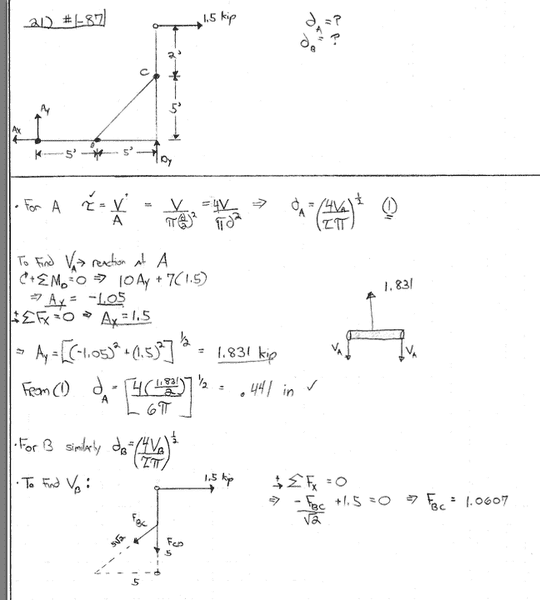
So I got the diameter of the pin at a no problem. For some reason I am screwing up the Force at B. I thought my reasoning was correct, but I am coming up short. The answer is larger then what I an getting, so my F_BC must be too small, thus I am not accounting for something.
![]() Here is my work:
|
| Feb2-08, 10:07 PM | #2 |
|
Recognitions:
|
Did you notice if you took moment at the joint where the 1.5 k force is applied in your last FBD, the force BC will have to be 0?
|
| Feb2-08, 10:35 PM | #3 |
|
|
Where did I err in my Sum of Forces rationale? But I am also confused when I now look at the original picture in the text. Is ADC all ONE piece? Or is AD a member that is pinned at D to the vertical piece? If it is all one piece, I can see how BC is zero, but if the horizontal AD and the vertical D to the end (where 1.5 is applied) are two separate pieces pinned at D, then I cannot see it. |
| Feb2-08, 10:48 PM | #4 |
|
Recognitions:
|
Finding diameter of pins from allowable shear stress
This is not a truss, this is a frame. Members in frames have 2 or more forces acting on them instead of just 2 like in trusses. To find the force along BC you could isolate member AD and take moment about D.
|
| Feb2-08, 10:57 PM | #5 |
|
Recognitions:
|
|
| Feb3-08, 08:23 AM | #6 |
|
|
BC cannot be a zero force member, else it all folds up like a card table. So, if you do sum of moments about D, what do you get for the horizontal component of BC? The horizontal and vertical pieces are single pieces, i.e., there are only 3 members in this problem.
|
| Feb3-08, 12:00 PM | #7 |
|
|
If I take the moment about D, I get that BC=2.97, which works like a charm. Thanks. Can someone tell me though, why did my sum of the forces approach, fail? It really shouldn't? If I make a horizontal cut through BC and CD like I did in the last FBD I drew and analyze the top half, I should get, [tex]\sum F_x=0\Rightarrow -\frac{5\sqrt{5}}{5}F_{BC}+1.5=0\Rightarrow F_{BC}=2.12[/tex] What happened? Casey |
| Feb3-08, 12:10 PM | #8 |
|
|
You generally should use a combination of force summations and moment summations - just do what's easy.
So, by visual eamination Ax = - 1.5kip Likewise, by visual examination, Cy = - Ay Then, summing moments about A solves for Cy You just have to work at it gently. If one joint doesn't work, move to another. And, when you're starting, standard angles help (although you really don't need them for this problem). |
| Feb3-08, 12:18 PM | #9 |
|
|
Okay, but I still do not see why sum of forces fails. And I chose to use that initially because it doesn't get much easier then that.
If either way, I have to make a cut to expose the internal force in BC, why should it matter if I take sum of forces or sum of moments? Why would one method take priority over the other? Thanks for your help by the way! I know it's annoying, but I feel like if I can figure out exactly why some methods don't work as opposed to just using the ones that do work, I will have a deeper understanding of the methods of analysis. Thanks, Casey |
| Feb3-08, 12:27 PM | #10 |
|
|
Well, you don't really have to cut BC. Just look for convenient pins that have lots of zero moment arms. The trick in analysis is to be lazy and always take the easiest path. Just remember to carefully label everything and be super neat in your calculation sheet(s). In almost every analysis, you have to use BOTH moments and forces, and there's no real understanding to be had except this: Static means not moving. Not translating. Not rotating.
Then, just work a few hundred problems and it will start to look OK to you. |
| Feb3-08, 03:43 PM | #11 |
|
Recognitions:
|
|
| Feb3-08, 05:35 PM | #12 |
|
|
Casey,
If you're teaching yourself statics, I might suggest the book Simplified Engineering for Architects and Builders, Harry Parker and James Ambrose, John Wiley & Sons. You can probably pick up a used copy off Amazon for less than $20 (US). |
| Feb3-08, 06:25 PM | #13 |
|
|
Hey, I posted another engineering thread in the physics section, since it's the physics part that's really screwing with me. I thought it might get more traffic there. If one of you guys happens to get a moment and wants to give me a nudge in the right direction, that would be rad. Here it is http://www.physicsforums.com/showthread.php?t=212920. Thanks for all of your guys! Casey |
| Feb3-08, 07:02 PM | #14 |
|
|
I think I figured it out now! You were right Cyclovenom, I have it in my head that the method of sections works on frames too. I don't use that method for frames, I am supposed to "take the frame apart" right? And analyze the the forces acting on each member right?
Casey |
| Feb3-08, 07:12 PM | #15 |
|
Recognitions:
|
|
| Feb3-08, 07:14 PM | #16 |
|
Recognitions:
|
|
| Thread Closed |
| Thread Tools | |
Similar Threads for: Finding diameter of pins from allowable shear stress
|
||||
| Thread | Forum | Replies | ||
| Allowable Stress | General Engineering | 7 | ||
| Allowable shear - indeterminate Torsion | Engineering, Comp Sci, & Technology Homework | 0 | ||
| Allowable Stress Calculation | Mechanical Engineering | 5 | ||
| shear stress eqn | Advanced Physics Homework | 0 | ||
| compressional stress & shear stress | Introductory Physics Homework | 1 | ||