| Thread Closed |
Boost Chopper or Buck converter? |
Share Thread | Thread Tools |
| May7-09, 06:34 AM | #1 |
|
|
Boost Chopper or Buck converter?
Ok, first post so be nice guys!
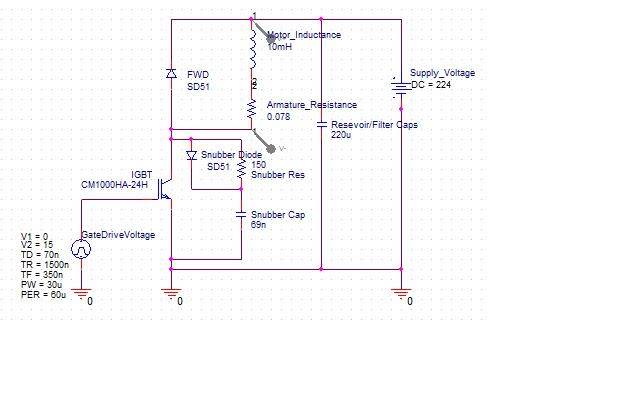
I've designed and simulated a design for controlling a brushed DC series motor in OrCAD and it does what i was aiming for it to do. Which is to step down voltage to an average of 50% with duty cycle at 50% etc. I thought I had it all figured out but recently I've got really confused about what I am doing. :P Ok so I thought I had designed a Buck converter see figure below: ![]() However from the link below it seems that i have designed a Boost Chopper, which is really confusing me. Can someone please just explain to me what the hell i have done? http://www.microsemi.com/catalog/par...GBT&P3_CONF=47 emaN resU |
| May7-09, 12:57 PM | #2 |
|
Mentor
|
Welcome to the PF. That's definitely not a Buck topology circuit. A Buck converter (to decrease voltage) uses a series switch element, not a switch to ground.
What are you trying to do? Just PWM the supply voltage for the motor winding? |
| May7-09, 01:06 PM | #3 |
|
|
Sorry for my ignorance, iv'e never done anything to do with power electronics before! Any links, data sheets that i could read through would be good guys, i obviously need to learn what's going on! Cheers emaN resU |
| May7-09, 01:11 PM | #4 |
|
Mentor
|
Boost Chopper or Buck converter?
I googled "dc-dc converter" +tutorial, and got lots of good hits. Here's one of the first ones, from Maxim:
http://www.maxim-ic.com/appnotes.cfm/an_pk/2031/ . |
| May7-09, 01:16 PM | #5 |
|
|
I thought i had designed a buck-boost circuit, but as its a 1 quadrant drive and will never go into boost (regen) mode so it's just a buck converter. I'm so confused. I'll just fiddle around with some equations, see if they match my results. Cheers for the advice. |
| May7-09, 08:32 PM | #6 |
|
Recognitions:
|
You haven't said what results you are getting. Have you built it? What do you see on a CRO?
If you are looking for a name for it, it is just an amplifier. It looks like you would just get the motor current being switched at the mark-space ratio of the input. Nothing wrong with that, though. It is a perfectly OK way to do it. The diode across the motor shorts out any inductive kickback from the motor. This is normally done with inductive loads to protect the switching transistor which would otherwise get a positive going spike when the transistor turned off. What frequency are you driving it at? |
| May8-09, 01:17 AM | #7 |
|
|
EDIT: HAHA ooooooh its just Duty Cycle, my bad. |
| May8-09, 04:21 AM | #8 |
|
Recognitions:
|
If you switch the transistor so that the motor gets power for only half the time, it will have half the average voltage it would have if it was conducting all the time.
Likewise, give it power for a quarter of the time and it will get a quarter of the average power. So, whether you call that a chopper or a buck converter doesn't really make much difference except that the motor will really have a square wave across it, not a nice smooth reduced DC voltage which you would hope for from a buck circuit. The leads to the motor will also radiate radio and TV interference at multiples of that 16.4 KHz chopping rate, so you may like to make them short or to shield them. |
| May8-09, 05:12 AM | #9 |
|
|
However, the difference between a buck and boost circuit has a difference, the formulas are different, the output graphs are different, their arrangement is different they are different. So my question at the start was, is it a chopper boost circuit or a buck converter? Is a chopper boost circuit the same as a boost converter? I'm unsure whether its the semantics I'm getting confused on. All I wanna do at the moment is to prove this works in CCM. To do that I need to know what type if converter it is, so I can use the appropriate formula. From the simulation results, current over the inductor(motor coil) ramps up as you would expect however does not reach equilibrium for the simulation time i've entered, which took my computer ages to do, so its in CCM at this point as current never falls to 0, but I just need to prove that with formulas. It's nice of you to reply by the way vk6kro and berkeman. PeaCe emaN resU |
| May8-09, 10:06 AM | #10 |
|
Recognitions:
|
OK.
I think you have about half of a buck converter. You have the chopper bit, but the full thing does some integrating of the chopped waveform to give a steady filtered output. I doubt if you can model a DC motor purely on its stationary inductance. When it starts rotating there is a pretty powerful back EMF in there as well. Interesting project though. |
| May8-09, 10:40 AM | #11 |
|
|
It'll be fiiiiiiine! Did you read my comment in post #5? The guy I asked who designs motor controllers confirmed my suspicions. http://www.ecircuitcenter.com/Circui.../smps_buck.htm Need to wait until I get a job! Cheers for the help guys emaN resU |
| Thread Closed |
| Thread Tools | |
Similar Threads for: Boost Chopper or Buck converter?
|
||||
| Thread | Forum | Replies | ||
| DC-DC Buck-Boost converter using 555 Timer? | Electrical Engineering | 4 | ||
| Control Design for a Bidirectional Buck Boost Converter | Electrical Engineering | 2 | ||
| Help! PWM DC Chopper (DC-DC Converter) | Electrical Engineering | 5 | ||
| StepDown/Buck Chopper circuit | Engineering, Comp Sci, & Technology Homework | 0 | ||
| Buck,boost and buck-boost with PID controller problem | Electrical Engineering | 8 | ||