| Thread Closed |
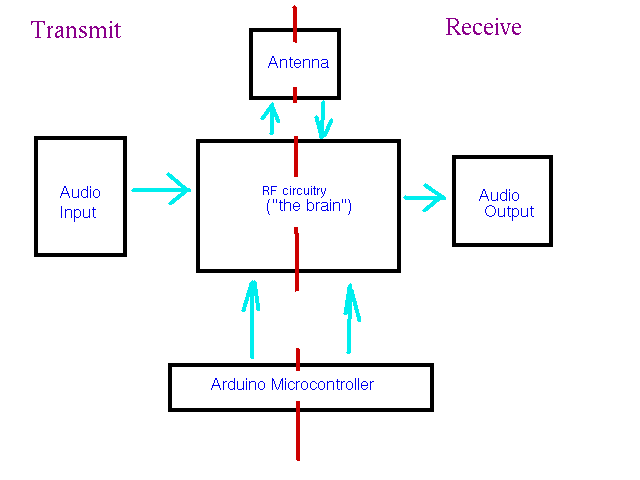
RF transmit circuit/RF receive circuit? (Hard to explain; I made a diagram.) |
Share Thread | Thread Tools |
| Sep15-09, 09:39 PM | #1 |
| Sep15-09, 09:48 PM | #2 |
|
Recognitions:
|
Not sure what you are asking.
Are you trying to send data on an FM transmitter? Apart from the legalities, why are you trying to do this? Are you trying to control something or send data for some other reason? Just switching a transmitter with a micro is quite easy, but it depends on what else you are trying to do. |
| Sep15-09, 10:04 PM | #3 |
|
|
I am aware of legalities, I'm not planning large scale - just tinkering for the sake of experience. Eventually, though, I would like to have a short-range system like this - as in, a transmitter connected to my computer, and a few receivers, located at select spots in the house, so that I could be notified (via an audio cue) of various things (such as RSS updates, new email, et cetera). When I do get that far, though, I would definitely make sure that I couldn't pick up the signal from outside the house (maybe giving a foot or two leeway near windows). Also, I know some law enforcement officials, so I'd talk to them before I put too much effort into this project. Edit: With this type of thing, is there a strict limit on the variety of frequencies that could be used with the same circuitry, or is it quite broad? (Would it be limited to +/- 50 MHz, or would +/- 2 GHz be obtainable with the same device, but different pulse rates?) |
| Sep16-09, 12:02 AM | #4 |
|
Recognitions:
|
RF transmit circuit/RF receive circuit? (Hard to explain; I made a diagram.)
An FM transmitter normally operates on just one frequency and this is pulled slightly to transmit information.
A commercial broadcast transmitter might shift in frequency by +/- 50 Khz at 95 MHz which is only 0.1 % of the carrier frequency. FM transmitters used in cars for mobile coummunications may only use +/- 5 KHz deviation, or less. Transmitters have to be designed for the frequency they are used on. So, you can't use a 90 MHz transmitter on 500 MHz. If you just wanted to signal that something had happened, you could just make a noise at the computer. There are plenty of low powered FM transmitter circuits and kits available on the Internet. These are typically used on the 90 to 108 MHz FM band where the commercial transmitters transmit. They usually have a microphone attached, but this could be modified to accept data. This band has the advantage that receivers are readily available. Such low powered transmitters would not be detectable beyond house boundaries unless you attached a larger antenna than is intended. Not sure what you mean by this: Would it be limited to +/- 50 MHz, or would +/- 2 GHz be obtainable If you mean could you use deviations like this on simple equipment, the answer is NO. |
| Sep16-09, 06:47 AM | #5 |
|
|
First, I do understand the part about the "center" frequency; I think it's sometimes called "spread spectrum"? Anyways, thanks for mentioning it; I'm definitely not sure of the proper usage of these terms in this context. Let me see if I can clarify... I appreciate your patience; Google has not been much help for this.
![]() Edit: Below, I use the term "selectable frequency" where I think it might refer to "carrier frequency", also I'm not referring to "deviation", if that is the "drift" from the carrier frequency to distinguish/encode data/audio being sent. Where you said "FM band", I mention the "frequency range"; perhaps, in my case, this should be called "frequency band for cf8's hard-to-describe circuit idea"? For example: For the +/- 50 MHz, having the circuit's selectable "center" frequency be no lower 100 MHz, and no higher than 200 MHz; in this case, the "middle" of the selectable frequencies would be 150 MHz. Putting it in context with the FM broadcasting range, no lower than 90 MHz, no higher than 110 MHz, so 100 MHz as the "middle" of the selectable frequencies, and +/- 10 MHz frequency "range". (Yes, I know these numbers are not quite accurate, but rounding like that made it easier to explain.) So, for the +/- 2 GHz, an example for the range of selectable frequencies might be 27 MHz to 4.027 GHz; therefore 2.027 GHz "middle" of the range. |
| Sep16-09, 07:43 AM | #6 |
|
Recognitions:
|
Still not getting you.
Do you mean something like a scanner where you might select one of 10000 possible frequencies, but each one only occupies 10 KHz? Spread spectrum is something else. If your computer uses a USB printer, you might have a spare parallel port available. It is very easy to send commands to a printer port and these could then either make lots of noise from near the computer (without having to turn the sound up) or feed into wires going around the house to speakers. No need to have FM receivers running all the time if you did this. The problem would be: how do you tell if you have an RSS feed or email so that you can send these signals? |
| Sep16-09, 10:11 AM | #7 |
|
|
If you need to make this wireless, then consider getting a kit, or a wireless module.
Building a wireless com link like this from scratch is a pain even for the novice and experienced. You might need access to oscilloscope, frequency counter, and ideally, a spectrum analyzer to make proper alignments. Not only that, if you don't synthesize your rx/tx frequency will drift and you could lose bandwidth. If you want to play with wireless, start with smaller projects, such as build a filter, oscillator, amplifier separately and test them, see how it goes. |
| Sep16-09, 11:48 AM | #8 |
|
Mentor
|
|
| Sep16-09, 05:48 PM | #9 |
| Thread Closed |
| Thread Tools | |
Similar Threads for: RF transmit circuit/RF receive circuit? (Hard to explain; I made a diagram.)
|
||||
| Thread | Forum | Replies | ||
| What does this circuit diagram mean? | Electrical Engineering | 4 | ||
| DC circuit diagram help | Introductory Physics Homework | 2 | ||
| EE Circuit State Diagram | Engineering, Comp Sci, & Technology Homework | 1 | ||
| MOST difficult circuit ever made | Engineering, Comp Sci, & Technology Homework | 10 | ||
| DAC Circuit diagram | Electrical Engineering | 2 | ||