Thread Closed

solve the structure in the diagram below
 
Share Thread
Feb24-10, 02:44 PM   #1
 

solve the structure in the diagram below


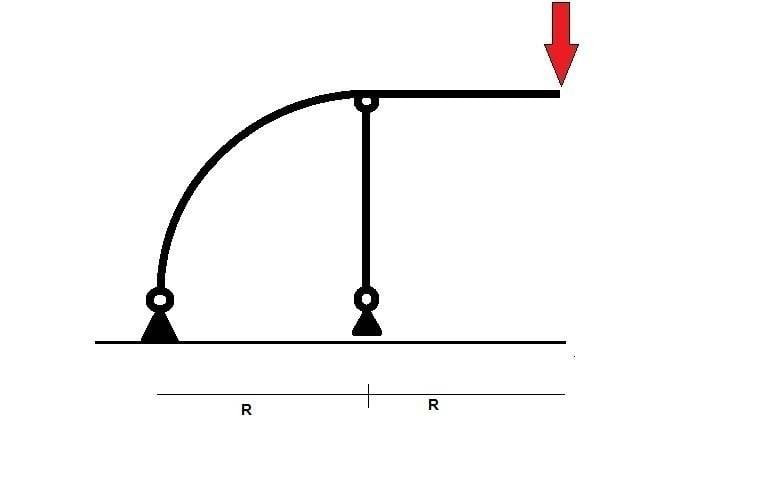
I have been asked to solve the structure in the diagram below
Click image for larger version

Name:	Untitled.jpg
Views:	15
Size:	19.8 KB
ID:	23918
where the arcs radius is R, and the force acting is P

my question is whether this structure is at all stable?? surely the middle leg cannot resist and moment about about the joint at its top end and will fall (it only has a vertical reaction)causing the arc to fall with it, ( the arc developing a moment about the permanent joint support at its base)

is there a problem in the question or am i not understanding it correctly?

i have only learned to solve stable structures
PhysOrg.com science news on PhysOrg.com

>> New language discovery reveals linguistic insights
>> US official: Solar plane to help ground energy use (Update)
>> Four microphones, computer algorithm enough to produce 3-D model of simple, convex room
Feb24-10, 03:52 PM   #2
 
Mentor
Quote by Dell View Post
I have been asked to solve the structure in the diagram below
Attachment 23918
where the arcs radius is R, and the force acting is P

my question is whether this structure is at all stable?? surely the middle leg cannot resist and moment about about the joint at its top end and will fall (it only has a vertical reaction)causing the arc to fall with it, ( the arc developing a moment about the permanent joint support at its base)

is there a problem in the question or am i not understanding it correctly?

i have only learned to solve stable structures
What are the 3 little circles meant to represent?
Feb25-10, 01:23 AM   #3
 
sorry, should have added names for the points,
the bottom left hand and bottom right hand circles are section joints- like a ball and socket joint- which do not at all resist to circular motion (no moment) the top joint is a half joint meaning - a permanent connection to the top piece and a ball and socket joint to the vertical bar.

i am not sure what the correct term is in english
hope that it is clear now
Feb25-10, 10:37 AM   #4
 

solve the structure in the diagram below


There is a triangle between the joints, two of its sides being r, and the third is [tex]\sqrt{2} r[/tex]
As [tex]\sqrt{2} < 2[/tex] The thing won't collapse to the ground.
Moreover (setting mechanics aside for a moment) as none of the sides of the triangle would change geometry, it won't even move.
Now with mechanics. As the parts stretch, contract and bend, the system will move a bit.
I am also courious how to calculate tension in non-straight beams. I feel I will learn something from this thread.
Feb25-10, 11:06 AM   #5
 
agwas
mim not 100% sure i sunderstand what you are saying but i think you misunderstood the diagram, the bottom left hand support is a fixed support, lets call it A, so i have reactions Ax and Ay
the second support -lets call it B, is not fixed and i only have reaction Bx,

i think the straight beam can fall causing the arc to fall with it.
Feb25-10, 11:23 AM   #6
 
I see.
And I suppose we suppose there is no friction between B and ground.
Feb25-10, 11:41 AM   #7
 
correct,
Feb25-10, 05:30 PM   #8
 
It may be badly drawn. It looks like A and B are both supposed to be hinged supports. But at B, there can only be a By force. I think Magwas would learn more from this thread if P was horizontal, because then, Ax would have a value. Really this is just a simply supported bent beam, isn't it?
Thread Closed

Similar discussions for: solve the structure in the diagram below
Thread Forum Replies
PNA-DNA Stability Chemistry 1
Consider the problem y' = Ay Differential Equations 0
What determines whether or not a matrix is stable? Linear & Abstract Algebra 2
Stability Introductory Physics Homework 4
Stability Calculus & Beyond Homework 4