Thread Closed

Psi/Consciousness studies alluding to downwards causality

 
Share Thread
Mar21-10, 08:55 AM   #1
 

Psi/Consciousness studies alluding to downwards causality


I've been doing a lot of reading on Psi-phenomena experiments as of late, and it appears as though an overwhelming number of experiments are producing statistically compelling positive results (although, these are small results that are produced over long period of time). I find this amazing as if proven this will be a discovery that will change almost all of science. Obviously, I can't wait to see what the next 30 years of attempted replication will bring.

Discuss:
What more is needed for conclusive proof.
If this phenomenon is conclusively proven, what are the subsequent consequences.

Some sources:
- http://dbem.ws/online_pubs.html (Scroll down to "Psi phenomena (ESP)" for his papers)
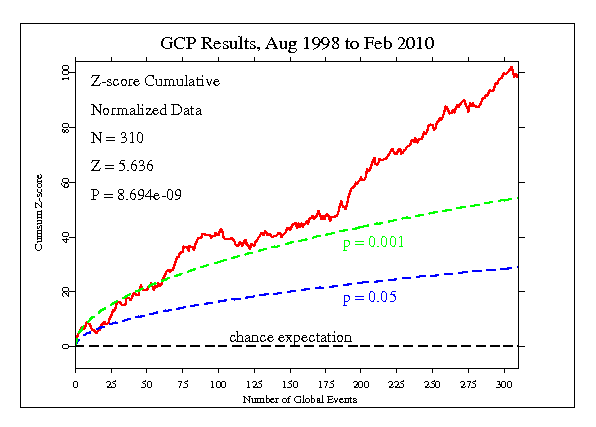
- http://noosphere.princeton.edu/ (The most compelling, the most bulletproof to skeptical criticisms, click on "main results" up the top left)
- http://www.princeton.edu/~pear/ (Go to publications and read the papers)

Criticism (actually by Apeiron, PF member):
http://dichotomistic.com/mind_readin...ear%20lab.html

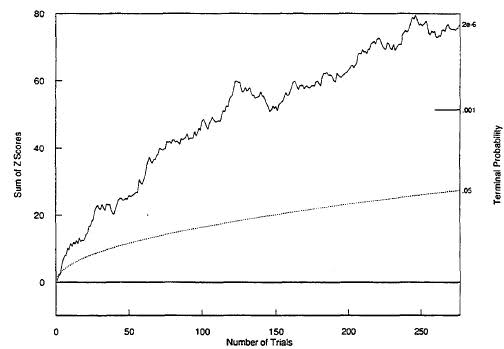
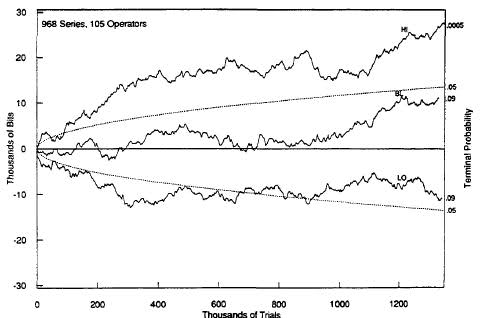
EDIT: Some graphs to get you guys reading:

(PEAR proposition 1995 paper)
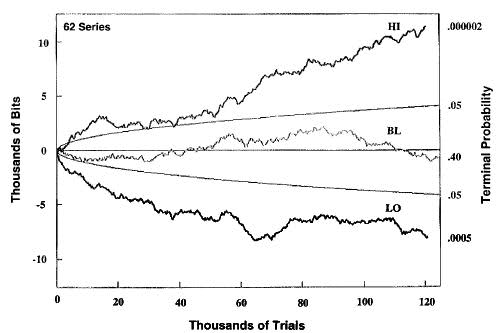


(Princeton PEAR 1992 paper on human/machine interaction)
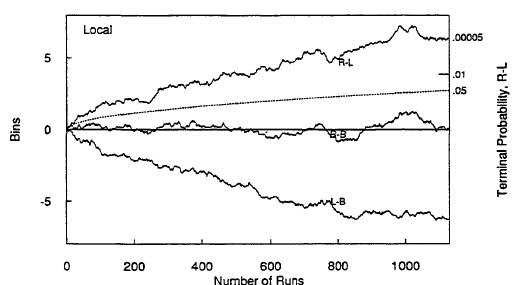


(noosphere.princeton.edu experiment)
PhysOrg.com science news on PhysOrg.com

>> City-life changes blackbird personalities, study shows
>> Origins of 'The Hoff' crab revealed (w/ Video)
>> Older males make better fathers: Mature male beetles work harder, care less about female infidelity
Mar21-10, 09:11 AM   #2
 
Mentor
I've never seen a study I considered all that compelling and I'm not going to read through the dozens you posted: could you point to one good one that had a good experimental setup and produced consistent, statistically significant positive results?
Mar21-10, 09:17 AM   #3
 
Quote by russ_watters View Post
I've never seen a study I considered all that compelling and I'm not going to read through the dozens you posted: could you point to one good one that had a good experimental setup and produced consistent, statistically significant positive results?
Okay, read the noosphere one. I like this one the best as all the data has been in the public domain for over a decade.

The PEAR papers are also really good..
Mar21-10, 10:21 AM   #4
 

Psi/Consciousness studies alluding to downwards causality


Double post, sorry.
Mar22-10, 03:13 AM   #5
 
This is really weird, especially theory and speculations part in the princeton link.
Mar22-10, 03:28 AM   #6
 
This is either one of the most groundbreaking discoveries of our lifetime, or a spectacular failure of experimental design, or a spectacular misuse of statistics. Truly exciting.
Mar22-10, 01:35 PM   #7
 
Recognitions:
Gold Membership Gold Member
Science Advisor Science Advisor
Retired Staff Staff Emeritus
Quote by imiyakawa View Post
The PEAR papers are also really good..
Only papers that were published in mainstream journals are considered to be scientific information. At best. all others count only as anecdotal evidence. At worst, any paper may be blatent crackpottery.

If an author can't get a paper published in the mainstream, why should we give it any weight at all?
Mar22-10, 03:20 PM   #8
 
Recognitions:
Gold Membership Gold Member
The mainstream isn't the holy Grail. I'm kind of curious what the problem with downward causation is.

I'm uncomfortable with it too, but the general tenant is that the system affects the components. Would it really be surprising that global constraints in a system effect the outcome of the individual elements of the system?

Also, we've never seemed to have mentioned upward causation before downward causation was mentioned. Why do we suddenly assume upward causation is the only type of causation once somebody mentions downward causation? We never cared before.

I'm also confused about the significance of the heirarchy. If the heirarchy can be described subjectively, then we could construct models in either direction depending on our interest.
Mar22-10, 03:53 PM   #9
 
Recognitions:
Gold Membership Gold Member
Quote by Pythagorean View Post
Also, we've never seemed to have mentioned upward causation before downward causation was mentioned. Why do we suddenly assume upward causation is the only type of causation once somebody mentions downward causation? We never cared before.

I'm also confused about the significance of the heirarchy. If the heirarchy can be described subjectively, then we could construct models in either direction depending on our interest.
Hierarchy theory describes complementary causality - were upward and downward actions (construction and constraint) are in interaction, and furthermore will find their equilbrium.

Even Newton's third law recognised downward causality - for every (ie: locally constructive) action, there is an equal and opposite (ie: equilbrium) reaction (ie: global constraint). Though Newton's simplification of course was to reduce the global scale constraint to a locally opposed force vector. But that is just a modelling convenience, not an ontic truth.

Had to mention that again Pythagorean as there is a sequence of ideas here. Complementary or synergistic causality is where it all starts to come into focus in the systems perspective.
Mar22-10, 04:01 PM   #10
 
Recognitions:
Gold Membership Gold Member
Science Advisor Science Advisor
Retired Staff Staff Emeritus
Quote by Pythagorean View Post
The mainstream isn't the holy Grail. I'm kind of curious what the problem with downward causation is.
For our purposes, it is a minimum requirement. Discussion that assumes the validity of an unpublished paper is not allowed. General discussion is fine. Specific references may be a problem depending on how the information is presented.
Mar22-10, 04:02 PM   #11
 
Recognitions:
Gold Membership Gold Member
Quote by imiyakawa View Post
This is either one of the most groundbreaking discoveries of our lifetime, or a spectacular failure of experimental design, or a spectacular misuse of statistics. Truly exciting.
Spectacular abuse of statistics was what sceptics would presume. The criticism was that Radin and Nelson were data mining. Collect enough data, then throw the right data binning at it, and you can always find apparent significance in noise.

If you don't find the signal you want averaging over say five minute intervals, then something may pop out over 3 or 15.

But its been a few years since I read the literature or talked with those involved. So the REG analysis may have been standardised to fix this criticism.
Mar22-10, 04:04 PM   #12
 
Recognitions:
Gold Membership Gold Member
Science Advisor Science Advisor
Retired Staff Staff Emeritus
Quote by apeiron View Post
Spectacular abuse of statistics was what sceptics would presume. The criticism was that Radin and Nelson were data mining. Collect enough data, then throw the right data binning at it, and you can always find apparent significance in noise.
You need to present evidence supporting your claims about Radin and Nelson.
Mar22-10, 05:02 PM   #13
 
Recognitions:
Gold Membership Gold Member
Quote by Ivan Seeking View Post
You need to present evidence supporting your claims about Radin and Nelson.
What kind of evidence do you require of conversations that I had with Radin, Nelson, Jahn, Broughton and others some 17 years ago?

I can tell you Radin did agree that data-mining was a valid possible criticism. He also defended himself against it, but I wasn't too convinced.

But for those who find googling a chore, here are a few links it took seconds to find.

http://www.lfr.org/LFR/csl/library/Sep1101.pdf

http://noosphere.princeton.edu/papers/jseScargle.pdf

http://www.thenational.ae/article/20...1/1036/OPINION

http://www.skepticnews.com/2005/04/terry_schiavo_a.html

http://skepticreport.com/sr/?p=560

http://www.skeptiko.com/74-radin-nel...consciousness/

http://www.theage.com.au/news/in-dep...459869857.html

http://www.manticeye.com/article.php?id=1061_0_3_0_C
Mar22-10, 05:23 PM   #14
 
Recognitions:
Gold Membership Gold Member
Quote by Ivan Seeking View Post
For our purposes, it is a minimum requirement. Discussion that assumes the validity of an unpublished paper is not allowed. General discussion is fine. Specific references may be a problem depending on how the information is presented.
I guess my issue is that it's a more philosophical and methodological issue. We can interpret direction of causation in many ways without changing the technical aspects of the causal relationship, as apeiron showed with Newton.

There's also the more obvious example of air molecules confined in a balloon. If we take the volume of the system (the balloons boundares) to be at the top, it is causally affecting the air molecules.

But we can also look at the molecules of the balloon membraine to avoid mentionig downward causation. However, wouldn't occams razor cut the latter out as the more complicated explaination, leaving us with downward causation?
Mar22-10, 05:46 PM   #15
 
Recognitions:
Gold Membership Gold Member
Quote by Pythagorean View Post
But we can also look at the molecules of the balloon membraine to avoid mentionig downward causation. However, wouldn't occams razor cut the latter out as the more complicated explaination, leaving us with downward causation?
This is philosophy (yah!) rather than psi (dulls-ville) so should really be pursued elsewhere.

But downward causation is really to do with Aristotle's four causes analysis of causation. So that would be the reason why returning to material cause (talking about the rubber) would be missing the point.

At the global scale, we would be seeking the formal causes (the formal and the teleological in Aristotle's scheme). So the questions become who constructed the balloon, for what purpose, and what is the general form by which that construction exerts its downward constraint?
Mar23-10, 03:08 PM   #16
 
Recognitions:
Gold Membership Gold Member
Science Advisor Science Advisor
Retired Staff Staff Emeritus
Quote by apeiron View Post
What kind of evidence do you require of conversations that I had with Radin, Nelson, Jahn, Broughton and others some 17 years ago?
In order to dispute the claims formerly, we need published papers. All else only counts anecdotally at best. The danger here is that the skeptics wade into the waters of pseudoscience.
Mar23-10, 03:12 PM   #17
 
Recognitions:
Gold Membership Gold Member
Science Advisor Science Advisor
Retired Staff Staff Emeritus
It sounds like you two may want to start another thread in philosophy.

This is the question that must be addressed: Were any of the PEAR papers published in mainstream journals - not to include the journal of the National Institute for Discovery Science, which is not a proper source?

The journal must be subject-appropriate, and listed here
http://scientific.thomson.com/index.html
Thread Closed

Similar discussions for: Psi/Consciousness studies alluding to downwards causality
Thread Forum Replies
Near Death Studies - Consciousness After Death General Discussion 87
graduate studies and postgraduates studies Academic Guidance 2
Causality in QM General Discussion 11
p-consciousness, a-consciousness, and reflexes General Discussion 2
Consciousness Studies: Misdirected and Conclusions Fated? General Discussion 19