| New Reply |
Shot(s) of the lunar eclipse |
Share Thread | Thread Tools |
| Dec21-10, 01:56 AM | #1 |
|
|
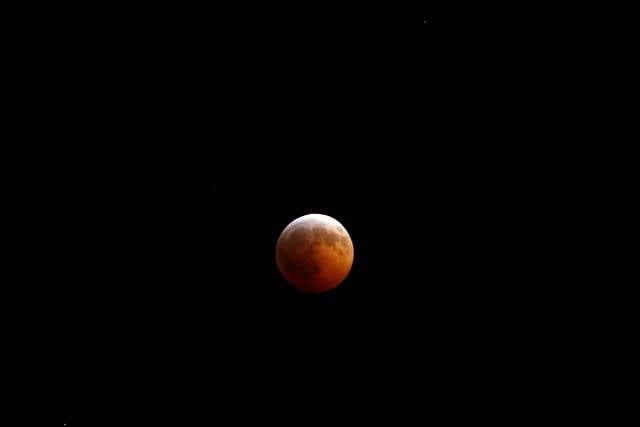
Shot(s) of the lunar eclipse
Here's a shot I took at about 11:40PM Pacific Time
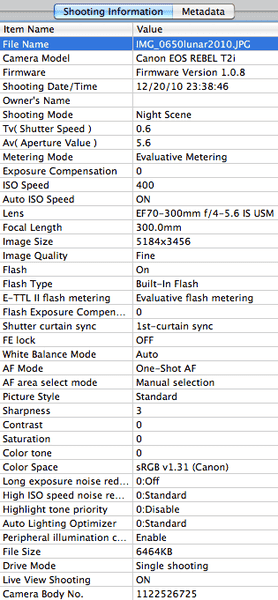
![]() I used my new lens! ![]() Shot info:
|
| Dec21-10, 06:10 AM | #2 |
|
|
Great one Dembadon, would you care to post also a live size crop of the moon?
|
| Dec21-10, 07:14 AM | #3 |
|
Mentor
|
Wow, that's an awesome shot
!
|
| Dec21-10, 08:34 AM | #4 |
|
|
Shot(s) of the lunar eclipse
One more thing, Dembadon,
A hint for the exposure, Dembadon. You have been using the extremes of the lens: f 300mm and Aperture 5.6. Now you can see here that lens performance degrades slightly at the extremes, (play with the slides). From 200mm to 300mm you see the blur increase sharply from ~1.5 to ~2.5 units, meaning that you get actually more resolution at 200mm than at 300mm, assuming that you have ample pixels like the EOS 550D. Also stopping down slightly (f8) increases the resolution again. So what I would have done for the sharpest result is using maybe 250-280mm, just slightly before the zoom hits the stop, because that stop could also decentre the lenses ever so slightly. And I would stop down a bit, like f7 or f8. I'd also would have select manually ISO 100, for minimizing the noise, and then put the combination on the tripod, and because this all would increase the shutter open time to some 5 seconds. |
| Dec21-10, 09:21 AM | #5 |
|
Recognitions:
|
|
| Dec21-10, 09:24 AM | #6 |
|
Admin
|
First of all - 5 sec is long enough for the Moon to move. Second, there is atmosphere between you and the Moon. Both pictures below were taken using my body attached to the telescope. Honestly I don't remember what make/model it was. What I do remember is a discussion and tests we did at the time with my old friend. ![]() ![]() First picture - 1/100 sec. Second picture - 1/1000 sec. Both 1:1 crops, the only thing changed was ISO speed (100 vs 800). First is visibly sharper. When taking pictures of Moon we are limited both by the lens quality and by the atmosphere motion/refraction/dispersion - and as you can see 1/100 sec is already long enough to add noise. Pictures were taken in a relatively good place - far from cities, in a southern Poland, at about 350 meters above sea level. You may need to do some testing, but I would check what gives better results - long time and high aperture number, or quite the opposite - short time and widely open lens. |
| Dec21-10, 09:30 AM | #7 |
|
|
I agree and I realize that the moon moves and I'm sure, you can calculate the arc radians over which it moves per second to some x digits, but I assumed that it would be negliglible. But I may be wrong. From those two pics I cannot discern any direction in which it would have moved. But I have the identical equipment as Dembadon has and as soon as I see the moon again, I'll try all the options.
|
| Dec21-10, 09:44 AM | #8 |
|
Admin
|
In this case it is not the motion - both pictures were taken for times short enough so that the motion can be neglected. It is more about atmospheric effect.
Could be that the resolution of the lens is too low for the effect to be seen - we are talking about 300 mm vs 1000 mm or even 1500 mm if memory serves me well. |
| Dec21-10, 09:47 AM | #9 |
|
|
interesting indeed. I'll try it at the first occasion. Thanks.
|
| Dec21-10, 10:03 AM | #10 |
|
|
Very nice shot Dembadon! Clouded in here with snow falling.
Congrats on the new lens - it covers some very handy focal range(s). |
| Dec21-10, 12:18 PM | #11 |
|
|
I'll try to keep the focal range around 250-280mm, as you suggest, from now on. |
| Dec21-10, 12:34 PM | #12 |
|
|
Good improvisation, but indeed a tripod is helpfull, especially when you can't resist no longer buying the macro lens
![]() And obviously the ultimate best result also requires the use of RAW. |
| Dec21-10, 03:36 PM | #13 |
|
|
Nice shot Dembadon. Maybe we should have a Photo Contest; moon-shot.
|
| Dec21-10, 05:42 PM | #14 |
|
Recognitions:
|
A very readable book is here: http://books.google.com/books?id=nuI...20book&f=false |
| Dec21-10, 07:42 PM | #15 |
|
|
![]() Apparently the camera wasn't as stable as I thought. It's quite blurry at this resolution.
|
| Dec22-10, 02:21 AM | #16 |
|
Admin
|
As explained earlier - it doesn't have to be camera motion.
It won't hurt to check how the lens performs in good light and with short times - at 300 mm rule of thumb says to use time 1/300 sec. Make it 1/500 (300 mm * 1.6 = 480 mm) and try to shot some distant object. Take a look at 1:1 crop then. |
| Dec22-10, 09:49 AM | #17 |
|
Recognitions:
|
First, using focal lengths of 300mm, 1000mm, and 1500mm on an APS-C sensor gives equivalent focal lengths of 480 mm, 1600mm, and 2400 mm, corresponding to magnifications of 9.6, 32, and 48 (assuming the back focal length of a Rebel T2i is the 35mm film standard). I chose an f/# of 8, corresponding to an aperture diameter D of 0.125*(focal length). The angular resolution is given as sin(theta) = 1.22 l/D, where l is the wavelength. Choosing green light (0.5 micron), the angular resolution of the lenses is: 480mm -> 0.34 arcmin 1600 mm -> 0.1 arcmin 2400 mm -> 0.07 arcmin (the human eye can distinguish about 1 arcmin at best). Ok- now the effect of turbulence. Using a model for 'Good seeing conditions' gives a spatial correlation time of 10 ms and a correlation length of 7.7 cm. That is, exposures longer than the correlation time give time-averaged effects, while short exposures do not. The long-time effect is fairly straightforward to calculate- the effect is to blur the image. Given the correlation length of 7.7 cm as compared to aperture diameters of 0.125*F decreases the cutoff frequency f as: 480 mm -> f' = 0.8 f 1600mm -> f' = 0.5 f 2400mm -> f' = 0.3 f This means that taking into account the atmospheric effects, the angular resolution has been decreased to 0.43 arcmin, 0.2 arcmin, and 0.2 arcmin: going from a 1000mm to a 1500mm lens will not increase the resolvable information. This is for 'good seeing'- calm weather. The HV-54 model (Hufnagel-Valley model with a 54 mph upper atmospheric wind) gives a correlation length of 4.2 cm, which will degrade the image a lot more than you expect: the resolution limits are now 0.5 arcmin, 0.4 arcmin, and 0.5 arcmin- empty magnification kicks in at the 300mm lens (and possibly at shorter lenses). Short time effects are considerably more complicated, but involve 'speckle imaging'. Exposures must be very short- 1 ms or less- for this to be seen. |
| New Reply |
| Thread Tools | |
Similar Threads for: Shot(s) of the lunar eclipse
|
||||
| Thread | Forum | Replies | ||
| Lunar eclipse | General Discussion | 25 | ||
| Lunar Eclipse | General Astronomy | 11 | ||
| Lunar Eclipse | General Discussion | 17 | ||
| Lunar Eclipse | Astrophysics | 5 | ||
| Lunar Eclipse | General Astronomy | 5 | ||