| New Reply |
Can someone explain why book use a vector to explain angular frequency of rotation? |
Share Thread |
| Mar12-11, 06:55 PM | #1 |
|
|
Can someone explain why book use a vector to explain angular frequency of rotation?
This is an example from the book and it is not a homework. There is one part of the step I just don't get. This is the question on page 236 of Griffiths "Introduction to Electrodynamics":
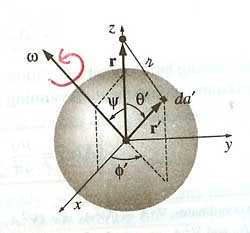
Example 5.11 A spherical shell, of radius R, carrying a uniform surface charge [itex] \rho [/itex], is set spinning at angular velocity [itex]\omega[/itex]. Find vector magnetic potential it produces at a point r. ![]() The book setup so the point is on the z axis and let the sphere spin on axis in the xz plane where the axis of spin make an angle [itex]\psi[/itex] with the +ve z axis. The equation used is: [tex]\vec A \;=\; \frac {\mu_0}{4\pi} \int_{s'} \frac {\rho \vec v }{\sqrt { R^2 +r^2 -2Rrcos \theta'}} dv' [/tex] [tex] \vec v \;=\; \vec {\omega} \;X\; \vec r \;' \;\hbox { where }\; \vec {\omega} =\hat x [\omega \;sin (\psi)] + \hat z [\omega \;cos (\psi)] [/tex] (1) I don't understand how the book arrive to (1) My question is how do you go from a sphere spinning on the axis at direction of [itex]( \omega sin \psi, 0, \omega cos \psi )[/itex] to just a vector of [itex] \omega[/itex]? Can anyone explain to me how they arrive the velocity vector [itex]\vec v[/itex]? Thanks |
| Mar13-11, 06:47 AM | #2 |
|
|
hi yungman!
![]() (have an omega: ω )if the angular velocity of a body is the vector ω, then the velocity of a point at position vector r is ω x r
|
| Mar13-11, 04:33 PM | #3 |
|
|
I got the info on Wikipedia. What class is the angular velocity taught? I thought I have enough math background for the Griffiths' book after I study PDE!!! Thanks for your time. Alan |
| Mar13-11, 04:40 PM | #4 |
|
|
Can someone explain why book use a vector to explain angular frequency of rotation?
|
| Mar13-11, 05:55 PM | #5 |
|
|
For instantaneous rotation about a fixed axis, a (skew-symmetric) operator takes a point in the fixed frame and maps it to the velocity in the fixed frame: [tex]\left(\begin{array}{c} \dot{q_1}\\ \dot{q_2}\\ \dot{q_3} \end{array} \right) = \left( \begin{array}{ccc} 0 & -\omega_3 & \omega_2\\ \omega_3 & 0 & -\omega_1 \\ -\omega_2 & \omega_1 & 0 \end{array} \right) \left(\begin{array}{c} q_1\\ q_2 \\ q_3 \end{array} \right) [/tex] Or as noted: [tex]\dot{\vec{q}}=\vec{\omega} \mbox{x} \vec{q} [/tex] |
| Mar15-11, 11:43 PM | #6 |
|
|
Thanks |
| Mar16-11, 01:16 AM | #7 |
|
|
I have a second question from this same problem. I followed and worked out all the way to get A at the point both inside and outside of the rotating charged sphere |R>r| and |r>R| resp.
The book than want to get the more general solution where they let [itex]\vec {\omega} [/itex] be on the z-axis and the point be any random point (x,y,z). I cannot verify what the book's answer. Please help. From calculation as in my original post where the point [itex]P_{\vec r} [/itex] is on the z-axis and the [itex]\vec {\omega} [/itex] is in the xz plane making angle [itex] \psi [/itex] with the z-axis as shown in post #1: [tex]\vec A_{(\vec r)} = -\hat y \frac {R^4 \omega \rho_s \mu_0 sin \psi }{3r^2} \;\hbox { for r bigger than R.} [/tex] (3) [tex]\vec A_{(\vec r)} = -\hat y \frac {R r \omega \rho_s \mu_0 sin \psi }{3} \;\hbox { for R bigger than r.} [/tex] (4) [tex]\vec{\omega} \;X\; \vec r \;=\; -\hat y r \omega sin \psi [/tex] Substitude into (3) & (4) [tex]\vec A_{(\vec r)} = \frac {R^4 \rho_s \mu_0 }{3r^2} (\vec{\omega} \;X\; \vec r) \;\hbox { for r bigger than R.} [/tex] (5) [tex]\vec A_{(\vec r)} = \frac {R \rho_s \mu_0 }{3} (\vec{\omega} \;X\; \vec r) \;\hbox { for R bigger than r.} [/tex] (6) The above is in rectangular coordinates, the answer is consistance with the book so it is correct. The next step is where I get lost. The book want to derive the formulas for the point P in any position with [itex]\vec \omega [/itex] on z-axis. The book gave this as answer: [tex]\vec A_{(r,\theta, \phi)} \;=\; \hat {\phi}\; \frac {R^4 \rho_s \mu_0 \omega sin \theta}{3r^2} \;\hbox { for r bigger than R.} [/tex] (7) [tex]\vec A_{(r,\theta, \phi)} \;=\; \hat {\phi}\; \frac {R \rho_s \mu_0 \omega r sin \theta}{3} \;\hbox { for R bigger than r.} [/tex] (8) Below is what I tried to do and I just cannot get the answer of the book's example: From (5) & (6), the vector position is only contained in [itex] (\vec {\omega} \;X\; \vec r) [/itex]. So I just have to calculate this cross product in spherical coordinates with [itex]\vec {\omega}[/itex] on z-axis and [itex] \vec r_{(R,\theta,\phi)} = (r_R, r_{\theta}, r_{\phi})[/itex]. To convert [itex] \vec{\omega} = \hat z \omega [/itex] in rectangular coordinates to spherical coordinates, I use: [tex]\hat R =\hat x sin \theta cos \phi \;+\; \hat y sin \theta sin \phi \;+\; \hat z cos \theta, \;\;\;\hat {\theta} =\hat x cos \theta cos \phi \;+\; \hat y cos \theta sin \phi \;-\; \hat z sin \theta, \;\;\;\hat {\phi} =-\hat x sin \phi \;+\; \hat y cos \phi [/tex] To find each of the magnitude of each components of [itex]\vec{\omega}[/itex] in spherical coordiantes: [tex]\omega_R \;=\; \vec {\omega} \cdot \hat R = \omega cos \theta, \;\;\;\omega_{\theta} \;=\; \vec {\omega} \cdot \hat {\theta} = -\omega sin \theta, \;\;\;\omega_{\phi} \;=\; \vec {\omega} \cdot \hat {\phi} = 0 [/tex] [tex]\vec {\omega}_{(x,y,z)}= \hat z {\omega} \;\Rightarrow\; \theta =0 \;\Rightarrow\; sin \theta =0,\;\; cos \theta =1[/tex] [tex]\Rightarrow \; \vec {\omega} _{(R,\theta,\phi)} \;=\; \hat R \omega, \;\;\hbox { and from above }\; \vec r_{(R,\theta,\phi)} = (r_R, r_{\theta}, r_{\phi})[/tex] [tex] \vec {\omega}_{(R,\theta,\phi)} \;X\; \vec r_{(R,\theta,\phi)} \;= -\;\hat {\theta} \omega r_{\phi} \;+\;\hat {\phi} \omega r_{\theta}[/tex] As you can see, I have all three components instead of what the book's answer that only contain the [itex]\hat {\phi}[/itex] component in (7) & (8). What did I do wrong? I double check my work on the conversion already. Please help. Thanks Alan |
| New Reply |
Similar discussions for: Can someone explain why book use a vector to explain angular frequency of rotation?
|
||||
| Thread | Forum | Replies | ||
| Could somebody please explain this problem to me?(torque/angular momentum) | Introductory Physics Homework | 8 | ||
| Where can I find a book to explain the maths behind physics? | Science Textbook Discussion | 8 | ||
| Can someone explain angular power spectrum | Cosmology | 2 | ||
| Can anyone PLEASE explain axis rotation? | Classical Physics | 2 | ||
| How would you explain conservation of angular momentum to a six year old? | General Physics | 9 | ||