| Thread Closed |
Is there a simpler design? |
Share Thread | Thread Tools |
| Aug18-11, 07:37 PM | #1 |
|
|
Is there a simpler design?
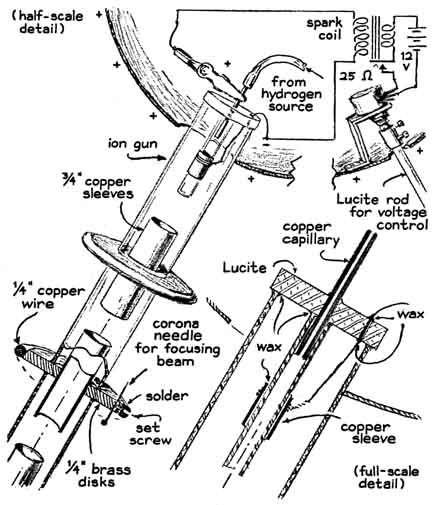
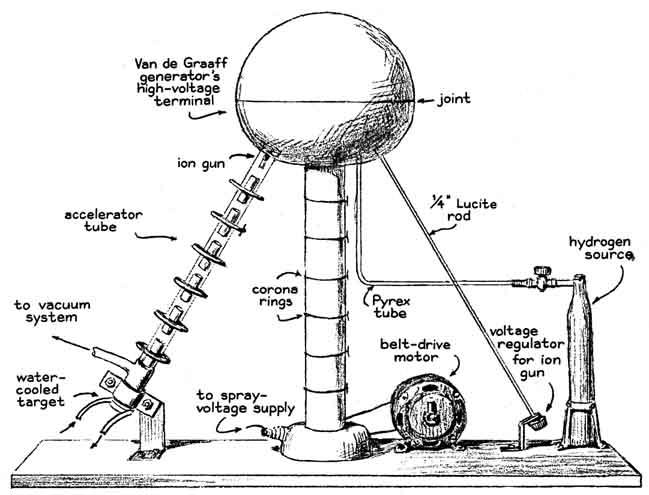
I'm a high school student and i have a great interest in particle physics. I'm looking to build a small linear particle accelerator. I have come across the designs attached
Thanks |
| Aug20-11, 06:07 PM | #2 |
|
|
First, do you have any knowledge of how to safely use high voltage and how to deal with radiation? Those are REQUIRED if you are going to build anything like this.
|
| Aug20-11, 10:32 PM | #3 |
|
|
Yes i have prior experience with high voltage applications (examples, 900,000 Volt Tesla Coil-500,000 volt Van De Graaff generator. all of which i have built.) I am familiar with the fact that particle accelerators emit radiation. I would like some help and information about controlling the radiation and protecting my self from it, there was some suggestions in the attached link to a pdf file on the last page on protection from the radiation. I understand this is a very complicated project. I'm just trying to accelerate particles at a slower rate than what this particular design runs at. I'm not trying to create antimatter or anything of that nature, I'm just trying to run my own experiments in which i can study the collisions of atoms.
http://www.sciencemadness.org/talk/f...91439&aid=2765 |
| Aug20-11, 11:00 PM | #4 |
|
|
Is there a simpler design?
i was also planning on running this in my backyard as it is about 1/4 of an acre. By controlling it remotely, about 25 to 30 feet away using a switch board and a wireless camera. I would suppose this would eliminate the possibility of becoming in contact of any radiation, gamma rays and x-rays. The link to the pdf recommended using 18 inches of concrete to shield yourself, which i would have no problem setting up, in which case it will probably be more like 25 inches just to be safe.
|
| Aug21-11, 02:04 AM | #5 |
|
|
I don't have any experience with accelerators, so I can't really say whether or not there are simpler ones available.
|
| Aug21-11, 04:43 PM | #6 |
|
|
you are seems to be too much curious and brave. I think we should think about what we are trying to achieve by all this, definitely you would have some purpose and aim. We should work together in groups for achieving something great.
|
| Aug21-11, 05:14 PM | #7 |
|
Mentor
|
You should stop now. The most likely outcome from this project is your injury or death, or perhaps someone else's injury or death. There are many dangerous aspects to this, and it's evident that your experience is nowhere near where it needs to be to do this safely.
It would be like someone saying "I want to go skydiving, and I'll just hold on to a bedsheet to be my parachute. What color should I use?" |
| Aug23-11, 06:11 PM | #8 |
|
|
|
| Aug23-11, 06:28 PM | #9 |
|
|
I appreciate your input as this is a very serious project. I understand that this is a very complex and dangerous undertaking. I noticed that you have a PhD and i was wondering where you work ex. Fermilab, Stanford's LINAC. I was also wondering if you have an idea of a better project that would perhaps be safer that would still be related to the field of particle physics. I'm somewhat confused on what your finding is the dangerous part. I have no problem with dealing with the high voltages in evolved as i have built a series of high voltage apparatuses, so i'm thinking you are thinking of the radiation, the gamma rays and x-rays, which do present a dangerous problem. Also I'm the kind of person who does like constructive criticism and or ideas and opinions. So please give any input you may have. Thanks |
| Aug23-11, 06:32 PM | #10 |
|
Mentor
|
|
| Aug23-11, 06:55 PM | #11 |
|
|
I looked this up once out of curiosity. There is this PDF http://www.ifpan.edu.pl/firststep/aw...altineller.pdf
Also: Any CRT will work as a particle accelerator accelerating electrons from the back of the tube to the front. |
| Aug23-11, 08:06 PM | #12 |
|
|
As long as you follow appropriate safety measures you should be fine. It looks like you already work with high voltage, so as long as you learn how to deal with radiation you should be ok. It really doesn't seem that much more dangerous than building a homemade Fusor. (Tabletop fusion reactor)
Hit up the forums at fusor.net and you can find a lot of info buried around in there about appropriate ways to deal with the hazards related to what you are wanting to do. Just realize that you CANNOT cut corners with safety. And especially if you do this in your backyard or somewhere with nearby neighbors. Also, it is very unlikely that you will really be able to learn much from a homemade accelerator in my opinion. We've had accelerators for over 50 years, ranging from small ones the size of something you are thinking of making, up to the Large Hadron Collider. I'm not sure what you would really gain from making one of these. |
| Aug23-11, 08:45 PM | #13 |
|
|
If I was you I'd study classical mechanics first, then classical E&M, then quantum mechanics, then find a graduate school who is doing research on particle physics and join them.
That's my idea for you... |
| Aug24-11, 12:01 AM | #14 |
|
Mentor
|
Thread locked. |
| Thread Closed |
| Thread Tools | |
Similar Threads for: Is there a simpler design?
|
||||
| Thread | Forum | Replies | ||
| How Can I Make This Simpler? | Calculus | 4 | ||
| simpler proof that sequence x_n = n does not converge? | Calculus | 3 | ||
| Which is simpler and easier to imagine? | Cosmology | 23 | ||
| can y(x)=a*sin(kx)+b*cos(kx) presented simpler? | General Math | 2 | ||
| What simpler indentity is equal to sin(x) - cos(x) | General Math | 10 | ||