Discussion Overview
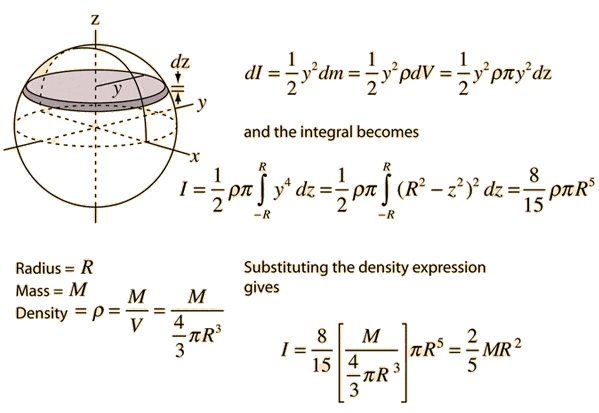
The discussion revolves around the derivation of the moment of inertia (MoI) of a solid sphere, specifically examining the volume and surface area calculations involved. Participants explore the relationships between differential volume elements and surface area, questioning the applicability of certain formulas in the context of solid and hollow spheres.
Discussion Character
- Technical explanation
- Conceptual clarification
- Debate/contested
- Mathematical reasoning
Main Points Raised
- Some participants question the validity of using the formula dA=2πydz for surface area calculations, arguing that it does not align with the volume element dV=πy²dz.
- Others assert that the volume of circular disks is correctly represented by dV=πy²dz, suggesting that surface area considerations are separate from volume calculations.
- A participant expresses confusion regarding the assumptions made when calculating the MoI of hollow spheres, indicating a need for clarity on the area formulas used.
- There is a discussion about the geometric implications of using dz versus slant lengths in surface area calculations, with some arguing that slant lengths must be accounted for while others maintain that higher order differentials can be ignored in volume integrals.
- One participant proposes a geometric analogy involving rectangles to explain why dz works for volume integrals but not for area integrals, seeking a mathematical proof for this distinction.
- Another participant mentions deriving the MoI of a solid sphere using the MoI of a hollow sphere, suggesting alternative methods for calculation.
Areas of Agreement / Disagreement
Participants express differing views on the applicability of certain formulas for surface area and volume calculations, indicating that multiple competing perspectives remain unresolved. There is no consensus on the best approach to derive the moment of inertia for solid versus hollow spheres.
Contextual Notes
Participants highlight limitations in their understanding of the geometric relationships involved, particularly regarding the use of slant lengths versus vertical heights in calculations. The discussion reflects a range of assumptions and interpretations that are not fully reconciled.

 )
)