New Reply

Question about which oxygen acts as a nucleophile

 
Share Thread Thread Tools
Jan29-13, 11:20 PM   #1
 

Question about which oxygen acts as a nucleophile


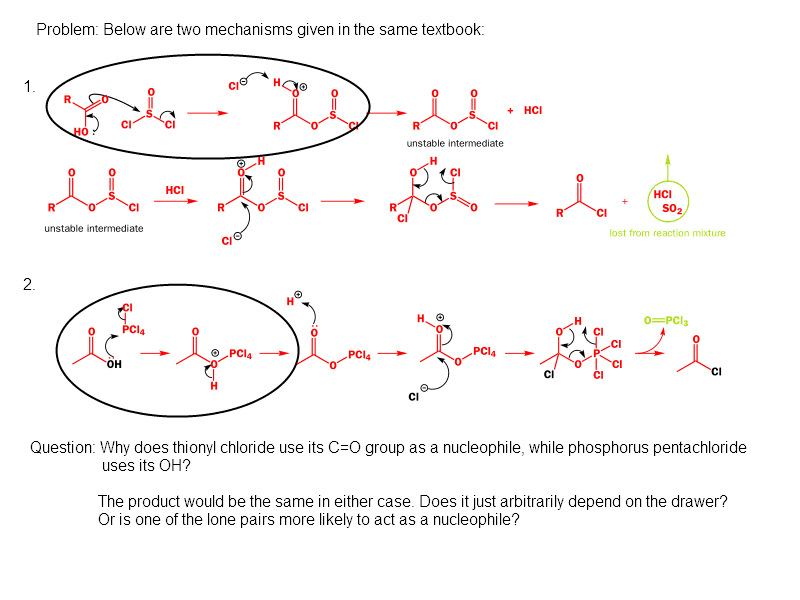
I posted in picture format to post on another website, but haven't found a reply yet:
 
PhysOrg.com
PhysOrg
chemistry news on PhysOrg.com

>> Attacking MRSA with metals from antibacterial clays
>> Femtosecond 'snapshots' reveal a dramatic bond tightening in photo-excited gold complexes
>> Beautiful 'flowers' self-assemble in a beaker
Jan30-13, 07:49 AM   #2
 
How long ago did you post the other question - seems to me that this was posted whilst a vast majority of PFers were asleep, perhaps this is the issue with your other question.

However, by analogy with other reactions of the carbonyl group I'd think this is likely to involve effectively internal attack on the C=O by the COH, and work from there. Proton transfer, however is fairly rapid so the two mechanisms are pretty identical. Whether a kinetic isotope effect may be present in pure deuterated acid, I don't know.
 
Jan31-13, 08:32 PM   #3
 
You're question is a little unclear because the mechanism shows nucleophilic attack by a -COOH group. The oxygens in these groups are actually equivalent and are best represented by resonance structures where the hydroxyl and carbonyl oxygens exchange.
 
Jan31-13, 11:15 PM   #4
 

Question about which oxygen acts as a nucleophile


I was able to find an answer - the protonated carbonyl is the correct mechanism for both (the second is a mistake). You can see why by considering resonance.
 
Feb1-13, 02:34 AM   #5
 
Quote by Yanick View Post
You're question is a little unclear because the mechanism shows nucleophilic attack by a -COOH group. The oxygens in these groups are actually equivalent and are best represented by resonance structures where the hydroxyl and carbonyl oxygens exchange.
No, they are equivalent in the carboxylate anion, but not in the protonated version. Resonance structures do not involve the movement of protons.
 
Feb1-13, 09:47 AM   #6
 
Quote by sjb-2812 View Post
No, they are equivalent in the carboxylate anion, but not in the protonated version. Resonance structures do not involve the movement of protons.
You are correct sir. I shouldn't be answering questions when I'm dead tired.
 
New Reply
Thread Tools


Similar Threads for: Question about which oxygen acts as a nucleophile
Thread Forum Replies
A force acts on a particle based on position, determine work. Sign question. Introductory Physics Homework 1
When does LiAlH4 act as a base and when does it act as a nucleophile? Chemistry 3
Which Nucleophile should I use? Biology, Chemistry & Other Homework 1
organic chemistry determing nucleophile strength Biology, Chemistry & Other Homework 2
Nucleophile Biology, Chemistry & Other Homework 1