Calculating Work in an Electric Field: Moving Point Charges

  • Thread starter Thread starter Scirel
  • Start date Start date
  • Tags Tags
    Electricity Work
Click For Summary
SUMMARY

The discussion focuses on calculating the work required to move point charges in an electric field. Two identical point charges of q = +1.25 x 10⁻⁸ C, initially 1.10 m apart, require an external force to move them to a distance of 0.60 m. The correct approach involves using the formula for electrostatic potential energy, U = 0.5(q1V1 + q2V2 + ... + qnVn), and understanding the sign convention for work done in electrostatics. The confusion arises from determining the correct signs for work when moving charges closer together or to infinity.

PREREQUISITES
  • Understanding of electrostatic potential energy
  • Familiarity with the concept of electric potential (V)
  • Knowledge of point charge interactions
  • Proficiency in applying formulas for work in electric fields
NEXT STEPS
  • Study the derivation and applications of the formula U = 0.5(q1V1 + q2V2 + ... + qnVn)
  • Learn about the concept of electric potential and its calculation for multiple charges
  • Explore the implications of sign conventions in electrostatics
  • Investigate the work-energy principle in the context of electric fields
USEFUL FOR

Students and professionals in physics, electrical engineering, and anyone involved in electrostatics or electric field calculations will benefit from this discussion.

Scirel
Messages
10
Reaction score
0
Two identical point charges of q = +1.25 x 10⁻⁸ C are separated by a distance of 1.10 m. What is the minimum amount of work required by an external force to move them closer together so that they are only 0.60 m apart?


I have no idea how to do this. I tried using -q(Vb-Va), but that got me 1x10^-6, which is wrong.


The figure below shows three charges at the corners of a rectangle of length x = 0.45 m and height y = 0.29 m. What is the minimum amount of work needed to move the +2.7 µC charge to infinity?
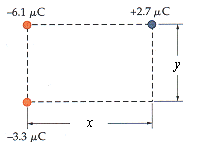
potentialR.gif


Again, same thing, I tried using that formula, and Vb would be 0 since it is to infinity, but I got -.4779, which is wrong.
 
Physics news on Phys.org
The total amount of electrostatic potential energy stored in a system of n point charges is
U = 0.5(q1V1 + q2V2 + q3V3 + ... qnVn)
Where q is a charge and V is the potential at that point (q) due to all other charges.
 
I think the idea here is that you just flip the sign around from positive to negative depending on the context. If you are bringing the charges closer together you are adding work to the system so it should be a positive value of work. If you are bringing the charges from close back to infinity then I think you just switch to a minus sign and report a negative amount of work (system is losing energy). Either way, the signs are the only thing that really differ (the answer is the same, you just change the sign to plus or minus depending on the context). I always get confused about which is which on these types of problems as well...
 

Similar threads

Replies
5
Views
2K
  • · Replies 1 ·
Replies
1
Views
5K
  • · Replies 3 ·
Replies
3
Views
2K
  • · Replies 7 ·
Replies
7
Views
2K
  • · Replies 1 ·
Replies
1
Views
1K
Replies
14
Views
2K
Replies
1
Views
2K
Replies
4
Views
2K
Replies
1
Views
2K
Replies
4
Views
2K