Appropriate tolerance for shaft and housing for bearings?

Click For Summary
SUMMARY

This discussion focuses on determining the appropriate tolerances for shaft and housing designs involving bearings. The user emphasizes the importance of an interference fit for securing bearings on the shaft while also ensuring that the housing provides a tight fit around the bearing's outer diameter. Key recommendations include avoiding reliance on press fits for bearing retention, using tube spacers between bearings, and considering the use of angular contact ball or tapered roller bearings for optimal performance. Resources such as SKF's installation and maintenance guide are highlighted for further guidance on fits and tolerances.

PREREQUISITES
  • Understanding of interference fits in mechanical design
  • Familiarity with bearing types, specifically angular contact ball and tapered roller bearings
  • Knowledge of shaft alignment and preloading techniques
  • Basic principles of mechanical tolerancing and fits
NEXT STEPS
  • Research SKF's Bearing Installation and Maintenance Guide for detailed information on fits and tolerances
  • Learn about the design principles of interference fits in mechanical assemblies
  • Explore the characteristics and applications of angular contact ball and tapered roller bearings
  • Investigate methods for shaft alignment and preloading in bearing assemblies
USEFUL FOR

Mechanical engineers, design engineers, and anyone involved in the design and assembly of bearing systems in rotating machinery will benefit from this discussion.

friscoboya
Messages
6
Reaction score
1
Hello,

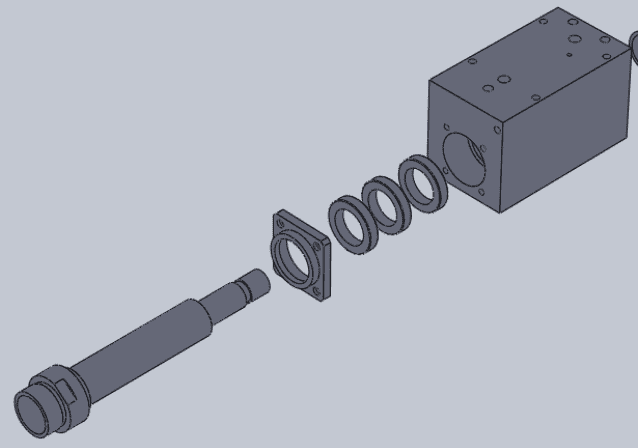
So I am designing a shaft which would involve bearings on the shaft, and a housing which would enclose the shaft. The shaft would be slightly bigger than the bearing hole which would create an interference fit so the bearings would stay on the shaft tightly. At the same time the bearing and shaft would be placed in a housing where the housing holes would be slightly smaller than the bearing outer diameter which would provide a tight fit so the bearings would stay in place. How would I determine the tolerance for the appropriate desired bearing stiffness? Below is a picture.
upload_2018-11-28_22-59-32.png
Thanks
 

Attachments

  • upload_2018-11-28_22-59-32.png
    upload_2018-11-28_22-59-32.png
    8.2 KB · Views: 765
Engineering news on Phys.org
It would be unwise to rely on a press fit to hold bearings in place. The bearings should be mounted by sliding them freely along a shaft until they are pressed gently onto a land that will locate them. Significant external or internal crush will change the diameter of the bearing running surfaces. If a retaining ring is not shrunk onto the shaft, a tube spacer should be used between bearings to prevent individual bearings moving along the shaft.

Spindle bearings are usually made from opposed pairs of angular contact ball or tapered roller bearings. The bearing cones can then be a hand fit on the shaft. Screw adjustment of the axial force on the bearings will then clamp the bearing position, while setting shaft alignment and preloading.

Your diagram seems to show three bearings on the shaft in the housing, why three and what type of bearings are they?
What size shaft and what RPM are you expecting.
Will the shaft bend when in use, or does it require maximum directional control by the bearing assembly?

See; https://www.gmnbt.com/downloads.htm
 
Last edited:
  • Like
Likes   Reactions: Asymptotic, anorlunda and Tom.G

Similar threads

  • · Replies 5 ·
Replies
5
Views
2K
Replies
6
Views
2K
Replies
4
Views
2K
Replies
11
Views
3K
  • · Replies 16 ·
Replies
16
Views
2K
Replies
1
Views
3K
  • · Replies 16 ·
Replies
16
Views
3K
  • · Replies 8 ·
Replies
8
Views
2K
  • · Replies 12 ·
Replies
12
Views
11K
Replies
8
Views
2K