Energy Bands: Kronig-Penney Model

  • Context: Graduate 
  • Thread starter Thread starter torehan
  • Start date Start date
  • Tags Tags
    Energy Model
Click For Summary

Discussion Overview

The discussion centers around the Kronig-Penney model, specifically focusing on the solutions to the time-independent Schrödinger equation within and outside a periodic potential. Participants explore the mathematical formulation of the wavefunctions in different potential regions and the implications for energy band structures.

Discussion Character

  • Technical explanation
  • Mathematical reasoning
  • Exploratory

Main Points Raised

  • One participant questions why the solution in the region of -b < x < 0 does not involve complex exponentials, unlike the region of 0 < x < a.
  • Another participant explains that in the region -b < x < 0, the wavefunction must decay, which requires the argument of the exponential to be real, leading to a specific form of the solution.
  • There is a discussion about the second-order ordinary differential equation (ODE) in both regions, with participants confirming that both regions indeed represent second-order ODEs.
  • One participant describes the solutions in the region with V=0 as traveling waves, indicating the nature of the wavefunctions in that area.
  • A later reply expresses gratitude for clarifications and acknowledges previous conceptual errors regarding the wave equation.
  • Another participant seeks guidance on reproducing band structure diagrams and outlines the wavefunctions for different potential regions, along with boundary conditions that must be satisfied.
  • The same participant raises a question about defining allowed and forbidden energy values based on the determinant derived from the boundary conditions.

Areas of Agreement / Disagreement

Participants appear to agree on the mathematical formulation of the wavefunctions in different regions, but there is no consensus on how to define the allowed and forbidden energy values, as this remains an open question in the discussion.

Contextual Notes

Participants reference boundary conditions and the application of Bloch's theorem, indicating that the discussion involves complex mathematical relationships and assumptions that may not be fully resolved.

Who May Find This Useful

This discussion may be useful for students and researchers interested in quantum mechanics, particularly those studying solid-state physics and the mathematical modeling of energy bands in periodic potentials.
torehan
Messages
41
Reaction score
0
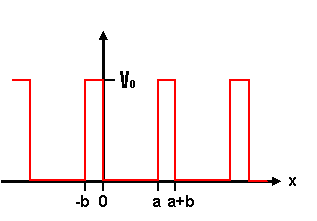
In Kronig-Penney Model we seek solutions for time independent Scrödinger equation inside and outside of the periodic potential.
Delta.png


for 0 < x < a;​
V(x) =
V0 for -b < x < 0​

My question is why solution of the KP Scrödinger equation in the region of -b &lt; x &lt; 0 doesnot have complex exponentials as in the region of 0 &lt; x &lt; a ?
 
Physics news on Phys.org
In this region we have
<br /> \frac{{d^2 \psi }}{{dx^2 }} = k^2 \psi,<br />

where

<br /> k^2 = \frac{{2m\left( {V_0 - E} \right)}}{{\hbar ^2 }}.<br />
The solution to this 2nd order ODE is a linear combination of exponentials (with real arguments). If you think about it physically, the wavefunction will also decay in this area, which can only happen if the argument of the exponential is real.
 
Niles said:
In this region we have
<br /> \frac{{d^2 \psi }}{{dx^2 }} = k^2 \psi,<br />

where

<br /> k^2 = \frac{{2m\left( {V_0 - E} \right)}}{{\hbar ^2 }}.<br />
The solution to this 2nd order ODE is a linear combination of exponentials.


OK, so what about first region?

<br /> \frac{{d^2 \psi }}{{dx^2 }} = q^2 \psi,<br />

where
q^2 = \frac{{2m\left( {E} \right)}}{{\hbar ^2 }}.

Isn't it also 2.nd order ODE ?
 
In the region with V=0 we have
<br /> \frac{{d^2 \psi }}{{dx^2 }} = -\hat k^2 \psi,<br />

where

<br /> \hat k^2 = \frac{{2m\left( {E} \right)}}{{\hbar ^2 }}.<br />

Solutions are traveling waves (going left and right).
 
Oh i see, I had some conceptual errors on writing the wave eq.
Thanks!
Torehan
 
I know that this topic doesn't take much attention of most of you as there are more interesting topics about paradoxes of physics but I need a little bit guidance about reproducing the band structure diagrams shown in Kittel , 170p in 8th Edition :)

So we have different wave solution for V0 region and 0 region,

\psi_{1}(x)=Ae^{ikx}+Be^{-ikx}\ \ \ \ \ \ \ for \ \ \ \ \ \ \ \ 0&lt;x&lt;a

\psi_{2}(x)=Ce^{qx}+De^{-qx}\ \ \ \ \ \ \ for \ \ \ \ \ \ \ \ \-b&lt;x&lt;0

After we apply the boundary conditions (usual QM boundary condiions in in square well potentials ),

\psi_{1}(0) = \psi_{2}(0) and \psi_{1}&#039;(0) = \psi_{2}&#039;(0)

\psi_{1}(a) = \psi_{2}(-b) and \psi_{1}&#039;(a) = \psi_{2}&#039;(-b)

Then, we have four equations

A+B=C+D

ik(A-B)=q(C-D)

Ae^{ika}+Be^{-ika}=(Ce^{-qb}+De^{qb})e^{i\alpha(a+b)}

ik(Ae^{ika}-Be^{-ika})=q(Ce^{-qb}-De^{qb})e^{i\alpha(a+b)}

Determinant of the coefficients of this equation system mush vanish to have solutions. Than determinant yields,


([q^{2}-k^{2}]/2qk) sinh(qb)sin(ka) + cosh(qb)cosh(ka) = cos (\alpha(a+b))


Finally my issues
  • How can I define the allowed and forbidden energy values?
  • to be continued...


e^{i\alpha(a+b)} ---->The term \alpha came from Bloch's Theorem and (a+b) came from application of transitional symmetry operation to Bloch form wavefunction!
 
Last edited:

Similar threads

  • · Replies 1 ·
Replies
1
Views
7K
  • · Replies 1 ·
Replies
1
Views
1K
  • · Replies 7 ·
Replies
7
Views
10K
Replies
1
Views
2K
  • · Replies 2 ·
Replies
2
Views
4K
  • · Replies 3 ·
Replies
3
Views
6K
  • · Replies 1 ·
Replies
1
Views
2K
Replies
8
Views
1K
  • · Replies 2 ·
Replies
2
Views
3K
Replies
25
Views
1K