interestedperson
- 9
- 4
Hello there,
I'd like to model a simplified version of a "Magic Eye" tube (e.g. without the amplification triode, and for a start, 2 dimensions only), or the visible display behavior.
What I'm talking about:
https://en.wikipedia.org/wiki/Magic_eye_tube#Operation
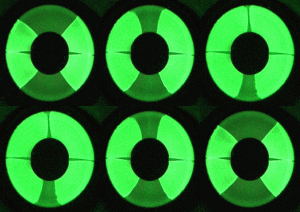
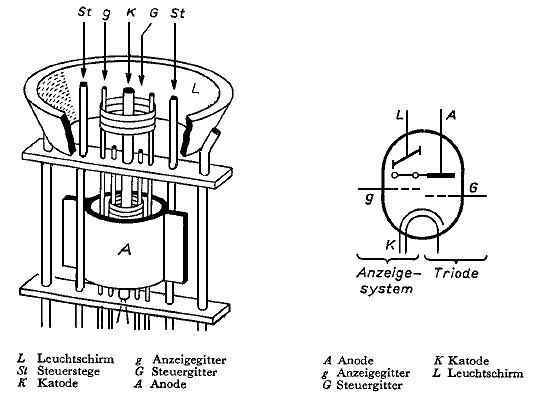
Here is a nicer depiction of how it's actually constructed, and also an animation of what it looks like, the EM34 tube (which is my target). As can be seen, it's not exactly straight lines on that screen anode, next to other welcome imperfections.
Source: (Text in German only, sorry)
http://www.netzmafia.de/skripten/hardware/Roehren/mag_eye.html
Using the German page's images for labels:
So, if viewed as a 2d case from above for now: Basically, there's a small circular cathode (K) in the very center, at 0 Volt. Around it is a grid (g) to somewhat dampen the electron flow (I've seen it electrically tied to the cathode in a particular radio receiver circuit). If we can, I'd like to ignore the extra anode (A) and its grid (G) which are for signal amplification, of the signal that goes to those 2 rods (St), in our 2d case even smaller circles spaced somewhat apart from the cathode. If we can, let's pretend I can control the voltage on those two (St) directly.
Then there is the screen (L) which acts as anode for the display function of the device - usually at 250 Volt.
This screen has a layer that will visibly emit green light if hit by sufficient number of electrons per time unit.
In the 2d case, it is the largest diameter ring, concentrically placed around the cathode.
In the function description it says, if both rods (St) are at the same voltage as the screen anode, they will not cause an "electron shadow", and the whole screen "ring" will be illuminated.
The lower the voltage gets on the rods, the more of a "shadow" (2 of them) is said to be produced.
Resulting in the display behavior as seen in the gif animation on the second linked site.
I Have searched a bit about calculating acceleration of electrons and found one on this site:
https://www.physicsforums.com/threads/velocity-of-electron-moving-between-charged-plates.360134/
This is a straight forward field between two plates. I guess my scenario is a bit more complicated.
I only had high school physics, and I don't even have an idea of how to model this, and what to compute. Well I imagine lots of vectors in different directions, but that's about it.
My goal, for now, is to make a simulation with "electrons moving" at human-observable speeds, and play around with voltages to see changes. (I'm a software dev of the rather less mathematical sort, I'd like to get somewhat more mathsy if it's not too late, though ;))
So I'd be fine with some stepped, discrete interval calculation of what happens.
I guess computing the end result (which parts of the screen "ring" are hit how much) could be computed with less effort with some fancy math, which is probably above my head or I have forgotten in all those years.
(By "compute end result" I mean, the display as a function of voltage(s) on the rods as parameters).
Since it's only about the humanly observable effects, this probably does not need to be extremely accurate - if corners can be cut to simplify things, let's do that.
What too much corner cutting would look like: Just drawing sections of a 2d ring with a fixed angle, and all at the same intensity. Which works without any physical calculations :)
If this turns out not to be way over my head, extending this to "3d enough" to get the irregularities, and different intensities, the glowing, at least somewhat convincingly, that would be a later goal.
Those irregularitities / glow on an already weakened tube (the different reaction curves of the left/right angles to the input signal is deliberate - how this is done exactly in the physical setup, I do not know)
Well, how could one go about this?
I'd like to model a simplified version of a "Magic Eye" tube (e.g. without the amplification triode, and for a start, 2 dimensions only), or the visible display behavior.
What I'm talking about:
https://en.wikipedia.org/wiki/Magic_eye_tube#Operation
Here is a nicer depiction of how it's actually constructed, and also an animation of what it looks like, the EM34 tube (which is my target). As can be seen, it's not exactly straight lines on that screen anode, next to other welcome imperfections.
Source: (Text in German only, sorry)
http://www.netzmafia.de/skripten/hardware/Roehren/mag_eye.html
Using the German page's images for labels:
So, if viewed as a 2d case from above for now: Basically, there's a small circular cathode (K) in the very center, at 0 Volt. Around it is a grid (g) to somewhat dampen the electron flow (I've seen it electrically tied to the cathode in a particular radio receiver circuit). If we can, I'd like to ignore the extra anode (A) and its grid (G) which are for signal amplification, of the signal that goes to those 2 rods (St), in our 2d case even smaller circles spaced somewhat apart from the cathode. If we can, let's pretend I can control the voltage on those two (St) directly.
Then there is the screen (L) which acts as anode for the display function of the device - usually at 250 Volt.
This screen has a layer that will visibly emit green light if hit by sufficient number of electrons per time unit.
In the 2d case, it is the largest diameter ring, concentrically placed around the cathode.
In the function description it says, if both rods (St) are at the same voltage as the screen anode, they will not cause an "electron shadow", and the whole screen "ring" will be illuminated.
The lower the voltage gets on the rods, the more of a "shadow" (2 of them) is said to be produced.
Resulting in the display behavior as seen in the gif animation on the second linked site.
I Have searched a bit about calculating acceleration of electrons and found one on this site:
https://www.physicsforums.com/threads/velocity-of-electron-moving-between-charged-plates.360134/
This is a straight forward field between two plates. I guess my scenario is a bit more complicated.
I only had high school physics, and I don't even have an idea of how to model this, and what to compute. Well I imagine lots of vectors in different directions, but that's about it.
My goal, for now, is to make a simulation with "electrons moving" at human-observable speeds, and play around with voltages to see changes. (I'm a software dev of the rather less mathematical sort, I'd like to get somewhat more mathsy if it's not too late, though ;))
So I'd be fine with some stepped, discrete interval calculation of what happens.
I guess computing the end result (which parts of the screen "ring" are hit how much) could be computed with less effort with some fancy math, which is probably above my head or I have forgotten in all those years.
(By "compute end result" I mean, the display as a function of voltage(s) on the rods as parameters).
Since it's only about the humanly observable effects, this probably does not need to be extremely accurate - if corners can be cut to simplify things, let's do that.
What too much corner cutting would look like: Just drawing sections of a 2d ring with a fixed angle, and all at the same intensity. Which works without any physical calculations :)
If this turns out not to be way over my head, extending this to "3d enough" to get the irregularities, and different intensities, the glowing, at least somewhat convincingly, that would be a later goal.
Those irregularitities / glow on an already weakened tube (the different reaction curves of the left/right angles to the input signal is deliberate - how this is done exactly in the physical setup, I do not know)
Well, how could one go about this?

