New Approaches Coming for Blood Cancers

  • Thread starter Thread starter BillTre
  • Start date Start date
  • Tags Tags
    Blood
Click For Summary

Discussion Overview

The discussion centers on new approaches to treating blood cancers, particularly through the manipulation of immune system cells. Participants explore various methods, including the use of modified T-cells and the potential for oncolytic viruses, while considering the implications and challenges of these treatments.

Discussion Character

  • Exploratory
  • Technical explanation
  • Conceptual clarification
  • Debate/contested

Main Points Raised

  • Some participants highlight the advantages of using immune cells for treatment due to their accessibility and ease of manipulation compared to solid tissues.
  • One participant mentions a study involving an "off switch" for modified cells, allowing researchers to control potential side effects with a specific drug.
  • Concerns are raised about the unpredictability of manipulating immune functions, with a participant noting that alterations may have unintended consequences that are not fully understood.
  • Another participant points out that while the immune system's role in combating malignancy is known, cancers have evolved mechanisms to evade immune detection, complicating treatment efforts.
  • The discussion includes mention of the FDA's approval of modified T-cells for treating B cell acute lymphoblastic leukemia, emphasizing the personalized nature of this treatment.
  • Some participants suggest that the development of oncolytic viruses may offer a more natural approach to targeting cancer cells.

Areas of Agreement / Disagreement

Participants express a range of views on the effectiveness and risks associated with new treatment methods, indicating that multiple competing perspectives remain. There is no consensus on the best approach or the implications of these new technologies.

Contextual Notes

Limitations include the uncertainty surrounding the long-term effects of immune cell manipulation and the varying strategies that cancers may employ to evade treatment. The discussion reflects an early stage in the development of these medical approaches.

Who May Find This Useful

Readers interested in advancements in cancer treatment, immunology, and the evolving landscape of medical therapies may find this discussion relevant.

BillTre
Science Advisor
Gold Member
Messages
2,752
Reaction score
12,020
This article from the NY Times describes new ways to treat blood cancers (cancers of blood cells). Some of these may be approved in a few months.
They involve manipulating immune system cells (also a form of blood cells) to get them to attack the cancer cells, while trying to avoid unintended concequences (like immune responses against the patient).

The immune system has research advantages since the cells are very easy to obtain (just get blood) and culture (grow in a dish) compared to solid tissues. Although many blood cells look alike, there are many different kinds of immune cells based on their molecular differences and stages of development. These are among the easiest human cells to work with.

The exposed position of blood cancer cells (just floating around in the blood mostly) also makes them very accessible to attack by immune cell (also floating around in the blood) approaches, whereas solid tumors might not allow such access.

Trials of similar approaches are also being attempted on solid tumors.
 
Last edited:
  • Like
Likes   Reactions: jim mcnamara, Ygggdrasil, berkeman and 1 other person
Biology news on Phys.org
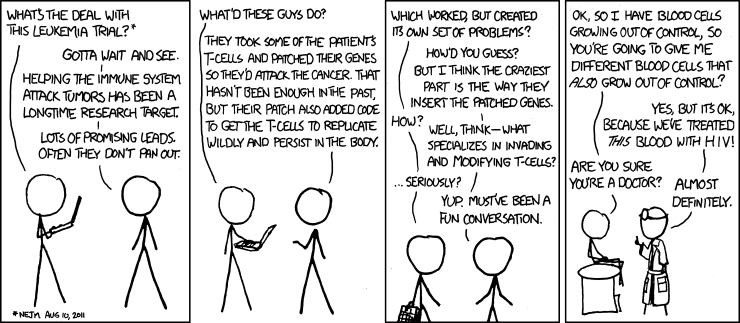
Obligatory XKCD reference:
t_cells.png

https://xkcd.com/938/

(the comic references some of the preliminary CAR-T trials done in 2011, see http://www.nejm.org/doi/full/10.1056/NEJMoa1103849#t=article)
 
  • Like
Likes   Reactions: member 563992, jim mcnamara and BillTre
I also found it interesting that one of the studies had some kind of an off switch (details not explained) for the cells they were going to inject:
"They also have an “off switch,” a gene that will let the researchers shut down the cells with a certain drug if they cause dangerous side effects that cannot be controlled."​

I would expect this kind of approach to become common in the future.
 
The biggest problem is that we don't always know as much about these types of manipulations as we believe we do. Sometimes when you think you are altering one and only one function, only later do you recognize that there were another set of effects influenced by your "singular" alteration. That is usually when the scientists say "Oops!" and disappear into their lab. We still are not as smart as we think we are!
 
These ideas are not new, we have known for quite some time that the immune system is involved in the control of malignancy. However one of the defining features of cancers is that they have evolved strategies of avoiding destruction and as cancers progress and the cells become progressively more distant from one another
any cancer may have cells capable of using a variety of strategies to avoid our immune system. Using the new technology to modify our immune cells generally involves ways of overcoming one of these strategies, such drugs or modified cells would form part of the arsenal of available treatments but would be unlikely to replace them. Also tackling some of these strategies is more risky than others. A perhaps more natural approach is in the development of oncolytic viruses, which preferentially attack the cancer cells and in doing so either kill them or label them for destruction.
We are at the very start of a revolution in medicine based on our greater understanding of some biological processes, its interesting stuff but its still early days.
 
The FDA has now approved using modified T-cells (from the patient, to avoid rejection problems) to attack B cell acute lymphoblastic leukemia (ALL) as a treatment in the US.
The T-cells had a gene for a chimeric antigen receptor added which targets the leukemia cells. Because the T-cells come from each individual patient, the modified cells are created uniquely for each patient (which makes it expensive and in short supply).
The particular treatment was developed by Novartis.
 
  • Like
Likes   Reactions: Ygggdrasil

Similar threads

  • · Replies 1 ·
Replies
1
Views
3K
  • · Replies 21 ·
Replies
21
Views
4K
  • · Replies 1 ·
Replies
1
Views
3K
  • · Replies 1 ·
Replies
1
Views
2K
  • · Replies 2 ·
Replies
2
Views
2K
  • · Replies 1 ·
Replies
1
Views
2K
Replies
3
Views
2K
  • · Replies 4 ·
Replies
4
Views
3K
  • · Replies 1 ·
Replies
1
Views
2K
  • · Replies 2 ·
Replies
2
Views
5K