Temperature of gas during water electrolysis

Click For Summary

Discussion Overview

The discussion revolves around the temperature of gas produced during water electrolysis, specifically how to calculate it given certain parameters such as moles, volume of the container, and energy input. Participants explore the relationship between the energy used for electrolysis and the heating of both water and gas, as well as the implications of system constraints.

Discussion Character

  • Technical explanation
  • Mathematical reasoning
  • Debate/contested

Main Points Raised

  • Some participants propose using the specific heat capacity formula to find the temperature of water during electrolysis, given mass, specific heat constant, and energy input.
  • Others argue that part of the energy is used for splitting water, complicating the calculation of temperature for the gas produced.
  • A participant suggests subtracting the mass of gas produced from the initial mass of water to find the remaining mass for calculations.
  • Another participant emphasizes that energy input is used for both water decomposition and heating, and that calculating final temperatures in a closed system is complex.
  • There is a discussion about combining specific heat capacities of water and gas to calculate the overall heat capacity of the system.
  • One participant expresses confusion about the relationship between heat capacity and specific heat capacity, leading to further clarifications from others.
  • Participants discuss the importance of using correct units and notation in calculations, with some corrections made throughout the thread.

Areas of Agreement / Disagreement

Participants do not reach a consensus on the best approach to calculate the temperature of the gas produced during electrolysis. There are multiple competing views on how to account for energy distribution between heating and decomposition, and the discussion remains unresolved.

Contextual Notes

Participants highlight the need for precision in definitions and calculations, particularly regarding mass versus volume and the use of specific heat versus heat capacity. There are unresolved mathematical steps and assumptions about system conditions that affect the calculations.

Who May Find This Useful

This discussion may be useful for individuals interested in thermodynamics, electrolysis processes, and the calculations involved in energy transfer and temperature changes in chemical systems.
HelloCthulhu
Messages
150
Reaction score
3
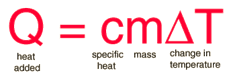
I know I can use the specific heat capacity formula to find the temperature of the water during electrolysis as long as I know the mass, specific heat constant of water and joules added beforehand:

upload_2015-6-29_3-6-28.png


But I'm not sure how I could find the temperature of the gas produced. If the pressure was given, I could use ideal gas law.

8a1df8044b202c20aefce32e5ab98ecc.png
But what if I only know the moles, volume of the container, and joules added? Any help would be greatly appreciated!
 
Chemistry news on Phys.org
HelloCthulhu said:
I know I can use the specific heat capacity formula to find the temperature of the water during electrolysis as long as I know the mass, specific heat constant of water and joules added

That's not correct. Part of the energy was used for splitting water, not for heating it. (Which also means there is no straightforward answer to your further question).
 
Borek said:
That's not correct. Part of the energy was used for splitting water, not for heating it. (Which also means there is no straightforward answer to your further question).

Can I subtract the gas produced from the mass and use that in the formula?
 
No. Problem is not with the mass, but with the energy that was used for heating water. Actually we have ignored that part of the problem when you asked very similar question some time ago.

Energy you put into the electrolysis is used for water decomposition and heating - heating of both water and escaping as. Assuming an isolated system calculating final temperature of the gas and water (they will be the same) is not that difficult. If the gas escapes this is by no means a trivial problem.
 
So if it's a closed system, I can use the specific heat capacity formula for the water and the temperature will be the same for the gas?
 
No, you will need to combine specific heat of water with mass water and specific heat of gas with gas mass. That will give you a heat capacity of the system, which can be used to calculate its final temperature, as ΔT will be identical.
 
Let's use my last scenario (including a few adjustments):

36mL of water at 20°C undergoes electrolysis inside a closed container at 15A/6V. What is the temperature of the water after 1 min? What is the temperature of the gas?

Gas produced
(15*60s*4g)/(F*4) = 0.00933g H2
(15*60s*32g)/(F*4) = 0.07462g O2

0.00933g + 0.07462g = 0.08395g

Final mass
36g-0.08395g = 35.916g

Specific Heat Capacity
5400J = (4.18 x 35.916g) x (T2-20°C)

5400J = (4.18 x 36g) x ΔT
5400/(4.18 x 35.916g) = (T2-20°C)
35.969°C = T2-20°C
55.969°C = T2

Borek said:
No, you will need to combine specific heat of water with mass water and specific heat of gas with gas mass.

Does this mean adding the specific heat of water (55.969°C) plus the mass (36mL)? And if I have to solve for the specific heat of produced gas, can I use the same value Q (5400J)? If not how can I calculate how much of the heat is now in the gas?
 
What is the problem you are trying to solve? I have a feeling you are moving goalposts with each new thread (BTW: don't start new threads if it is the same problem all the time).

HelloCthulhu said:
Does this mean adding the specific heat of water (55.969°C) plus the mass (36mL)?

No, you can't add different things at random. Besides, 55.969°C is not a specific heat, but temperature, and 36 mL is not mass, but volume. You have to be precise about these things.

Do you know what the heat capacity is? Do you know how it is related to the specfic heat capacity?
 
Borek said:
What is the problem you are trying to solve? I have a feeling you are moving goalposts with each new thread (BTW: don't start new threads if it is the same problem all the time).

Honestly I'm just trying to learn more about thermodynamics during electrolysis under standard and nonstandard conditions. I'll try to keep my questions to this thread from now on.

Borek said:
Do you know what the heat capacity is? Do you know how it is related to the specfic heat capacity?

Sorry, I often get a little confused. Heat capacity is the amount of heat required to raise the temperature of an object by 1°C
and specific heat capacity is heat capacity per unit mass of a material. So when you say "combine specific heat of water with mass water" do you mean 4.18 plus 36g of water?
 
  • #10
By "combine" I didn't mean "add them". I meant "use them both to calculate heat capacity of water present".
 
  • #11
Borek said:
I meant "use them both to calculate heat capacity of water present".

I'm sorry, but I either don't understand what you're asking for or haven't learned how to do that yet (or probably both). Are you asking me to solve for specific heat capacity for the heated water and solve specific heat capacity for the gas produced and then use both to solve for heat capacity of the system?

If so, do I use the same number of joules in both specific heat equations? I'm very confused, but I'll make an attempt...

Liquid:
5400J = (4.18 x 35.916g) x ΔT
5400/(4.18 x 35.916g) = (T2-20°C)
35.969°C = T2-20°C
55.969°C = T2

Gas
5400J = (2.080 x 0.08395g) x ΔT
5400J/(2.080 x 0.08395g)=(T2-20°C)
30.925°C=(T2-20°C)
50.925°C=T2

(55.969°C + 50.925°C)=106.894°C
 
  • #12
HelloCthulhu said:
Are you asking me to solve for specific heat capacity for the heated water and solve specific heat capacity for the gas produced and then use both to solve for heat capacity of the system?

This is so unclear I have no idea whether you got it right or wrong.

You don't "solve for specific heat capacities". You use them to calculate the heat capacity of the system. In the equation you have listed:

Q = c \times m \times \Delta T

c \times m is the heat capacity of the system consisting of one component. In general, for any system

Q = c_s \times \Delta T

where cs is the heat capacity of the system. If the system consist of one component only

c_s = m \times c

but if there are many components, you simply sum their individual heat capacities (beware: not specific heat capacities). So you can write system heat capacity as

c_s = \sum_i m_i \times c_i

where mi and ci are masses and specific heat capacities of individual components. In your case this sum will consist of two parts - one describing the water, one describing the gas.
 
  • #13
Thank you so much for that clarification! I hope I understand how to do this now.

Borek said:
cs=m×c

Liquid 36mL x 4.18=150.48

Gas 0.08395 x 2.080=0.17462

150.48 + 0.17462=150.654

[c][/s]=150.654

Borek said:
Q=cs×ΔT

5400J=150.654 x ΔT
5400J/150.654=(T2-20)
35.84+20=T2
55.84=T2
 
  • #14
Don't omit units.

HelloCthulhu said:
36mL x 4.18=150.48

While this gives a correct value, technically it is not correct.

What are units of your result?
 
  • #15
Apologies. Thanks again for helping me out with this!

Liquid 36mL x 4.18=150.48J/K
Gas 0.08395 x 2.080=0.17462J/K
150.48 + 0.17462=150.654J/K

Cs=150.654J/K

5400J=150.654 x ΔT
5400J/150.654=(T2-20°C)
35.84°C+20°C=T2
55.84°C=T2
 
Last edited:
  • #16
HelloCthulhu said:
Liquid 36mL x 4.18=150.48J/K

You are still ignoring units - please write them everywhere.
 
  • #17
Liquid 36g x 4.18J⋅g−1⋅K−1=150.48J/K
Gas 0.08395g x 2.080J⋅g−1⋅K−1=0.17462J/K
150.48J/K + 0.17462J/K=150.654J/K

Cs=150.654J/K

5400J=150.654J/K x ΔT
5400J/150.654J/K=(T2-20°C)
35.84°C+20°C=T2
55.84°C=T2
 
  • #18
HelloCthulhu said:
Liquid 36mL x 4.18=150.48J/K

HelloCthulhu said:
Liquid 36g x 4.18J⋅g−1⋅K−1=150.48J/K

So, you have silently corrected your initial mistake, didn't you?

Please be careful about your notation, it is really not difficult to properly format your equations. We have tools for displaying heat capacity either as J⋅g−1⋅J⋅g−1⋅K−1 or J \times g^{-1} \times K^{-1} or just \frac {J}{g \times K}. Even J/(g⋅K) is better than things like g-1.
 
  • #19
Borek said:
So, you have silently corrected your initial mistake, didn't you?

Yes, I remembered what you said earlier about volume and mass. I'll be sure to use the thread tools on my next post. Thanks again Borek!
 
  • #20
There is nothing wrong with using the volume - just use density to convert to mass.

36~mL \times 1 \frac g {mL} = 36~g
 
  • #21
Now that you've helped me solve for the heat capacity of the system, I have a few more questions about calculating internal energy (nonstandard conditions) inside of a closed system during electrolysis. Would it be alright to post them here or should I start a new thread?
 
  • #22
Please start a new thread.
 

Similar threads

  • · Replies 20 ·
Replies
20
Views
3K
  • · Replies 8 ·
Replies
8
Views
4K
  • · Replies 5 ·
Replies
5
Views
3K
  • · Replies 4 ·
Replies
4
Views
3K
  • · Replies 19 ·
Replies
19
Views
12K
  • · Replies 7 ·
Replies
7
Views
5K
  • · Replies 5 ·
Replies
5
Views
2K
  • · Replies 2 ·
Replies
2
Views
2K
Replies
14
Views
4K
  • · Replies 3 ·
Replies
3
Views
2K