What kind of flowers are these? (eerie)

  • Thread starter Thread starter berkeman
  • Start date Start date
Click For Summary

Discussion Overview

The discussion revolves around identifying a specific type of flower observed by a participant during their workouts, focusing on the unusual visual effects experienced when viewing the flowers from different angles and lighting conditions. The conversation includes aspects of color perception, potential flower identification, and the implications of structural coloration in plants.

Discussion Character

  • Exploratory
  • Technical explanation
  • Debate/contested

Main Points Raised

  • One participant describes experiencing a color shift in the flowers from red to purple depending on the angle of view, suggesting a possible influence of their eyeglasses' UV filtering.
  • Another participant proposes that the flowers might be Calandrinia grandiflora, while others suggest Bougainvillea, noting discrepancies in petal and plant structure.
  • Some participants discuss the role of rod and cone receptors in the retina, explaining how peripheral vision may affect color perception.
  • There are mentions of structural elements in flowers that can refract light, leading to perceived color changes based on viewing angles.
  • A later reply highlights a recent discovery regarding flower petals producing a 'blue halo' to attract pollinators, which may relate to the observed visual effects.
  • One participant notes that honeybees cannot see red but can see near UV light, which may influence how flowers appear to different species.
  • Another participant shares a personal anecdote about the color-changing properties of buttercups, suggesting this may be an adaptive trait for attracting pollinators.
  • Philosophical questions about the nature of color perception arise, with some participants cautioning against discussing philosophy in the forum context.

Areas of Agreement / Disagreement

Participants express multiple competing views regarding the identification of the flowers, with no consensus reached. There is also ongoing debate about the implications of color perception and how it varies among different species.

Contextual Notes

Participants acknowledge the complexity of color perception, including the influence of lighting and structural properties of flowers, but do not resolve the underlying questions about the actual color of objects as perceived by different observers.

berkeman
Admin
Messages
69,409
Reaction score
24,805
I run by these flowers near my work on some of my noon workouts, and the first time I ran past them I had to stop because I thought I was having some kind of vision problem. When I looked right at the flowers they looked like one color, but when I saw them out of my peripheral vision, they looked like they were a different color (red versus purple, respectively).

I thought I'd figured out the cause as being my eyeglasses (which have UV filtering) -- they tend to make the flowers look less purple and more red, which would match the UV filter characteristic extending down a bit into the visible violet range. I figured that I saw more purple in the flowers with my peripheral vision because that light wasn't going through the eyeglass lenses.

But then today when I saw the flowers from farther away in bright sunlight, the middle part of the bank of flowers looked more red, and there was a thin blue halo around the whole group, especially along the top edge. Strange (and very beautiful).

Does anybody know what kind of flowers these are? I wanted to do some reading to see if this unusual visual effect has been noticed and documented.

Thanks! :smile:
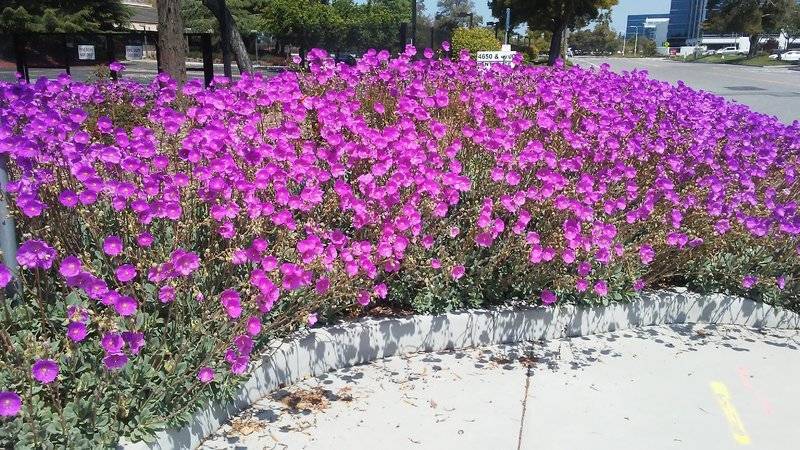
Flowers by PHD Better.jpg
 

Attachments

  • Flowers by PHD Better.jpg
    Flowers by PHD Better.jpg
    112.3 KB · Views: 1,029
Biology news on Phys.org
My best guess is Calandrinia grandiflora, Chilean Rock Purslane.
Here's http://www.marathonlandscape.com/wp-content/uploads/2010/01/IMG_1782.jpg from http://www.marathonlandscape.com/?page_id=63; "We serve the entire Monterey Bay Area including Los Gatos and Saratoga."
I think that's Silicon Valley-ish area.

My worst guesses are corn poppy and rose campion.
 
  • Like
Likes   Reactions: collinsmark and berkeman
Thanks Om. Yes, I should have said this is in Santa Clara California. Silicon Valley. :smile:
 
Google images search says they are Bougainvillea.
However, both the petals and the plant structure look different to me. Perhaps a closer picture of the flowers/plant would work better.
Or someone more knowledgeable about flowers (such as @jim mcnamara ).

Here are some thoughts on your color observations (not sure any are all that pertinent to what you're describing however):

1) the periphery of the retina is mostly composed of rod receptors (lower light level, often called black and white, broad wavelength sensitivity). The brain provides peripheral colors by filling in based on what's previously been seen (in the recent experiential past). See graph of cone vs. rod distribution in this link. The fovea contains most of the color detecting cones and rapidly scans aspects of a scene to build up and overall idea of what's out there. I am avoiding using image since it is not an instantaneous view, but built up over time.

2) The retinal and brain both have mechanisms where contrasts are enhanced (and used to build up large scale observed objects (like lines)) from circle surround sensory fields. There are also color contrast systems R vs. G and Blue vs. Yellow). Not sure how this might work here, ut are optical illusions based on this.

3) If there some of the flower's color is due to structural elements rather than color pigments, the colors can change depending on the the angles of observation and illumination.

4) The color of the light illuminating an object can affect the perceived color.
 
Last edited by a moderator:
  • Like
Likes   Reactions: berkeman
Looks like the genus Calandrina - Chilean rock purslane @OmCheeto got it I think. Calandrina spectablilis most likely. An import.

There is a structural element with these flowers' pigmentation in cells. They refract light as well as reflect it. The wider the angle of incidence to viewing angle, the more color change you see. Really wide angles and the color fades.

@BillTre his #3 is probably the best explanation.

Hint: pictures of flowers taken at about 1 foot make this whole process less guessworthy
 
  • Like
Likes   Reactions: BillTre and berkeman
BillTre said:
Google images search says they are Bougainvillea.

Unlikely IMHO, bougainvillea is either a bush or wine and wouldn't make sense planted in a flower garden directly on the flat ground.
 
These are in my mom's garden in winters but my gardener won't know their names cause he is illiterate.They refer plants as the light purple one ,the purple with dots ,etc in layman language. I don't have uv glasses.
 
jim mcnamara said:
...
There is a structural element with these flowers' pigmentation in cells. They refract light as well as reflect it. The wider the angle of incidence to viewing angle, the more color change you see. Really wide angles and the color fades.
...
Fascinating.
Looking at Berkeman's original image, I sensed a subtle hue difference in the central portion vs the periphery.
I went ahead and sampled it, and found a very subtle shift from red to blue, when going from the center to the periphery: rgb(220, 58, 209) --> rgb(207, 60, 220)

But then I found out that honeybees can't see red!; "... honey bees also have a weak point in their vision as they cannot see the color red. " [ref]
Not sure about Andean bees, which is where this particular flower is from.

But I went ahead and removed the red portion from the two colors, and compared that to what humans would see:

human.vs.bee.flower.vision.maybe.png

Looks like a color blindness test!

Anyways, after some more googling, I also discovered a new discovery:

Petals produce a 'blue halo' that helps bees find flowers
Date: October 18, 2017
Source: University of Cambridge
Summary: Latest research has found that several common flower species have nanoscale ridges on the surface of their petals that meddle with light when viewed from certain angles.​

That's just 6 months ago!

I have to admit, I've never noticed this "Blue halo" before.
Though, I have noticed that Rose Campions catch my eye, in a weird "That plant is doing something to light that I can't describe." kind of way. (First noticed this around 1990.)
No other flower I've ever seen does it like it does.
 

Attachments

  • human.vs.bee.flower.vision.maybe.png
    human.vs.bee.flower.vision.maybe.png
    3.8 KB · Views: 827
  • Like
Likes   Reactions: pinball1970, BillTre and berkeman
OmCheeto said:
Anyways, after some more googling, I also discovered a new discovery:

Petals produce a 'blue halo' that helps bees find flowers
Date: October 18, 2017
Source: University of Cambridge
Summary: Latest research has found that several common flower species have nanoscale ridges on the surface of their petals that meddle with light when viewed from certain angles.
That's just 6 months ago!
Thanks Om! Awesome stuff. So you're saying I'm not crazy after all? o0)
 
  • #10
In addition to lacking the ability to see red (something I was not aware of) bees can see near UV (bee purple).
Sometimes people make photos with the colors shifted so people can see what bees see (the patterns not the actual psychological internal colors). The patterns often make the flowers look like a target.

berkeman said:
So you're saying I'm not crazy after all? o0)
I considered that (along with colorblindness), but left it off my list. :smile:
 
  • #11
Ranunculus - buttercup - does that refractive trick, too. If you hold the flower about a few cm under your chin (no beards allowed) and have the sun hit the flower you get a bright yellow splot of light. The yellow splot is a somewhat different color of yellow - so I am told. This is a 'folk' test to see if you like butter. Hence, buttercup, the common name. Looking at the petals: the upper surface has a 'shiny' coating and if you move the flower around you get some color changes.

As a wild guess this must be adaptive for attracting pollinators.
PS: splot is a highly scientific term which has a very specialized meaning, closely related to blotch and blob. :biggrin:
 
  • #12
So you all are saying that colours are different for different animals.
Thus i ask this question
What is the actual color of something?
 
  • #13
Suyash Singh said:
What is the actual color of something?
Remember, we don't discuss philosophy at the PF. Thanks.
 
  • Like
Likes   Reactions: Suyash Singh
  • #14
berkeman said:
Remember, we don't discuss philosophy at the PF. Thanks.
I was asking for the scientific answer.
Like what is the actual color of something because if we are seeing that object it is being perceived by us as another color.
 
  • #15
Borek said:
Unlikely IMHO, bougainvillea is either a bush or [v]ine and wouldn't make sense planted in a flower garden directly on the flat ground.

@Borek is correct, plus that family of species requires a warm climate, and is not frost tolerant.
 
  • #17
@Suyash Singh there is no good scientific answer. Don't believe me? check this out: https://en.wikipedia.org/wiki/Synesthesia
Hearing sounds can cause a color vision response. We already have several threads on this topic so let's not for for a deep dive into synesthesia, just go lookup those threads. See? we are diverging already...
 
  • Like
Likes   Reactions: BillTre and Suyash Singh
  • #18
berkeman said:
Thanks Om! Awesome stuff. So you're saying I'm not crazy after all? o0)
Interesting comment.
I wonder how many scientific discoveries are held back by the observer saying to themselves; "I think I see something odd here, but it might be a hallucination, so I won't mention it, lest people think I'm crazy."

I'm pretty sure this is why I've never mentioned my observations of Rose Campions before today.

I mentioned an observation of infrared light one day on Facebook, and everyone was silent.
I therefore assumed I was crazy.
Though, my camera caught it also, so I don't think I'm totally crazy.

what.the.heck.is.with.me.seeing.uv.q.mark.png

Spectrum cast by the sun through my fish tank on Halloween last year.

ps. I wonder if getting married has an effect on what people are "allowed" to observe?
"It's ok to look at flowers, dear. You'll still be the man in my life."

hmmmm...
 

Attachments

  • what.the.heck.is.with.me.seeing.uv.q.mark.png
    what.the.heck.is.with.me.seeing.uv.q.mark.png
    23.6 KB · Views: 757
  • Like
Likes   Reactions: berkeman
  • #19
There is also the issue of what "color" a colorblind person will see (meaning experience internally).
There are many different kinds of colorblindness in humans because you can lack or have impaired function of any combination of the different color receptors.
This can be tested and demonstrated in many ways, however, its not clear how to describe to a non-colorblind person what something looks like (internally) to a colorblind person.
Other species would seem to present even greater problems.
 
  • Like
Likes   Reactions: pinball1970
  • #20
@OmCheeto before you consider "crazy" as answer try tetrachromacy. http://discovermagazine.com/2012/jul-aug/06-humans-with-super-human-vision
This is an edgy concept, and only one tetrachomat (female humans only allowed in this group, as of now) has been found per the article. At least two steps better than crazy, maybe. Virtually all of the rest of us use different cone cell types, 3 - versions, to create normal color vision. Color blindness means missing or defective cone types.

Tetrachromacy means that a tetrachromat can differentiate among 1004 colors whereas the rest of us dull thuds with color vision only see about 1 million colors 1003.

Of course mantis shrimp are beyond the pale - they are dodecachromats - they have color vision based on 12 cone cell variants, we have 3 (or maybe 4 sometimes). We hit the Twilight Zone of known Science of vision on this one.

Here is why:
https://onlinelibrary.wiley.com/doi/abs/10.1002/scin.5591820609 Apparently they do not see color the way we do. Read the article, please. I'll "flub" the explanation.

Mantis shrimp are beyond cool in several ways - outre vision, 10400g acceleration of the hunting club - among them
https://en.wikipedia.org/wiki/Mantis_shrimp.
with an acceleration of 10,400 g (102,000 m/s2 or 335,000 ft/s2) and speeds of 23 m/s (83 km/h; 51 mph) from a standing start.

They can break heavy aquarium glass, and make burrows into coral by "sledgehammering".
 
  • Like
Likes   Reactions: OmCheeto and BillTre
  • #21
OmCheeto said:
Anyways, after some more googling, I also discovered a new discovery:

Petals produce a 'blue halo' that helps bees find flowers
Date: October 18, 2017
Source: University of Cambridge
Summary: Latest research has found that several common flower species have nanoscale ridges on the surface of their petals that meddle with light when viewed from certain angles.​

That's just 6 months ago!

I have to admit, I've never noticed this "Blue halo" before.
Though, I have noticed that Rose Campions catch my eye, in a weird "That plant is doing something to light that I can't describe." kind of way. (First noticed this around 1990.)
No other flower I've ever seen does it like it does.

I have seen something like this with that specific colour area on textiles for a quite a few years. Very bright bluish red shades at first I thought the dyeing was unlevel as I could distinctly see blue areas as well as red but the areas changed when I manipulated the fabric. After seeing this a few times I assumed it was some sort of optical effect. Textured surfaces only, this could explain it.
 
  • #22
BillTre said:
There is also the issue of what "color" a colorblind person will see (meaning experience internally).
There are many different kinds of colorblindness in humans because you can lack or have impaired function of any combination of the different color receptors.
This can be tested and demonstrated in many ways, however, its not clear how to describe to a non-colorblind person what something looks like (internally) to a colorblind person.
Other species would seem to present even greater problems.

I have tested a few colour blind people and its quite weird watching them describe what they see when you are looking at the same images.
 

Similar threads

Replies
8
Views
5K
  • · Replies 15 ·
Replies
15
Views
3K
  • · Replies 5 ·
Replies
5
Views
2K
  • · Replies 40 ·
2
Replies
40
Views
4K
  • · Replies 3 ·
Replies
3
Views
2K
  • · Replies 5 ·
Replies
5
Views
2K
  • · Replies 9 ·
Replies
9
Views
2K
  • · Replies 3 ·
Replies
3
Views
4K
  • · Replies 3 ·
Replies
3
Views
12K
  • · Replies 1 ·
Replies
1
Views
4K