LNG Tanker
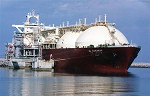
The photo of a Norwegian tanker is shown. The tanker capacity (all five of its spherical tanks completely full) is 128,000 cubic meters of liquid natural gas (LNG). A scale profile of the tanker is shown below.
Calculate the mass of LNG of the fully-loaded tanker.
The photo of a Norwegian tanker is shown. The tanker capacity (all five of its spherical tanks completely full)
is 128,000 cubic meters of liquid natural gas (LNG). A scale profile of the tanker is shown below.
Relevant densities of LNG are:
ρLNG,liq(1 atm, -162°C) = 422 kg/m3 and ρmethane(1 atm, 25°C) = 0.66 kg/m3.

Calculate the mass of LNG of the fully-loaded tanker.
♦ Mass (m), density (ρ) and volume (V) are related as: m = ρ V. The volume of the hold and the density of the liquid LNG, are provided, hence:
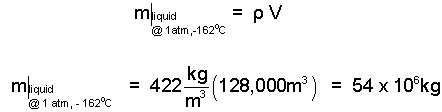
Mass equals density times volume.
This fuel is not sold by kilogram of liquid. It is measure of "standard cubic feet," or SCF. This number is calculated. The pressure of a standard cubic foot of any gas is one atmosphere and its temperature is 25°C
Calculate the number of standard cubic feet (SCF) of natural gas the tanker delivers.
♦ Again, mass, density and volume are related as: m = ρ V
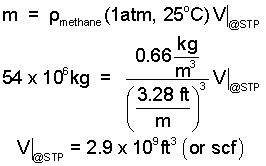
Unit conversion required.
Estimate the length of the tanker.
♦ A first step is to calculate the diameter of the identical spherical tanks using the volumetric capacity and the formula for the volume of a sphere.

Approximate diameter of a spherical tank.
A ruler might be used to measure the length but we used a graphics software to scan the tanker profile. The scan was then adjusted by moving the spheres to eliminate the space between them. Finally the software was set to display a grid over the image.
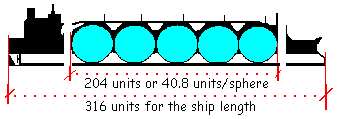
A count of grid units of the width of the 5 spheres yielded 204 units, meaning the diameter of each sphere is 40.8 units. But we have already determined that the spheres are 36.6 meters in diameter. Hence the scale is that each grid unit represents 0.9 meters. The count of the grid units in the full length of the tanker image is 316 units. Thus 313 units x ( 0.9m / unit) = 283 meters.
Estimate the beam of the ship.
♦ The beam of the ship is its widest width. The tanker must be at least as wide as the diameter of one sphere.
That would be 36.6 meters. But the beam measurement would also include two "thicknesses" of the hull. Estimate the hull thickness to be 2 meters then the beam of the tanker would be approximately 40.6 meters.