THERMO Spoken Here! ~ J. Pohl  ©
TOC ~ 183

Horsepower of an Ox

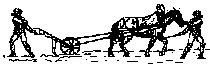
Old engraving of a team of oxen pulling a plow, guided by farm workers.

In many countries, oxen, guided by children, plow straight, level furrows through soil. The ox of the figure pulls its plow a length of 200 meters in five minutes.

Calculate the least average horsepower expended by the ox.
♦ We have no way of knowing what friction force occur. To ignore friction is a major assumption. We ignore friction; our answer will be a "least power required." As system, we take the soil removed from the furrow once the ox completes a furrow. The mass of soil tilled equals:
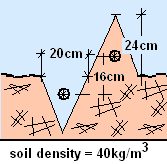
Cross-section of a plowed furrow: a triangular ridge of soil 20 cm wide at the base and 24 cm high, its center of mass raised 16 cm above that of the soil in the ground; soil density = 40 kg/m³.
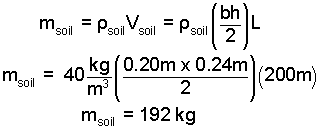
Equation (1): m_soil = ρ_soil V_soil = ρ_soil (bh/2) L; m_soil = 40 (kg/m³)((0.20 m × 0.24 m)/2)(200 m); m_soil = 192 kg
(1)

Ignoring friction, the Extrinsic Energy Equation applies:
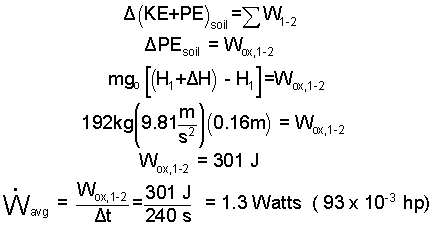
Equation (2): Δ(KE + PE)_soil = ΣW₁₋₂; ΔPE_soil = W_ox,1-2; m g_o [(H₁ + ΔH) − H₁] = W_ox,1-2; 192 kg (9.81 m/s²)(0.16 m) = W_ox,1-2; W_ox,1-2 = 301 J; Ẇ_avg = W_ox,1-2/Δt = 301 J/240 s = 1.3 Watts (93 × 10⁻³ hp)
(2) ♦  
Equation (3): ΔPE_soil = W₁₋₂,ox
(3) ♦  
Equation (4): m_soil g_o [(H₁ + ΔH) − H₁] (c.m. soil) = W₁₋₂,ox
(4) ♦  
Equation (5): 192 kg (9.81 m/s²)(0.16 m) = W₁₋₂,ox
(5) ♦  
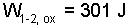
Equation (6): W₁₋₂,ox = 301 J
(6) ♦  
Equation (7): Ẇ_avg = W₁₋₂,ox/Δt = 301 J/240 s = 1.3 Watts (0.093 hp)
(7) ♦