trans-Alaska Pipeline
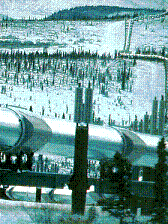
Some 800,000 barrels of oil per day are pumped 800 miles from Prudhoe Bay to Valdez where it is loaded into tankers. At a location in the pipeline, a gage measures the average velocity of the flow of oil passing through that measurement section of the four-foot diameter pipe.
Flow speed from the daily delivery
What average speed of flow of oil does the gage indicate?
♦ Let us imagine an event that starts right now, at the time,
t = 0+, with you and I standing beside the flow gage. By this time tomorrow 800,000 barrels of oil (now upstream of us) will have flowed past us.
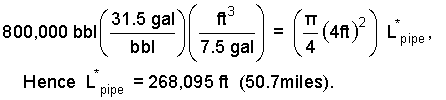
Put in a different way, right now, at the time t = 0+, way upstream at some unknown distance, L*, toward Prudhoe, a drop of oil is moving toward us with constant speed. That drop will pass here in precisely 24 hours. Also, at that time, the "entire mass" of oil contained by the pipe between here and the "drop" will have passed this location. We know the volume of that "entire mass" and we know diameter of its pipe. We use these facts to calculate the distance or length of the system of oil, L*.

Equating "right-of-equality above left" to "right-of-equality above right" yields:

The volume of oil arriving per day is 800,000 bbl (British barrel measure). The diameter of the pipe is four feet. and 1 = 31.5gal/bbl and 1= 7.5gallons/cu.ft.)
Now we choose to look at this delivery of oil as an event of "Uniform Motion." The system of our event will be the drop of "drop" we discussed above. Since we will deal with vectors, we fix an imaginary origin to the pipe at the location of the velocity gage. The actual pipe is not straight, but our answer will be correct. The initial and final position vectors of the drop are:

Uniform motion of a point in the oil is expressed as:
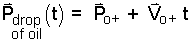
And upon substitution of our conditions (4),

At first it appears the answer is a negative speed while speed is zero or greater. The negative does not belong to the speed; it belongs to the direction ( - I ); meaning simply that the velocity is toward origin, the section of observation.
A second method: the mass equation
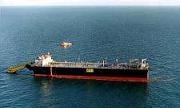 ♦ A second way of determining the oil flow velocity is to visualize the filling of an empty oil barge. The image, barge Douglas M., is empty and has the hold dimensions, 820 by 120 by 40 feet.
We take the mass of oil in the hold as our system. We represent that mass functionally at two arbitrary instances times which are:
Next we subtract the later from the former. That group is called a "difference."
Now we divide the difference by the increment of time, Δt. What we have now is a "difference quotient."
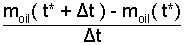
The teachings of Newton (and/or Leibnitz) are now applied as we "take the limit" of the quotient as Δt → 0. The resulting form is the pivotal entity of calculus, the derivative. In this case the derivative represents physically the rate rate of change of mass in the hold.

The rate of change of mass of oil within the tanker equals the constant mass rate (m-dotin) at which oil flows into the tank. Our simple differential equation becomes:
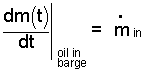
Solving for the flow speed
We developed this first order differential equation because some readers might not be familiar with it. The mass flow across the system boundary, m-dotin, equals the oil density time pipe area times flow speed. We now use constant hold geometry ( Abarge ) and constant density of oil to change the equation variable from mass to depth of oil, H(t).
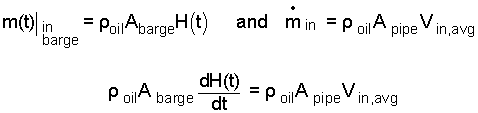
The velocity of oil delivered in the pipe, Vin,avg is the answer we seek. As the tanker is filled, the depth of oil, H( t ), increases from zero to a second height. A simple calculation gives the oil depth after 800,000 barrels are loaded.
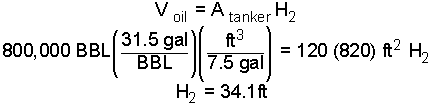
For this differential equation we have that the initial depth of oil in the tank, D( t = 0+) equals zero and the depth 24 hours later is D( t = 24 hr) is 34.1 feet. So we separate variables and integrate:
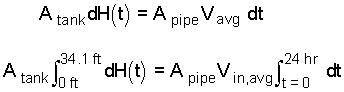
Entering numbers...
