|
 |
Glass riddle |
 |
Nov11-07, 08:33 AM
|
Last edited by Andre; Nov11-07 at 08:38 AM..
#1
|
Andre is
Online:
Posts: 4,072
|
Glass riddle
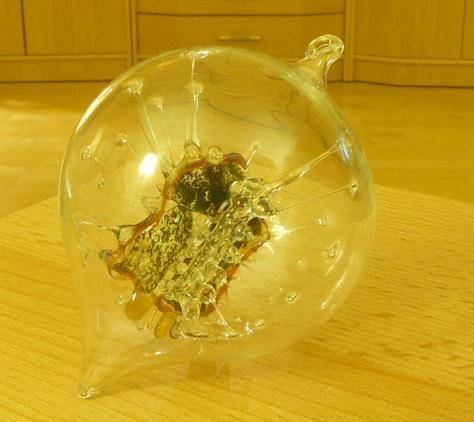
Bought these two glass bulbs at a local art fair, the other month
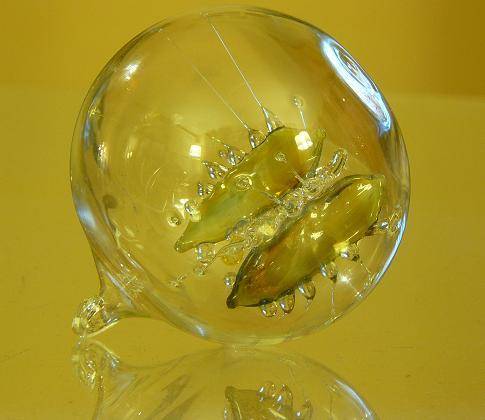
Size and shape as in Christmass tree balls, of hand blown glass but with a complex delicate glass object inside.
Looks like ship in a bottle, but how do you get an object like that inside during the glass blowing process?
|
|
|
|
Nov11-07, 09:36 AM
|
#2
|
turbo-1 is
Offline:
Posts: 4,803
|
You can first produce a glass sphere (the easiest shape to blow) or cylinder, cut it open, insert the ornament and reheat the shell to melt the tips of the filaments on the ornament and seal the bulb.
|
|
|
|
Nov11-07, 11:19 AM
|
Last edited by DaveC426913; Nov11-07 at 11:24 AM..
#3
|
DaveC426913 is
Online:
Posts: 8,943
|
Originally Posted by turbo-1
You can first produce a glass sphere (the easiest shape to blow) or cylinder, cut it open, insert the ornament and reheat the shell to melt the tips of the filaments on the ornament and seal the bulb.
|
I don't think they cut the bulb open to insert the ornament.
I suspect they keep a hole open in the end of the bulb and build the ornament within it.
One piece of evidence of this is that, if they could build the ornament free of the constraints of the bulb, it would likely be a MUCH more complex and skillfully made ornament. The fact that the ornament is quite ... freeform ... suggests to me that the creation process is extremely compromised - like, say because they're being constructed ship-in-a-bottle-style.
|
|
|
|
Nov11-07, 11:26 AM
|
#4
|
turbo-1 is
Offline:
Posts: 4,803
|
Originally Posted by DaveC426913
I'm not sure they cut it open to insert the ornament.
|
Look at the top ornament and notice the flattened thicker glass at the top right. That's probably where the initial bottle/bulb was opened. They would have to use a large opening to insert the ornaments with all those thin glass filaments. Then as they reheated the bulb to reform it and seal it, the bulb contracted against the tips of the filaments and melted them.
|
|
|
|
Nov11-07, 11:47 AM
|
#5
|
rewebster is
Offline:
Posts: 797
|
Originally Posted by turbo-1
Look at the top ornament and notice the flattened thicker glass at the top right. That's probably where the initial bottle/bulb was opened. They would have to use a large opening to insert the ornaments with all those thin glass filaments. Then as they reheated the bulb to reform it and seal it, the bulb contracted against the tips of the filaments and melted them.
|
I sort of agree with you---to add a little---it may have been a tube of glass where that inner item or really the hobnails of it touched the inner walls, when the tube was reheated, one end closed, and blown to expand to become round, the expansion pulled the hobnails that had attached to the inner walls to string--then the end was closed.
|
|
|
|
Nov11-07, 11:51 AM
|
#6
|
Moonbear is
Offline:
Posts: 11,761
|
I wonder if it's more that they used something with a slightly higher melting temperature for the inner "glob" and surrounded it by the glass before blowing to get the glass to stick to some of it. Those fine spindles attaching the glob to the sides look way too thin and in the second one, too numerous, to have been placed individually in a cut piece.
Of course, we wouldn't have to be guessing if Andre had just asked the artist when he bought them at the fair.  I've never had trouble getting an artist to tell me more about their work at an art fair...I have had trouble getting them to STOP telling me more about their work.
|
|
|
|
Nov11-07, 11:54 AM
|
#7
|
rewebster is
Offline:
Posts: 797
|
Originally Posted by Moonbear
I wonder if it's more that they used something with a slightly higher melting temperature for the inner "glob" and surrounded it by the glass before blowing to get the glass to stick to some of it. Those fine spindles attaching the glob to the sides look way too thin and in the second one, too numerous, to have been placed individually in a cut piece.
Of course, we wouldn't have to be guessing if Andre had just asked the artist when he bought them at the fair. I've never had trouble getting an artist to tell me more about their work at an art fair...I have had trouble getting them to STOP telling me more about their work.
|
he probably did---and just want to check how far we can be off with 'guesses'
|
|
|
|
Nov11-07, 11:57 AM
|
#8
|
Moonbear is
Offline:
Posts: 11,761
|
Originally Posted by rewebster
it may have been a tube of glass where that inner item or really the hobnails of it touched the inner walls
|
Now that sounds like the best explanation so far. Start blowing the globe, then insert the center part when there's room to get air around it to only blow the outside, but still small enough to allow contact.
I wonder if the rest of the artist's collection had a lot of green glass in it, from remelting all the ones where the inner piece didn't stick where it was supposed to.
I like how the first one looks like pickles inside it.
|
|
|
|
Nov11-07, 12:02 PM
|
Last edited by rewebster; Nov11-07 at 12:23 PM..
#9
|
rewebster is
Offline:
Posts: 797
|
I knew and hung around a glass blower 'artist' ---amazing use of the plasticity
--------------
I have a small collection of art glass too, and have read about Tiffany, Loetz, Pairpoint, etc.
---------------
I've tried to make some stuff--all you need is some tools and a propane torch
|
|
|
|
Nov11-07, 01:19 PM
|
#10
|
DaveC426913 is
Online:
Posts: 8,943
|
Originally Posted by Moonbear
Now that sounds like the best explanation so far. Start blowing the globe, then insert the center part
|
Question: if they were going to insert the inner piece in anything like partly-assembled condition, there would be virtually no limit on how much care and attention they could put into it before inserting. Instead of an amorphous blob of colour, why wouldn't they be inserting fully fiinished pieces like hummingbirds and beautiful flowers? I mean, that inner shape, - if you took it out of the bulb thus and out-of-context - is not exactly state-of the art blowing.
|
|
|
|
Nov11-07, 01:36 PM
|
#11
|
rewebster is
Offline:
Posts: 797
|
Originally Posted by DaveC426913
Question: if they were going to insert the inner piece in anything like partly-assembled condition, there would be virtually no limit on how much care and attention they could put into it before inserting. Instead of an amorphous blob of colour, why wouldn't they be inserting fully fiinished pieces like hummingbirds and beautiful flowers? I mean, that inner shape, - if you took it out of the bulb thus and out-of-context - is not exactly state-of the art blowing.
|
it came out of an art fair --not an art gallery---those may not have cost more than $20-30 each---I bet the artist did have more expensive items, too
|
|
|
|
Nov11-07, 01:44 PM
|
#12
|
Andre is
Online:
Posts: 4,072
|
No, she was happy to talk a lot but not how she did it. The only thing the artist told that she needed some 15 years to get to this result. She showed earlier work in which the fibres connecting the bulb with the ornament clearly distorted the round shape quite a bit.
These were among the first 'round'ones.
|
|
|
|
Nov11-07, 02:31 PM
|
#13
|
rewebster is
Offline:
Posts: 797
|
then, she may have had to find a way to shrink/vacuum the tube down against the hobnails--then, when connected to the inner walls, enlarge and pull the fibers making the threading in the ball --all while not melting the fibers and still hot enough to be able to blow it into a ball shape
|
|
|
|
Nov11-07, 03:08 PM
|
#14
|
FredGarvin is
Online:
Posts: 5,036
|
My guess is that the inner part was a small "billet" of glass that had the outer glass wrapped around it at the end of a tube. The tube would have an inner and outer flow path. The two are heated together to make them flow. Air is introduced in the outer flow path to get the outer sphere to start growing. Air is then introduced into the inner at a slower rate.
I am guessing that the strands that go from the inner to the outer surface are created while still hot by poking a sharp tool through the outer and into the inner part. The tool is then pulled back out, pulling the inner strand with it.
That's my guess anyways.
Those are really cool looking ornaments. My wife would LOVE one of those.
|
|
|
|
Nov11-07, 04:11 PM
|
#15
|
Andre is
Online:
Posts: 4,072
|
okay i'll see if I can trace her back and see what's possible.
|
|
|
|
Nov11-07, 06:12 PM
|
#16
|
zoobyshoe is
Offline:
Posts: 4,460
|
Originally Posted by Andre
okay i'll see if I can trace her back and see what's possible.
|
I think they're beautiful, especially the top one, which has a kinda venus fly trap thing going on, and I can see that the fibers attached to the inside wall must be a very difficult effect to achieve.
|
|
|
|
|
 |
 |
|
 |
|