Projectile Arcs Intersect
A body is projected from a point O on horizontal ground with speed of 70 m/s. It passes through a point P, which is 45 m above the ground and 50 m horizontally from O.
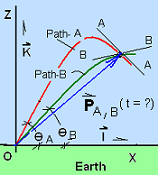 i) Calculate the tangents of the two possible angles of elevation of the projected body.
♦ Friction is assumed zero. The only applicable force is gravity, which acts in the -K direction. Assume elevations are small such that gravity is constant at its surface value. The space of the flight will be an arbitrary OXZ plane.
This is a "Work in Progress."
Two independent events are in consideration. We call them Event-A and Event-B. Newton's Second Law and the physical conditions of the events are shown in the table.
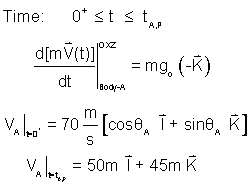

The "domain of time" for Body-A commences at the time t = 0+. We use the notation "zero-positive" to mean the instant after the event commenced. The last time of interest of Body-A is t = tp,A. This time is not known This is that instance Body-A arrives at the position P.
The above equation sets show only one difference, the angle of elevation upon launch." We will work on Set-A. The table below shows and explains the steps.
(i) 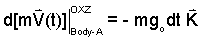 In this equation, there are two variables. Momentum of Body-A is the dependent variable mV(t). Time is the independent variable. To multiply the Newton's Second Law by dt separates variables: momentum on the left and time right-of-equality." |
(ii)  Next we "integrate the equation." Since the integral is a linear operator, integration symbols arrive ahead of the terms left and right of the equality. With this step, limits are also specified for the integration. The lower limit (nearly always) corresponds to the commencement of the event, to time equal to zero-positive. For the upper limit we choose the variable time of Event-A, tA (Other choices for the upper limit might be valid but by experience this is the way to go). |
(iii) Both integrals of step (ii) have "1" as integrand. The differentials of such integrals are called "exact." (If the integrand is "1", the integral gets a special, but needless title ~ exact). Such integrals integrate
|
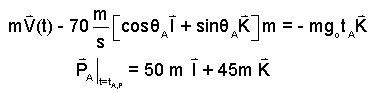
(iv) The above result can be made more specific. We know the initial speed (V(t=0+) and we have identified the launch angle as θ1. Enter these into the above equations. Finally, for this phase, write our result along with the special position given us: |
 readily to yield the difference of their differential variables, that is the value of the variable at the upper limit minus the value at the lower limit.