Ocean of Air - its Average Density
Earth is spherical, our atmosphere is a spherical shell of gases. The Earth diameter is about 6,380 kilometers and the depth of the atmosphere above its surface is about 30 kilometers. The standard atmospheric pressure, an average value for the Earth surface is 101.3 kPa.
 Estimate the average density of the Earth atmosphere.
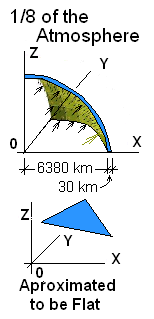
♦ As system take one-eighth of a shell of atmospheric gases.
The thickness of the mass of air at its boundaries is very small in comparison the length of its boundary. This permits us to approximate its shell shape as a flat surface being 30 kilometers thick with an area one-eighth the surface area of Earth. We imagine the area to be made flat with its lower surface its contact surface with Earth. The summed effect of a distributed pressure acts over the bottom, flat surface of atmospheric gas, to support it. The pressure acting over the top is taken to equal zero. Applying Newton's Second Law, we have:
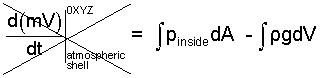
The error in taking the acceleration of gravity constant and equal to the surface value is negligibly small.


From which we obtain:
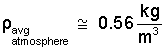
The answer is approximate of course. But since the surface density is about 1.2 kg/m3, and density decreases with elevation, the above number seems reasonable.