FRICTIONLESS ADIABATIC EXPANSION (or compression).Example - SIMPLE AIR PISTOL
pBAbullet end
pB = p
pTv
Tv
The development presented here is very important. Its steps are is repeated in .
The pressure of this equation is at the boundary of the air where its boundary displaces. This location is the area immediately behind the bullet. The work of the air equals the pressure-force pushing the bullet, times its displacement. As the bullet moves through the barrel, to continue to push it, air must flow very quickly from the large chamber into the barrel. Friction (loss of pressure with local tem0perature increase) will occur, particularly at the sharp-edged entrance where the air enters the barrel.
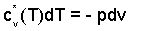
The friction we are discussing occurs "inside the the air." There is friction of the bullet in the barrel also. Beginning level methods are incapable of dealing with friction. With the barrel, we just ignor friction. To ignore friction in the air we assume its pressure decreases as it expands, but does so without friction, uniformly throughout all of the air. This means we assume, for the air for all stages of its expansion. With this change, we arrive at a simple differential equation for the air. The equation and its conditions are:
pistol_eqn_9
The first step of solution is to use the gas equation to replace with and . Then separate the variables and integrate.
pistol_eqn_11
By the rules of natural logarthms, the expression above right can be cast as a process path for the frictionless adiabatic expansion (or compression of a gas). Our immediate result has and as variables. Substitutions using the gas equation with a workout in dealing with exponents yield an equation form with T and p and another with p and v as variables. These are included here for completeness.
pistol_eqn_12
The left most form applies to our air pistol. Entering our numbers, the second temperature of the air is determined to be 267 K.
pistol_eqn_13
It is now possible to solve for the exiting velocity of the bullet.
pistol_eqn_14