THERMO Spoken Here! ~ J. Pohl ©
TOC ~ 169

Average Force to Brake

As a driver in a car traveling at 60 km/hr approaches an intersection, the light suddenly changes. The driver applies full breaks until the car stops. If the vehicle (plus driver) mass is 1075 kilograms and the deceleration is constant over the 5 seconds of stopping, calculate the average force that acts at the points of tire-to-road contact.

For an actual event, constant deceleration would be unusual. Here we solve 'however so the deceleration" might vary over the 5 seconds.
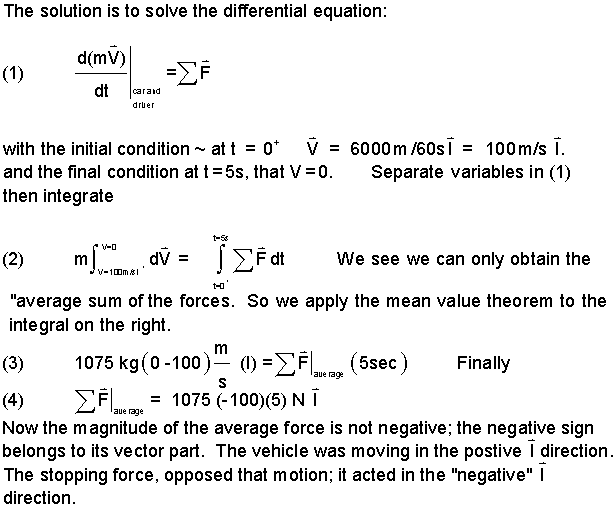
The solution is to solve the differential equation: (1) d(mV)/dt (car and driver) = ΣF, with the initial condition at t = 0+, V = 6000 m/60 s I = 100 m/s I, and the final condition at t = 5 s, that V = 0. Separate variables in (1), then integrate: (2) m ∫ from V = 100 m/s I to V = 0 of dV = ∫ from t = 0+ to t = 5 s of ΣF dt. We can only obtain the average sum of the forces, so we apply the mean value theorem to the integral on the right: (3) 1075 kg (0 − 100)(m/s)(I) = ΣF_average (5 sec). Finally (4) ΣF_average = 1075 (−100)(5) N I. The magnitude of the average force is not negative; the negative sign belongs to its vector part. The vehicle was moving in the positive I direction; the stopping force opposed that motion and acted in the negative I direction.