Cardiac "Horsepower"
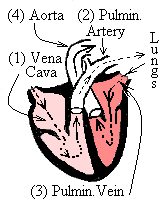
While your body is at rest your heart beats some 70 times a minute. Its rhythmic contractions causes about 5 liters of blood to circulate to your toes, back and elsewhere throughout your body. Your heart pumps your blood twice.
The blood flow returning from the body to the heart enters via the vena cava (1) with a low velocity and an average pressure of 10 millimeters of mercury. Next the heart pushes blood into your lungs. That flow exits the heart by the pulmonary artery (2) again at low velocity and 30mm of mercury. Returning from the lungs through the pulmonary vein (3) the pressure of the oxygenated blood flow is about 10mm Hg. Finally, the heart routes the blood through the aorta, exiting at 100 mm Hg to flow back (4) to your toes and other important (at rest) places. The heart of an engineer is just another pump! Right? Use the data, make some assumptions.
Estimate the horsepower of a human heart at rest.
♦ The human heart is a two stage, pulsating, transient acting, biological device. The volume of the heart decreases with each beat (as whoever designs artificial hearts will tell you).
Note: Data, taken from typical sources, have inconsistent and "unpreferred" units. Principles of calculation are correct: problems with units are "ironed to conformity" in the last equation yielding answers.
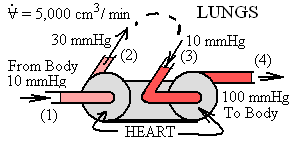
As a first approximation we assume a heart that operates in a steady fashion; not a "beat after beat" but more like the steady hum of an aquarium pump. With this assumption the arrangement of the heart chambers can be modeled as a pump having two stages. We assume the heart pumps in a steady fashion. Approximate blood as incompressible water. The mass rate will be needed:

In setting up the energy equation, the change of energy of the blood while in the heart is zero (dE/dt = 0). We write "energy with mass flow" in two pieces which are energy changes of the "first stage" and the "second stage" of the heart. The potential and kinetic energies differences, "entering (in) minus leaving (out)" are assumed very small.
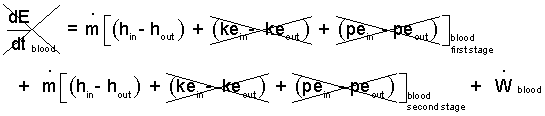
The mass rates are equal through each stage. The enthalpies contain internal energies of the blood. We assume the entering and leaving internal energies are equal such that what remains are p/ρ terms.

There are four pressures involved. Pressure is dealt with the same way always. We will do all four terms:

Terms are collected. Check to confirm this result is correct. Care has been taken to keep the density of mercury and blood properly involved.
(−110 mm)(m/1000 mm) + Ẇ_blood; 0 = −1.22 watts (hp/746 W) + Ẇ_blood ⇒ Ẇ_blood = 0.002 hp](pump_5.gif)
Our calculations show work to the blood as positive. In passing through the heart the blood gains 0.002 horsepower of energy. From the standpoint of the heart, energy passed from it to the blood in the amount:

A second check of the equation-stream shows the resulting minus sign to be correct. Also, the physics is correct; The energy transfer (work of the heart) is energy that passes from the heart muscles to become energy of the flowing blood.