View Full Version : Electric circui parameters
liucibegemoc
May2-06, 10:52 AM
Hello.
I have an electric circuit that's made from conductors, resistors and coils.
I needed to find a voltage between two points and I did. Got answer that plot is:
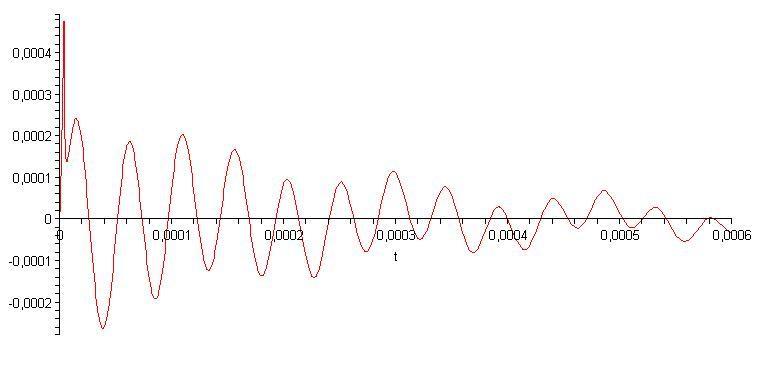
6828
I need to find electric circuit parameters like resonance, degression constant and other.
My teacher said something about finding zeros of current equation denominator.
Sorry for my English, but I'm in trouble. Please help me.
berkeman
May2-06, 11:09 AM
It looks like you've plotted current versus time? What is the equation for the current versus time based on the circuit that you are testing? The parameters like resonant frequency and damping constant can be derived from the i(t) equation, and checked against the data plot.
liucibegemoc
May2-06, 11:31 AM
Hi.
Thanks. This is plot of voltage over time. And it's equation is very huge.
I also have current over time and plot:
6829
How can I find all those circuit parameters?
And equtaion i(t) is:
funk := 0.5620773930e-4*Heaviside(t-0.4000000000e-5)*
exp(-3682527.090*t+14.73010836)-0.1174739794e-5*
exp(-3937.865780*t)*cos(133298.0502*t)-0.4341766870e-7*
exp(-3937.865780*t)*sin(133298.0502*t)-0.1429572824e-4*
exp(-571.4260766*t)*cos(35731.92305*t)+0.1268711907e-5*
exp(-571.4260766*t)*sin(35731.92305*t)-0.4451456129e-4*
Heaviside(t-0.4000000000e-5)*exp(-938125.1264*t+3.752500506)-
0.2695421453e-4*Heaviside(t-0.4000000000e-5)*
exp(-5398.616627*t+0.2159446651e-1)+0.1179385884e-5*
Heaviside(t-0.4000000000e-5)*exp(-3937.865780*t+0.1575146312e-1)*
cos(133298.0502*t-.5331922009)-0.5836283136e-6*
Heaviside(t-0.4000000000e-5)*exp(-3937.865780*t+0.1575146312e-1)*
sin(133298.0502*t-.5331922009)+0.1408171837e-4*
Heaviside(t-0.4000000000e-5)*exp(-571.4260766*t+0.2285704306e-2)*
cos(35731.92305*t-.1429276922)-0.3309067451e-5*
Heaviside(t-0.4000000000e-5)*exp(-571.4260766*t+0.2285704306e-2)*
sin(35731.92305*t-.1429276922)+0.4093686070e-5*
exp(-3682527.090*t)-0.1617240812e-4*
exp(-938125.1264*t)+0.2754912314e-4*exp(-5398.616627*t)
berkeman
May2-06, 12:00 PM
Hi.
Thanks. This is plot of voltage over time. And it's equation is very huge.
The vertical scale of your first plot is in Volts? So your waveform is in the milliVolt range? And how many components are in the circuit? If it's just an RLC, the equation won't be huge.
Curious3141
May2-06, 12:24 PM
The vertical scale of your first plot is in Volts? So your waveform is in the milliVolt range? And how many components are in the circuit? If it's just an RLC, the equation won't be huge.
That equation looks like classic blind best curve fitting.:rofl:
Gosh, even the Heaviside function is inside!
liucibegemoc
May2-06, 01:03 PM
yeah.
it's RLC circuit and the Voltage source is dependent from time.
But how can I find circuit parameters from i(t) function?
berkeman
May2-06, 05:43 PM
yeah.
it's RLC circuit and the Voltage source is dependent from time.
But how can I find circuit parameters from i(t) function?
When you solve the differential equation for i(t), the solution will include terms for things like the damping constant and resonant frequency. Can you write the homgenous differential equation for the circuit excluding the voltage source?
liucibegemoc
May3-06, 12:18 AM
yes of course, but it will be in laplace form. after making an inverce laplace transformation I get i(t). And I made voltage source 1000V. So there won't be any Heviside functions left.
Here you go:
I3(p) := 0.9090909090e14*p*(0.5946291561e23+0.2536345448e14 *p^2+0.5477237852e17*p+12264000.*p^3+1134.*p^4)/
(0.1056757215e46+0.1413175209e37*p^2+0.1985730159e 42*p+0.1663723689e33*p^3+0.3449827174e27*p^4+0.883 2606692e22*p^5+0.1156357118e17*p^6+2494800000.*p^7 )
liucibegemoc
May4-06, 05:41 PM
somebody please tell me how to find damping constant and resonance frequency from i(p) (laplace form of current).
Thanks
Ouabache
May4-06, 06:20 PM
Perhaps putting your equation in more compact form will make analysis easier. If it may be assumed that the first "open parenthesis" in the numerator (of your equation in #8) was misplaced, one form for your equation would be:
I(p) = \frac {\sum_{i=0}^{4} m_i p^i}{\sum_{j=0}^{7} n_j p^j}
liucibegemoc
May4-06, 11:46 PM
yes.but that doesn't help me at all. i need theoretical equation of how can i find damping constant and resonance frequency. i have found some on www, but that was only second level equation like p^2a+pb+c=0. This have only two zeros and they can be used by calculating those constants. Now I have a lot of zeros.... don't know what to do.
Ouabache
May6-06, 08:42 PM
You're right, an RLC circuit (http://en.wikipedia.org/wiki/RLC_circuit) (comprised of a resistor, capacitor and inductor) is represented by a 2nd order differential equation. The LaPlace transform of i(t) will have 2 zeros. Since you began with a circuit, you will know how many capacitive and inductive elements you have and the denominator of your equation should reflect that.
Since you're expressing the equation with 10 decimal precision, it appears you are using software to generate your equation. If that's true, I would explore the help files in your software toolkit, it may give you the format of the parameters you're looking for, as defined functions. Or it may indicate a pieces of code you can use to calculate them.
liucibegemoc
May7-06, 11:28 PM
Oh. Thanks for a repy! Yes, I'm using Maple. Will try
vBulletin® v3.8.7, Copyright ©2000-2012, vBulletin Solutions, Inc.