PDA

View Full Version : Urgent: Please Explain Friction Graph


petern
Oct23-07, 10:17 PM
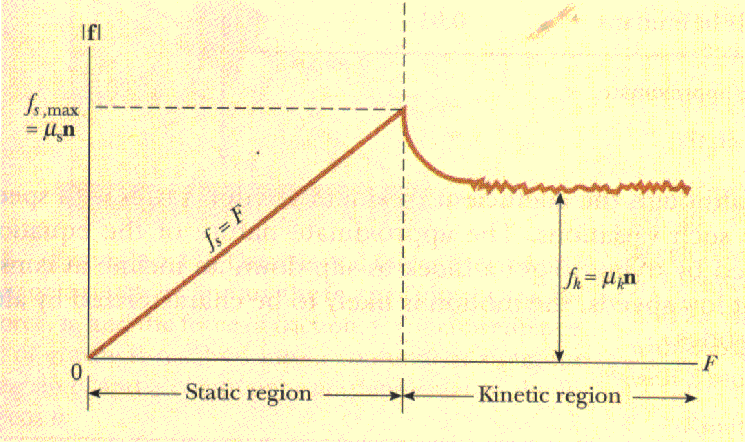
Here is a pic of the graph:

http://i24.tinypic.com/2h7pfn4.gif

Can someone explain to me what each of the four segments represents (not shown but assume there is a horizontal line at 0 for the first few seconds)? I am especially confused about the third segment where it suddenly drops from the peak.

Then, please answer and explain:

Identify the segment(s) where the tension was greater than the friction force. (I chose 3rd and 4th but it's wrong)

Identify the segment(s) where kinetic friction was opposing the motion. (I chose 4th but it's wrong)

Identify the segment(s) where the tension force equaled the friction force. (I chose 2nd but it was wrong)

Math Jeans
Oct23-07, 10:43 PM
You are supposed to show an attempt at the answers, but I'll answer one part for you.

The reason that the graph suddenly drops from the peak is because the force on the object has reached the peak of the static friction which then converts to kinetic friction when it starts moving. Static friction will be equal to the amount of force that you apply to the object until you reach its peak. That is why it is called static friction, because the object won't move. Kinetic friction is the friction after static friction is peaked and the object is moving. Because the more force you apply on the object, the faster it goes, it is reasonable to suggest that the kinetic friction is nearly constant.

Suppose you have a big textbook lying on a table. You will notice that when you push on the textbook lightly, it will not move, however, if you keep pushing harder, eventually you will notice that the book will jolt forward and move smoothly as long as you don't stop it again. When it jolts, you have overcome the static friction, and the now weaker force against your pushing is kinetic friction.

petern
Oct23-07, 11:07 PM
You are supposed to show an attempt at the answers, but I'll answer one part for you.

The reason that the graph suddenly drops from the peak is because the force on the object has reached the peak of the static friction which then converts to kinetic friction when it starts moving. Static friction will be equal to the amount of force that you apply to the object until you reach its peak. That is why it is called static friction, because the object won't move. Kinetic friction is the friction after static friction is peaked and the object is moving. Because the more force you apply on the object, the faster it goes, it is reasonable to suggest that the kinetic friction is nearly constant.

Suppose you have a big textbook lying on a table. You will notice that when you push on the textbook lightly, it will not move, however, if you keep pushing harder, eventually you will notice that the book will jolt forward and move smoothly as long as you don't stop it again. When it jolts, you have overcome the static friction, and the now weaker force against your pushing is kinetic friction.

Thanks for the reply, but I did show an attempt. I put in parenthesis the answers I chose but they were wrong. According to your explanation, the second segment (where there is static friction) would have tension that is equal to the friction force. I don't understand why this was marked wrong.

petern
Oct23-07, 11:28 PM
Delete. I accidentally posted twice.