Xkcd: Web Comics for Smart Masses

  • Thread starter Thread starter D H
  • Start date Start date
  • Tags Tags
    Comics Web
Click For Summary

Discussion Overview

The discussion revolves around a problem presented in an xkcd comic related to calculating resistance in an infinite grid of resistors. Participants explore various mathematical approaches, including the use of Fourier transforms and superposition, while also engaging in humorous commentary about the comic itself.

Discussion Character

  • Exploratory
  • Technical explanation
  • Debate/contested
  • Mathematical reasoning

Main Points Raised

  • Some participants propose that a discrete Fourier transform is necessary to solve the resistance problem, suggesting that simple superposition may not yield the correct answer.
  • Others mention that an integral derived from the Fourier transform leads to a complex expression that requires evaluation, with one participant seeking assistance in computing it.
  • A participant references a different expression from an external article that yields a resistance value of approximately 0.773 ohms.
  • There is a humorous exchange about the difference between a normal person and a scientist, highlighting the tendency for "nerd sniping" to occur when engaging with such problems.
  • One participant shares an anecdote about a friend who was distracted by the comic, illustrating the comic's impact on individuals with a scientific background.
  • Another participant clarifies that the resistance between adjacent nodes is exactly 0.5 ohms, while noting that this value changes for nodes further apart, suggesting a discrepancy in the expected results.
  • Some participants express uncertainty about the accuracy of their calculations and the implications of using inexpensive resistors in practical scenarios.

Areas of Agreement / Disagreement

Participants express differing views on the methods to calculate resistance and the resulting values, indicating that multiple competing approaches and interpretations remain unresolved.

Contextual Notes

Some participants reference external articles and mathematical expressions that are complex and may depend on specific assumptions or definitions. There is also mention of practical limitations when using inexpensive components.

Who May Find This Useful

This discussion may be of interest to those engaged in physics, electrical engineering, or mathematics, particularly in the context of theoretical problems involving resistive networks.

D H
Staff Emeritus
Science Advisor
Homework Helper
Insights Author
Messages
15,524
Reaction score
768
From "xkcd.com"[/URL] :

[ATTACH=full]120592[/ATTACH]
 

Attachments

  • nerd_sniping.png
    nerd_sniping.png
    37.6 KB · Views: 682
Last edited by a moderator:
Physics news on Phys.org
Is it 0.916333... ohms?

Damn, I missed dinner! :mad:
 
Gokul43201 said:
Is it 0.916333... ohms?

Damn, I missed dinner! :mad:

How did you get that? I think that to solve such problems (where a simple superposition doesn't give you the answer), a discrete Fourier transform is required, and then the final integral which gives the resistance looks very tricky.
 
D H: 4 points (or is it 2 and 1, for the engineer? :-p)
 
At least three points, since I made Gokul miss dinner.

This http://arxiv.org/abs/cond-mat/9909120" , question 10) uses a different expression and that enables Mathematica to yield (8-\pi)/(2\pi)\approx0.773 ohms.
 
Last edited by a moderator:
D H said:
This http://arxiv.org/abs/cond-mat/9909120" (see appendix A) gives an absolute mess.

The article uses the same principle of taking the Fourier transform and applying ohm's law. The integral one gets after the Fourier transform is (eqn 25 in the article)

\frac{1}{4 \pi^2} \int_{-\pi}^{\pi} \int_{-\pi}^{\pi} \left( \frac{1-\cos(2x+y)}{2-\cos{x} - \cos{y}} \right) dx dy.

I'm at home and don't have access to an integrator. Does anyone have access to a math package that evaluates this integral, or a way to find the value? Does it come out as (8-\pi)/(2\pi)\approx0.773?

Mathworld seems to have used some substitution in its expression.

EDIT: Nevermind. They've apparently used a contour integral and then a substitution. It's there in appendix A, which I missed the first time.
 
Last edited by a moderator:
The difference between a normal person and a scientist:
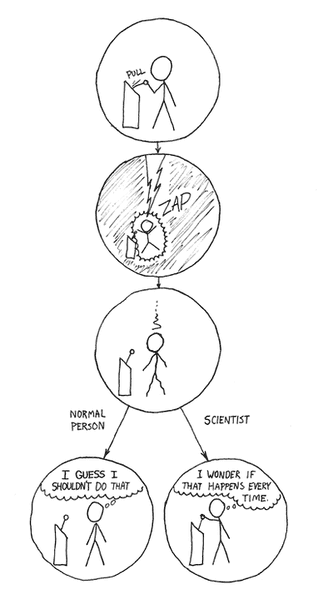
the_difference.png
 
D H said:
The difference between a normal person and a scientist:

the_difference.png
:smile:
 
That's actually a normal person and Homer Simpson => Homer = Scientist??
 
  • #10
siddharth said:
How did you get that? I think that to solve such problems (where a simple superposition doesn't give you the answer), a discrete Fourier transform is required, and then the final integral which gives the resistance looks very tricky.
I actually did use a superposition - I don't know why it fails! =(

I haven't yet looked at the article posted by D H.
 
Last edited:
  • #11
It's funny how this thread turned into a discussion about the problem in the comic strip rather than the humour about it.
 
  • #12
Oerg said:
It's funny how this thread turned into a discussion about the problem in the comic strip rather than the humour about it.

It just proves the first sketch of the comic strip. Nerd sniping in action.
 
  • #13
D H said:
From "xkcd.com"[/URL] :

[/QUOTE]
A friend of mine finished school some years ago with a BS in physics and immediately chucked it all to become a lawyer. After seeing this Nerd Sniping XKCD strip I sent it to him on a workday to see if he was truly a lawyer or if he would be sniped, along with with full disclosure of my intentions. Couple days later I checked back, sure enough, four billable hours went down the drain. :devil: Good thing he wasn't standing in the road.

BTW, engineer's solution: assume the infinite grid looks like a short to anyone node except for the four resistors directly attached into the node. The parallel resistance into the node then is 1/4 ohm and therefore the resistance between any two, non-adjacent nodes is 1/2 ohm. With actual (cheap) 20% resistors that's close enough to the actual (.7xx is it?)
 
Last edited by a moderator:
  • #14
The resistance betweeb any two horizontally or vertically adjacent nodes is exactly 1/2 ohms. The resistance between nodes further apart than that is not. That 20% fudge on top of 0.5 ohms yields 0.6 ohms, not 0.773 ohms. Its even worse for nodes further apart than that.

Why don't you try working out the answer for nodes separated by two diagonal hops?:devil:
 
  • #15
D H said:
The resistance betweeb any two horizontally or vertically adjacent nodes is exactly 1/2 ohms. The resistance between nodes further apart than that is not. That 20% fudge on top of 0.5 ohms yields 0.6 ohms, not 0.773 ohms.
Yes, ok, :redface: I'll have to make clear I'm using really cheap resistors when I go for the Google interview. :wink:

Its even worse for nodes further apart than that.

Why don't you try working out the answer for nodes separated by two diagonal hops?:devil:
Think I'll code up a quick sim for fun.
 

Similar threads

Replies
11
Views
4K
  • · Replies 1 ·
Replies
1
Views
966
  • · Replies 3 ·
Replies
3
Views
2K
  • · Replies 6 ·
Replies
6
Views
2K
Replies
1
Views
2K
  • · Replies 2 ·
Replies
2
Views
1K
  • · Replies 9 ·
Replies
9
Views
4K
  • · Replies 1 ·
Replies
1
Views
4K
Replies
7
Views
4K
  • · Replies 2 ·
Replies
2
Views
2K