View Full Version : Permutation symbol - indicial notation
1. The problem statement and attempt at solution
Hey, I'm still trying to get my head around indicial notation. I'm finding it quite hard..
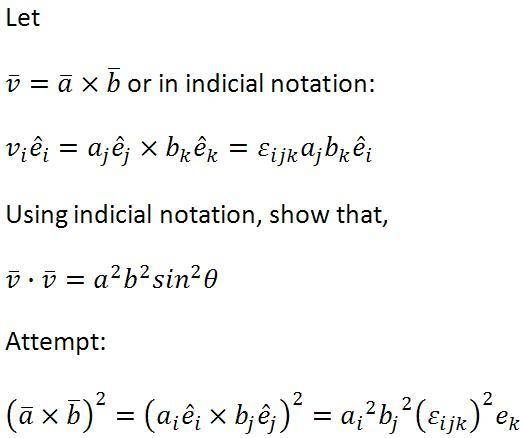
http://i163.photobucket.com/albums/t282/Calc_photos/21.jpg
I think this is somewhat right, but I don't know if the answer is clear enough..
Any hints/comments are greatly appretiated!
Thank you
HallsofIvy
Sep21-08, 07:29 AM
It would help if we knew what \theta was! The angle between \vec{a} and \vec{b}?
I think you need to add two things:
1) How you got from (a_i\hat{e}_i\times b_j\hat{e}_j)^2 to a_i^2b_j^2(\epsilon_{ijk})^2\hat{e}_k
2) Why \epsilon_{ijk} is equal to sin(\theta)
Pacopag
Sep21-08, 11:33 AM
Something important to note is that when you square an expression with indices, you can't re-use any of the "dummy" indices (i.e. the ones you sum over). You have to write out the second factor using different symbols for the dummy indices. You can't just raise everything to the power 2.
e.g. If you take the square of
v_i = \epsilon_{ijk}a_j b_k
you get
v_i^2 = (\epsilon_{ijk}a_j b_k)(\epsilon_{imn}a_m b_n)
You CANNOT write
v_i^2 = (\epsilon_{ijk})^2(a_j)^2( b_k)^2
Write the summations out in full for a small example and you'll see that this is true.
Pacopag:
you write that:
v_i = \epsilon_{ijk}a_j b_k
Does:
(\epsilon_{ijk}a_j b_k) = (\epsilon_{ijk}a_i b_j) ?
As for me not changing the indices when I took the square, that's exactly what I did :redface:
Thank you!
Pacopag
Sep22-08, 11:22 AM
(\epsilon_{ijk}a_j b_k) = (\epsilon_{ijk}a_i b_j) ?
No. On the left hand side you are implying a summation over the repeated indices j and k. On the right hand side you are implying summation over i and j. This is not the same thing. Furthermore, in
v_i = \epsilon_{ijk}a_j b_k ,
since i is not repeated in the left hand side, you are implying that i is fixed.
Do a google on the Einstein summation convention for more information.
v_i^2 = (\epsilon_{ijk}a_j b_k)(\epsilon_{imn}a_m b_n)
\epsilon_{ijk}\epsilon_{imn}=\delta_{jm}\delta_{kn }-\delta_{jn}\delta_{km}
(\delta_{jm}\delta_{kn}-\delta_{jn}\delta_{km})(a_ja_mb_kb_n)
a_ja_jb_kb_k - a_ja_kb_kb_j = a_j^2b_k^2 - a_ja_kb_kb_j
I'm so incredibly stuck :uhh:
HallsofIvy
Sep23-08, 08:07 AM
v_i^2 = (\epsilon_{ijk}a_j b_k)(\epsilon_{imn}a_m b_n)
\epsilon_{ijk}\epsilon_{imn}=\delta_{jm}\delta_{kn }-\delta_{jn}\delta_{km}
(\delta_{jm}\delta_{kn}-\delta_{jn}\delta_{km})(a_ja_mb_kb_n)
= (\delta_{jm}a_j)(\delta_{kn}b_n)a_mb_n- (\delta_{jn}a_j)(\delta_{km}a_m)b_kb_n
a_ma_m b_nb_n- a_na_kb_kb_n= a^2b^2- (a\cdot b)^2
a_ja_jb_kb_k - a_ja_kb_kb_j = a_j^2b_k^2 - a_ja_kb_kb_j
I'm so incredibly stuck :uhh:
a_na_n is a sum. It is equal to |a|^2 not a_n^2.
Alright, I get that but am still not able to solve the problem
Think I'll call it quits for now and do a bit more reading.
Looks like my head isn't ready for this yet :p
Thanks a lot though!
HallsofIvy
Sep24-08, 08:20 AM
I notice that you still haven't told us what \theta is. If it is, in fact, the angle between \vec{a} and \vec{b}, and you are using a and b to denote the lengths of those two vectors, then you probably want to use the very fundamental property that \vec{a}\times\vec{b}= ab sin(\theta).
Oh sorry, I totally forgot. Yes, theta is the angle between a and b.
v = (a x b) = (a_je_j x b_ke_k) = absin(\theta)
v_i = (\epsilon_{ijk}a_jb_k)=absin(\theta)
v_i^2 = (\epsilon_{ijk})^2a_j^2b_k^2=a^2b^2sin^2(\theta)
:redface:
vBulletin® v3.8.7, Copyright ©2000-2012, vBulletin Solutions, Inc.