Discussion Overview
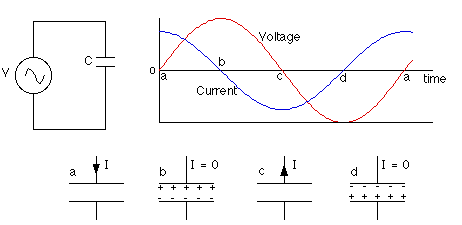
The discussion revolves around the representation of current and voltage curves in alternating current (A.C.) circuits, specifically addressing the differences in graphs found in various sources and the implications of these differences on understanding circuit behavior. The conversation includes technical explanations related to capacitors and inductors, as well as the mathematical relationships governing these components.
Discussion Character
- Technical explanation
- Debate/contested
Main Points Raised
- Some participants note that the relative positioning of current and voltage curves in graphs can vary, suggesting that it may be arbitrary.
- Others argue that scaling the y-axis of the graphs does not affect the underlying relationships, implying that the height of the curves is not significant.
- One participant presents mathematical relationships for capacitors and inductors, indicating that the ratio of voltage to current is frequency-dependent.
- A later reply attempts to clarify the phase shift between current and voltage in capacitors, explaining the mathematical derivation of current based on voltage and frequency.
- There is a request for clarification regarding the explanation of the voltage-current relationship, indicating some confusion among participants.
Areas of Agreement / Disagreement
Participants express differing views on the significance of the graphical representation of current and voltage, with some asserting it is arbitrary while others provide mathematical context. The discussion remains unresolved regarding the implications of these graphical differences on understanding A.C. circuits.
Contextual Notes
Participants have not reached a consensus on the importance of the graphical representation of current and voltage curves, and there are unresolved questions about the clarity of the mathematical explanations provided.