Solving for Tangential Speed of a Uniform Bar

  • Thread starter Thread starter wlvanbesien
  • Start date Start date
  • Tags Tags
    Speed Uniform
Click For Summary

Homework Help Overview

The problem involves a uniform bar released from a vertical position, with the goal of determining the tangential speed of one end as it strikes a horizontal surface. The context includes concepts of rotational motion, energy conservation, and the effects of a spring.

Discussion Character

  • Exploratory, Conceptual clarification, Energy conservation

Approaches and Questions Raised

  • Participants discuss using torques and moment of inertia, while others suggest applying energy conservation principles. Questions arise regarding the total energy at the beginning and end of the motion, as well as the components of that energy.

Discussion Status

The discussion is ongoing, with some participants offering guidance on energy conservation as a potential approach. There is a recognition of the complexity of the problem, and multiple interpretations are being explored without a clear consensus on the method to solve it.

Contextual Notes

Participants express frustration over the difficulty of the problem, indicating that it is challenging for the class as a whole. There is a focus on understanding the energy components involved in the system.

wlvanbesien
Messages
9
Reaction score
0
A 0.200 m uniform bar has a mass of 0.770 kg and is released from rest in the vertical position, as the drawing indicates. The spring is initially unstrained and has a spring constant of k = 28.0 N/m. Find the tangential speed with which end A strikes the horizontal surface.
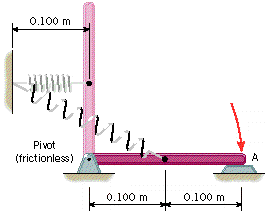
10_60.gif

(if the img doesn't work please enter http://www.webassign.net/CJ/10_60.gif into your browser)

---


I've been struggling with this problems for quite a while now.
I know that:
[tex]x = \theta r[/tex]

[tex]v _{f} = \frac{x}{t}[/tex]

Beyond these two simple steps I can't figure anything out... i tried experimenting by integrating with respect to theta and x, but it still didnt work out... any help would be great. Thanks.
 
Last edited:
Physics news on Phys.org
wlvanbiesen,

The first way I thought of was to consider the torques (there are two of them) that act on the rod. The rod has a moment of inertia about its pivot point, so you'd integrate angular acceleration over the time it takes for the rod to go from vertical to horizontal...That looked like a mess!

But then I thought of energy conservation! Give that a try; I think it will work.
 
I would use energy. You know the potential gravitational energy before and after and the potential spring energy after. The left over energy is the kineti energy (1/2)I omega^2, where I is the moment of inertia of the bar.

edit: Sorry, I didn't see that jdavel had already suggested this.
 
Nobody in the class can figure this problem out? Can anyone show me how to solve this exactly?
 
Did you try what krab suggested?

How much total energy is there at the beginnning? What are all the components of that energy? What do you know about the total energy at the end? What are the components of THAT energy?

If you give us answers to all those questions, and you're still stuck, we'll give you more help.
 

Similar threads

  • · Replies 4 ·
Replies
4
Views
6K
Replies
30
Views
2K
  • · Replies 41 ·
2
Replies
41
Views
5K
Replies
5
Views
3K
  • · Replies 3 ·
Replies
3
Views
2K
Replies
6
Views
3K
  • · Replies 3 ·
Replies
3
Views
8K
  • · Replies 2 ·
Replies
2
Views
2K
  • · Replies 17 ·
Replies
17
Views
4K
  • · Replies 1 ·
Replies
1
Views
16K