Kirchoffs Laws and Thevinen Equivalent

  • Thread starter Thread starter coldturkey
  • Start date Start date
  • Tags Tags
    Equivalent Laws
Click For Summary

Homework Help Overview

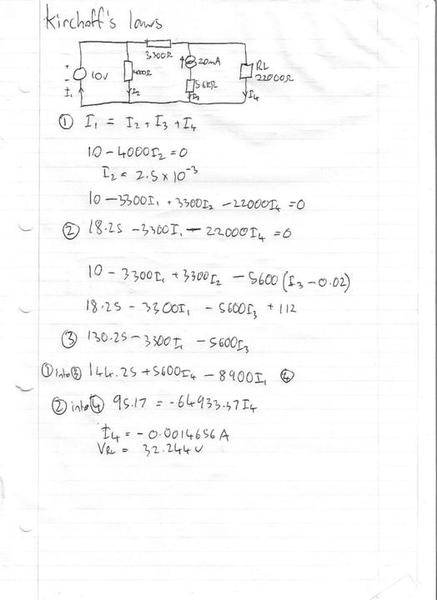
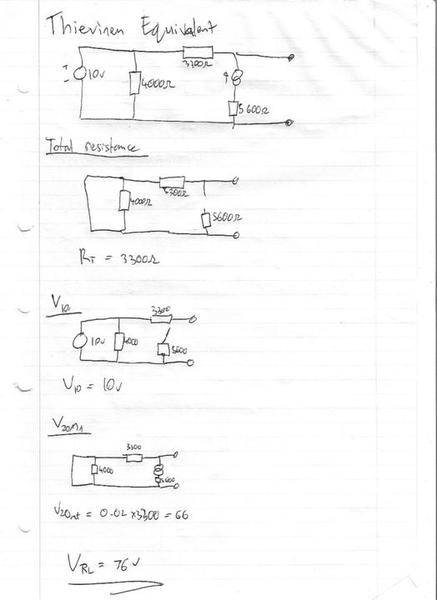
The discussion revolves around applying Kirchhoff's Laws and Thevenin's Theorem to analyze a circuit involving a resistor-inductor (RL) configuration. The original poster is seeking assistance in finding the voltage and current through the RL component using both methods, as they are obtaining different results.

Discussion Character

  • Mixed

Approaches and Questions Raised

  • The original poster attempts to solve the problem using both Kirchhoff's Laws and Thevenin's Theorem but encounters discrepancies in their results. Some participants suggest checking for sign errors and utilizing mesh current analysis for the Kirchhoff example. Others mention verifying results using circuit simulation software.

Discussion Status

Participants are actively engaging in identifying potential errors in the original poster's approach, with some offering specific suggestions for improvement. There is an acknowledgment of the correctness of the Thevenin voltage, while the Kirchhoff analysis remains under scrutiny. The discussion is ongoing, with no explicit consensus reached yet.

Contextual Notes

The original poster has shared their workings and a circuit diagram but expresses difficulty in identifying mistakes. There is mention of constraints related to software availability for circuit simulation, which may impact the verification of results.

coldturkey
Messages
25
Reaction score
0
I have a question here which asks me to find the Voltage and Current of RL in two different ways: using Kirchoffs Laws and then Thevinens Theorem.

I have tried it a couple times and get different answers using each method.

Perhaps somebody could tell me where I have gone wrong or if somebody that has access to multisim or some other circuit emulator could enter in the circuit and tell me what the answer is that would be a huge help.

Attached is my workings and a picture of the circuit.
P.s. sorry for the handwriting (its my quick working writing).

Many thanks
Untitled1212.jpg

Untitled123123.jpg
 
Physics news on Phys.org
Your Vth is correct in the thevenin example, it is indeed 76 Volts. I'm guessing you messed up a sign somewhere in the Kirchoff example--- being the nice person I am I'll try to find it for you :D

Also I'll check your Thevenin Rth by using a short circuit current method.
 
Whoops nm i didnt know that they gave you the resistance of the load! With that in mind, with your Thevenin voltage you can easily find the current through the load.
 
For your Kirchoff example, I found your mistake--- although your method is on the right track, you would do well to make use of Mesh Currents... that is, instead of labeling i1, i2, i3 etc... you should label each in terms of mesh currents... that is--- i1 would equal the current ia thru first mesh minus ib current through second etc...

Do that, use matrices to solve your system of equations, and you should get it.

And might I add, don't use a supermesh in this problem!
 
Thanks heaps.
I knew one of them would be right, and the thevinen is the simpler one to do, but i couldn't see where I went wrong in the kirchhoffs one. I will have another crack. Cheers
 
Oh, did you put the circuit in multisim to make sure it is correct? Thanks
 
I don't have Pspice or any other relevant software installed on my laptop, and I'm not at home unfortunately!

I don't doubt that it's correct.

Check your EE dept's IEEE student branch or local EE student organizations to see if they hold Pspice, Hspice, Multisim, Matlab, etc tutorials, you'd definitely benefit from them when you take the harder courses in ckt theory and digital design!
 
I still can't find the error in my kirchhoffs one. Could you point me to the right part?
 

Similar threads

  • · Replies 2 ·
Replies
2
Views
2K
Replies
10
Views
4K
Replies
4
Views
2K
  • · Replies 8 ·
Replies
8
Views
4K
Replies
7
Views
8K
  • · Replies 8 ·
Replies
8
Views
3K
  • · Replies 3 ·
Replies
3
Views
2K
Replies
20
Views
4K
  • · Replies 1 ·
Replies
1
Views
2K
  • · Replies 9 ·
Replies
9
Views
3K