Solving Nested Double Integration Problems

  • Thread starter Thread starter ApeXaviour
  • Start date Start date
  • Tags Tags
    Integration
Click For Summary

Homework Help Overview

The discussion revolves around challenges faced in solving nested double integration problems, particularly in the context of scholarship exam preparation. Participants are exploring the mechanics of integration, especially with respect to changing limits and handling complex integrands.

Discussion Character

  • Exploratory, Assumption checking, Mathematical reasoning

Approaches and Questions Raised

  • Participants discuss the process of integrating nested functions, with some expressing confusion over the limits of integration and the appropriate order of integration. There are attempts to clarify the setup of the problem and the reasoning behind changing limits. Questions arise regarding the integration of specific functions, such as sqrt(y^3 + 1), and the effectiveness of various integration techniques.

Discussion Status

Some participants have provided hints and suggestions for approaching the problem, including changing the limits of integration and trying different substitution methods. There is an acknowledgment of confusion and a lack of consensus on the best approach, with multiple interpretations of the problem being explored.

Contextual Notes

Participants note the absence of relevant examples in their textbooks and express concerns about the clarity of the problem statement, including potential misprints in the exam questions. There is a recognition of the need to visualize the integration region to better understand the limits.

ApeXaviour
Messages
34
Reaction score
0
Right, I was looking over some past exam papers from these science-maths scholarship exams I was looking to do. It's all revision for me but it's been a while. Anyway, skimming over the double integration questions. Now if I recall correctly it's a fairly simple process, integrate the inner bit, then the outer et voila right? Ok you got a bit more with oddly shaped areas (type I and II etc) and whatnot but it's still pretty straightforward.

I hit a bump, embarrassingly just with the mechanics of integrating itself, I just couldn't damn remember what to do when the question came up like this.

To elaborate, I'd come across this question:
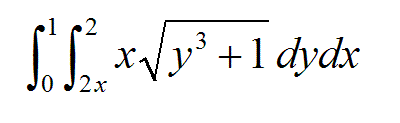
1.GIF


Now, if I'm doing this correctly I initially ignore the outer nested bits and concentrate on this:
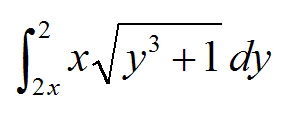
2.GIF


Wtf do I do with that? I put it through mathematica and it comes up with some "null" argument jive.
Skimmed numerous times through all relevant sections of my calculus book (by Anton) to no avail..

Looked at the previous year's question and sure enough there was one just like it:
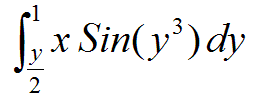
3.GIF


With no such example in my obviously inferior recommended text I'm left to ask for help.

Cheers
-Dec
 
Physics news on Phys.org
Hint:
Change the description of your region so that "y" runs from 0 to 2, and x runs from 0 to 1/2y.

EDIT:
I ended up with something like 13/18.
 
Last edited:
I'm at a loss, why would I do that? The limits are 2 to 2x for y and 0 to 1 for x, where did you get those other numbers from?
And I don't understand how changing the limits would help at all, it's before that. I mean how does one integrate sqrt(y^3 + 1) ?
 
ApeXaviour said:
I'm at a loss, why would I do that? The limits are 2 to 2x for y and 0 to 1 for x, where did you get those other numbers from?
DRAW the region in the xy-plane!
See that your region could equally well be described by my limits.
And I don't understand how changing the limits would help at all, it's before that. I mean how does one integrate sqrt(y^3 + 1) ?
Do the x-integration first, and you'll see that all your problems are solved.
 
Last edited:
arildno said:
DRAW the region in the xy-plane!
See that your region could equally well be described by my limits.
Ah, my apologies, I see where you get this now. Thank you. It has been over a year since I've studied mathematics.

arildno said:
Do the x-integration first, and you'll see that all your problems are solved.
Okay I did this with the new limits but I still came back to the same problem. After doing the x-integration I get:
1/4 *y^2 * sqrt(y^3 + 1). Which I can't integrate for y, I tried substitution and tabular integration. Looked over the previous integration and couldn't see any slip.

Thanks for your patience so far by the way..
 
ApeXaviour said:
Ah, my apologies, I see where you get this now. Thank you. It has been over a year since I've studied mathematics.


Okay I did this with the new limits but I still came back to the same problem. After doing the x-integration I get:
1/4 *y^2 * sqrt(y^3 + 1). Which I can't integrate for y, I tried substitution and tabular integration. Looked over the previous integration and couldn't see any slip.

Thanks for your patience so far by the way..

Try u=y3+1.
 
apmcavoy said:
Try u=y3+1.
OH MY GOD.. I'm so slow today. It's obvious. Thanks

This is what I get for not studying anything the last 5 months. Brainrot.. :redface:
 
Looked at the previous year's question and sure enough there was one just like it: http://www.maths.tcd.ie/~cockburd/3.GIF

Was this the actual question? It seems like it should be a double integral...
 
apmcavoy said:
Was this the actual question? It seems like it should be a double integral...
The actual question is to evaluate this:
http://www.maths.tcd.ie/~cockburd/4.GIF

Which I think is a missprint (I'd heard there was one on this paper) as otherwise I found it impossible to do. I substituted y/2 for x/2 and it worked out like the previous one.
 

Similar threads

Replies
26
Views
2K
  • · Replies 4 ·
Replies
4
Views
3K
  • · Replies 1 ·
Replies
1
Views
2K
  • · Replies 3 ·
Replies
3
Views
2K
  • · Replies 15 ·
Replies
15
Views
1K
Replies
2
Views
2K
  • · Replies 17 ·
Replies
17
Views
3K
  • · Replies 1 ·
Replies
1
Views
2K
  • · Replies 6 ·
Replies
6
Views
2K
  • · Replies 12 ·
Replies
12
Views
4K