Momentum fo two blocks and spring

Click For Summary

Homework Help Overview

The problem involves two blocks colliding, where one block is at rest on a frictionless surface and connected to a spring. The question focuses on determining the maximum compression of the spring after the collision, given the masses and initial velocity of the moving block.

Discussion Character

  • Exploratory, Conceptual clarification, Mathematical reasoning

Approaches and Questions Raised

  • Participants discuss the conservation of momentum and kinetic energy, questioning how to relate the kinetic energy of the combined blocks to the potential energy stored in the spring. There are attempts to derive relationships between these energies and the spring's compression.

Discussion Status

Participants have explored the relationship between kinetic energy and potential energy in the context of the spring's compression. Some guidance has been offered regarding the equations for kinetic and potential energy, and there is an ongoing examination of how these concepts apply to the problem.

Contextual Notes

There is a sense of urgency expressed by one participant regarding the approaching deadline for submission, which may influence the pace and focus of the discussion.

lando45
Messages
84
Reaction score
1
Hey,

I have been set this question and I'm half-way through answering it but am stuck on where to go next...here's the question:

The m1 = 1.1 kg block at rest on a horizontal frictionless surface is connected to an unstretched spring (k = 180 N/m) whose other end is fixed. (See Fig. 10-36.) The m2 = 2.2 kg block whose speed is 4.0 m/s collides with the 1.1 kg block. Assume that the two blocks stick together after the one-dimensional collision. What maximum compression of the spring occurs when the blocks momentarily stop?
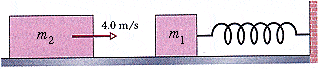
10_44alt.gif


Using m1v1 = m2v2 I got:

2.2 x 4.0 = 8.8kg/m/s
The joint mass of the two blocks is 3.3kg so the velocity must be 2.66m/s

But I don't understand how to calculate the spring compression knowing only the velocity and the "k" value of the spring?

Any help appreciated,
Thanks
 
Physics news on Phys.org
Hi

Good. You have the velocity of the composite mass which now presses against the spring.

Hint: What happens to the (composite mass + spring system) as the composite mass moves forward pressing against the spring? What happens to the velocity of the mass at maximum compression? What happens to the initial kinetic energy? Can you relate these two parameters now?

Hope that helps.

Cheers
Vivek
 
all of your composite mass K.E. is equal to all of the compressed springs ____ energy.

(hint: You have equations that represent these energies...and they are just floating around out there waiting for you to use them...)
 
Oh right...so at the springs maximum compression, the velocity of the two joint blocks will be 0m/s...so does the composite mass' KE equal the compressed springs PE?
 
OK so I calculated the KE of the composite mass:

KE = ½mv² = ½ x 3.3 x 2.6² = 11.674J

So is this value supposed to equal the PE of the compressed spring? And if it does, I don't really see how that helps me answer the question, as mgh won't tell me the length of compression...is there a different formula I need to use?
 
The key with the spring is

an unstretched spring (k = 180 N/m)

Spring force, F = kx, and PE in spring is just the integral of F dx = 1/2 kx2, where x is the displacement from fully relaxed (i.e. no force applied).

The spring reaches maximum deflection when the velocity of blocks = 0, i.e. the KE of the blocks is completely transformed into the stored mechanical energy or PE of the spring.
 
Last edited:
Astronuc said:
The key with the spring is
an unstretched spring (k = 180 N/m)
Spring force, F = kx, and PE in spring is just the integral of F dx = 1/2 kx2, where is the displacement from fully relaxed (i.e. no force applied).
The spring reaches maximum deflection when the velocity of blocks = 0, i.e. the KE of the blocks is completely transformed into the stored mechanical energy or PE of the spring.

Did you mean to write something between "where" and "is"?
 
x, sorry about that. Post has been corrected.
 
Ah. So the 11.674J will equal ½kx² so:

½kx² = 11.674 = ½ x 180 x x² = 90 x x²

11.674/90 = x²

x = 0.36m

Is this right do you think?
 
  • #10
Help, the deadline for this question is tomorrow, and I only have one submission left so I don't want to waste it...does 0.36m seem correct?
 
  • #11
It appears to be correct.
 

Similar threads

  • · Replies 5 ·
Replies
5
Views
2K
  • · Replies 12 ·
Replies
12
Views
4K
Replies
8
Views
6K
  • · Replies 5 ·
Replies
5
Views
2K
  • · Replies 4 ·
Replies
4
Views
2K
  • · Replies 6 ·
Replies
6
Views
3K
  • · Replies 2 ·
Replies
2
Views
3K
  • · Replies 16 ·
Replies
16
Views
3K
  • · Replies 10 ·
Replies
10
Views
2K
  • · Replies 20 ·
Replies
20
Views
4K