| Thread Closed |
Electric field becomes electromagnetic waves if observer is moving |
Share Thread | Thread Tools |
| Dec29-07, 10:41 AM | #1 |
|
|
Electric field becomes electromagnetic waves if observer is moving
At school (a long time ago that is) we were taught:
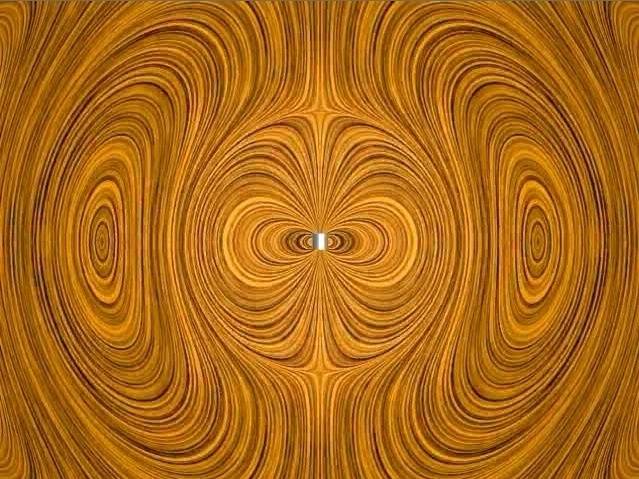
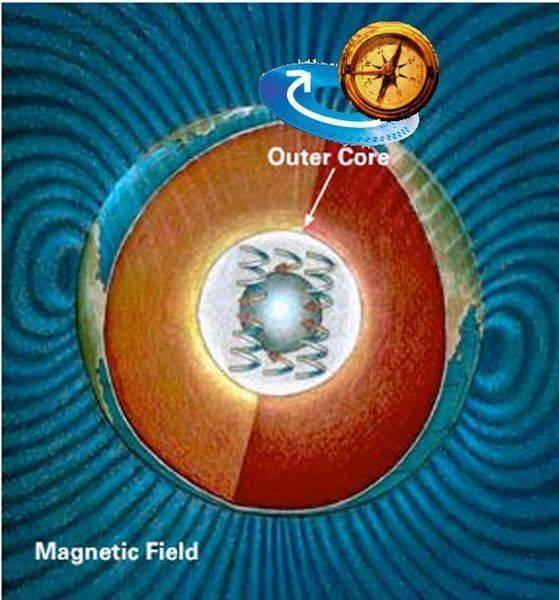
1. a stationary charge produces a static electric field. 2. a moving charge produces a magnetic field, plus an electric field that is slightly different from the original electric field of the stationary charge. 3. a periodically accelerating charge like an electron in a dipole produces electromagnetic waves. For example, electrons accelerating up and down in a dipole produce waves like these: What happens if the observer moves, and the charge is stationary? Since it is the relative velocity that matters, the moving observer will experience a magnetic field (plus an electric field, slightly different from the static electric field). Observers moving at different speeds will experience different magnetic fluxes at the same point in space! So it is not a fixed property of space, the magnetic field is a property of moving charges, different for each observer depending on the velocity of each observer. But here's another interesting fact about moving observers: A periodically accelerating observer will experience electromagnetic waves, if stationary charges exist nearby. In other words, stationary charges emit electromagnetic waves, as far as this observer is concerned!!! For example an observer is going up and down at each pixel of the following picture, instead of electrons going up and down in the dipole. Also there is no dipole, only a fixed stationary charge in the centre. Here is a video of the waves experienced by observers at each pixel. http://web.mit.edu/~sdavies/MacData/...Dipole_640.mpg So maybe if you go to the magnetic north pole of the earth, and put a campus on the edge of a rotating disk, then at the right rate of rotation the campus will register no magnetic force! Or maybe not. Maybe I have the maths wrong, magnetic fields do not superimpose linearly, right? Can someone provide the full maths of electromagnetic forces between moving and accelerating point charges please, the full equations for the forces that is, anyone? If the conclusion is correct, ie that superposition of magnetic fields due to different rotations of the iron in the earth's core is LINEAR, then how fast does the disk have to rotate, in order for the campus to register no magnetic field? (diagram not to scale of course, magnetic field can be assumed constant in the vicinity of the campus and disk). ------------ PS. How do I show the pictures in full size in the post? |
| Dec29-07, 01:22 PM | #2 |
|
Mentor
|
Hi Ulysees, welcome to PF.
Here are a couple of wiki links to get you started: http://en.wikipedia.org/wiki/Formula...ial_relativity http://en.wikipedia.org/wiki/Four-vector Be aware, both the oscillating and rotating frames that you are talking about are non-inertial. So you will have to add all sorts of "correction" terms and ficticious forces in order to use them. |
| Dec30-07, 04:48 PM | #3 |
|
|
Thanks for the links and the information.
I was wondering, as a first step in a search for the true meaning of magnetic field which is really what I was after when I drew that rotating observer at the north pole, can you initially assume velocities are well below the speed of light to avoid relativistic equations? In other words, what are the classical equations for the electromagnetic field of a moving charge? 1. A point charge that moves is not really equivalent to current in electromagnetic equations, is it? 2. If N charges move, can I just add up the magnetic field from each charge to get the total magnetic field? If not, how do I add them up? 3. 1 coulomb moving at 1 m/s is the same "current" as 2 coulombs running at 0.5 m/s, so they produce the same magnetic field B at a given point P, right? But then, at what speed does the observer at P have to move, in order to cancel the magnetic field B, 1 m/s or 0.5 m/s? What if both charges run at the same time? Something is wrong here. Any thoughts? |
| Dec30-07, 07:11 PM | #4 |
|
Mentor
|
Electric field becomes electromagnetic waves if observer is movingThat said, my gut feeling is that you could not neglect relativistic effects even at low angular velocities. EM forces are so strong that relativistic effects can become important when changing between inertial reference frames even for velocities on the order of 1 m/s. http://www.physics.upenn.edu/courses..._28_2003.shtml You will see that the Biot-Savart law is simply the superposition of the magnetic field from each of an infinite number of infinitesimal moving point charges in order to get the total magnetic field. |
| Jan3-08, 02:20 PM | #5 |
|
|
If you want som more formal in the matter, I can recommend D. J. Griffiths "Introduction to electro Dynamics" (isbn: 0-13-919960-8) chapter 12 on electrodynamics and relativity
|
| Jan3-08, 04:06 PM | #6 |
|
|
Thanks everyone.
I guess fictitious forces have to do with being in the frame of reference of a lift that is falling freely, for example, in which frame the earth seems to be accelerating towards the lift at 9.8 m/s^2, therefore a fictitious force F=Mg must be acting on the earth. Likewise to an oscillating observer of stationary charges, they seem to be accelerating, therefore fictional forces must be acting on them. If the observer is oscillating slowly, I guess fictional forces do not matter, it's straightforward Biot-Savart law in its point-charge version, but at relativistic speeds, Biot-Savart is drastically modified, right? Especially considering the time it takes for the wave to go from the charge to the observer. Or is it the other way round? Strange that an observer that is oscillating fast enough, will in theory experience radiowaves or even light from a stationary charge! Can this possibly be right? |
| Jan3-08, 04:24 PM | #7 |
|
|
[tex] \mathbf{B}=\frac{\mu_0}{4\pi}\frac{q\mathbf{v}\times\mathbf{\hat r}}{r^2} [/tex] as being such. It is only approxmimately correct for point charges in linear motion, but certainly not if the charge is accelerating and/or moving at relativistic speeds The fields of a point charge in motion (I thus assume that is it the observer in the rest frame), can be calculated in two ways: relative to the rest frame using the retarded (yes they are called that) Liénard-Wiechert potentials or by calculating the (static) electric field in the moving frame and using the methods of relativistic electrodymanics to transform the fields to the restframe. The latter is usually much simpler. I will again advise D. J. Griffiths for very beautyfull examples on how both is done |
| Jan9-08, 10:13 PM | #8 |
|
|
I have tried to get hold of Griffiths but I have not found the time yet for a visit to a university library. It's available with "Search Inside" in amazon though, any chance you could point me to those beautiful examples you mentioned? (just a a key phrase and a page number would do, from the second method).
Thanks. |
| Jan10-08, 05:08 AM | #9 |
|
|
That, of course depends on what you already know. If you already are familiar with the time dependent generalization of the electric and magnetic potential, gauge transformations, dipole radiation and basic special relativity, you might settle for sec 10.3, sec 11.2 and sec 12.3 The relativistic transformation of electromagnetic fields are discussed in section 12.3 in the subsections 12.3.2 "how the fields transform" and 12.3.3 "The field tensor" (page 525 through 540 in 3rd ed.) |
| Jan11-08, 04:51 PM | #10 |
|
|
Thanks. It will take me some time because I don't know much. But seems a great book indeed, thanks again.
|
| Jan12-08, 05:26 PM | #11 |
|
|
Thus you may be safer off to do it the brute force way, using retarted potentials and classic point charge radiation. The argument of relativity should still apply though, that is, a stationary point charge will appear to be oscilating to an observer in an oscilating frame and will produce radiation accordingly. Only thing that nags me is how the radiation reaction would fit into al this... The observer would claim that the point charge is damped in its oscilation, because the radiation caries off kinetic energy. But if the charge it stationary, then it would have to be the observer who is damped in his motion! Otherwise, there would be a violation on energy-conservation. Could it be that the charge exert a damping force in on the observer as he detects it's field? Or is there some other mechanism at work? Interresting scheme to say the least... |
| Jan14-08, 06:06 PM | #12 |
|
|
In other words, what are the action-reaction force pairs involved here? I guess the charge experiences the reaction, delayed. So action and reaction are not simultaneous, right?
|
| Jan14-08, 06:14 PM | #13 |
|
|
In the end there is no such thing as field, there is only interaction between charges. Delayed interaction that is.
An observer cannot measure fields without using a device, and inevitably the device is based on forces experienced by charges in it. |
| Jan15-08, 03:12 PM | #14 |
|
Mentor
|
EDIT: On the other hand, they are frame variant quantities. In that sense they are more like energy or time than mass which is invariant. |
| Jan15-08, 05:25 PM | #15 |
|
|
You're right.
I was wondering what the equation is, that gives the momentum of a given field as a function of E and B at a given point and time. Does anyone have it handy? |
| Jan16-08, 05:51 AM | #16 |
|
|
Sorry to interrupt but if you could trace the field from an oscillating electron, would it be in the form of rapidly expanding and alternating tori as the first cross section suggests?
|
| Jan16-08, 10:59 AM | #17 |
|
|
Not necessarily, depends how the electron oscillates, I guess the cross section is exactly as shown for a sinusoidal oscillation, like in a dipole.
----------- PS. Can someone tell me the policy on diagrams? What's stopping us from showing diagrams in full clear size? Can't I just host them on imageshack.net so they don't consume the forum bandwidth? |
| Thread Closed |
| Thread Tools | |
Similar Threads for: Electric field becomes electromagnetic waves if observer is moving
|
||||
| Thread | Forum | Replies | ||
| Charges moving along an electric field: | Classical Physics | 3 | ||
| Simulating electric or electromagnetic field of a dipole antenna with MATLAB PDETOOL | Math & Science Software | 0 | ||
| Could moving observer be stationary vs moving and still give Albert the same results | Special & General Relativity | 17 | ||
| [SOLVED] Charge moving through electric and magnetic field | Introductory Physics Homework | 4 | ||
| electric charges moving and magnetic field | General Physics | 6 | ||