| New Reply |
Lebesgue integral |
Share Thread | Thread Tools |
| May7-12, 06:04 PM | #1 |
|
|
Lebesgue integral
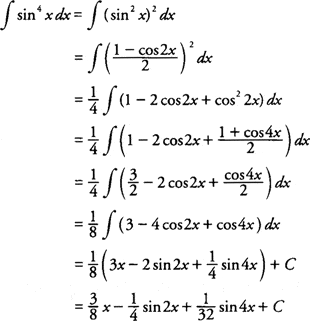
can anyone please show me that how to apply Lebesgue integral by showing some example like we do Riemann integral in calculus class? for example:
|
| May7-12, 07:47 PM | #2 |
|
|
It is a standard fact that if f is a real valued function defined on a closed interval which is integrable in the Riemann sense, then the function is measurable and integrable (in the Lebesgue sense) and the two integrals are equal. So if what you're asking for is an example of finding an anti-derivative of functions as is done in calculus, then the procedure is to note the above and integrate.
However, the power and utility of the Lebesgue integral is the ease with which more complicated functions can be integrated (the integral can easily be broken up over various sets which have specific properties and has powerful convergence theorems; there also exist functions which may fail to be integrable in the Riemann sense; see the characteristic function of the rationale over any closed interval). But these don't have general calculus style approaches. These sorts of integration arguments require more care than applying a set of procedural formulas. |
| May7-12, 09:33 PM | #3 |
|
|
|
| Aug15-12, 04:37 AM | #4 |
|
Recognitions:
|
Lebesgue integral
Sorry for the necropost; I ran into this in a search. Feel free to Ignore if you don't need
it anymore: Just like the case with a Riemann integral, where you do Riemann sums, in the Lebesgue case, you do Lebesgue sums, where you partition the range instead of the domain, and then the value of the Lebesgue integral is the sum of these values: If your range likes in [y1,y2], then you partition your range, select some points yi, i.e., you select a point in each interval of the range ---remember you select points in your domain when you do Riemann sums--then your sums are of the form: Ʃy=1n yi*m(A) where A is the preimage set under f, so that you sum a value selected in your range. There are , of course, conditions for this integral to exist/converge; some of these conditions can be described with simple functions, but I think it is important to note that, just like with Riemann, the value of the sum should approach a limit as the number of partitions increases. Is that what you were asking? times the measure of the associated preimage. |
| Aug15-12, 11:34 AM | #5 |
|
|
once again thanks a tonne. Edited note: what is m here? is it some function? if it takes A (which is domain) then what does map into ? range? can you please guide me in the context of probability if it's possible. Thanks |
| Aug15-12, 05:47 PM | #6 |
|
|
The Lebesgue integral assumes you partition up the range and approximate. I use word assume because its not obvious you can do this and and even achieve a unique answer. In Riemann, you take an interval [a,b] and split it into subintervals [x0, x1], [x1, x2], ... You then define a way to "measure the length" of these subintervals ##m([\alpha,\beta]) = \beta-\alpha##. This gives you the width of each rectangle. In Lebesgue, we split up the range, then look at the sets of form ##f^{-1}(E) = \{ x \in X | f(x) \in E\}##. This is the pullback, all the x that f sends to E. However, in general this set will look nasty even if E looks nice. So we define a "measure", a function whose input is subsets of the domain of f and outputs a number (the "length" of that set). That is m. The theory is called measure theory and if you are doing probability you will need to know this. |
| Aug15-12, 06:45 PM | #7 |
|
Recognitions:
|
In a very basic and informal way, this is part of how it is laid out:
You have a measure triple (X, m, Sigma). X is a set/space, m is a measure (see below), and the sigma algebra is a collection of subsets of X. You have a measure m, which is a function defined on a certain collection of subsets that is countably subadditive (measure of the union of sets is ≤ sum of the measures), non-negative and monotone (A Subset B, then m(A) < m(B)) . You normalize your space, so that m(X)=1 . Then the probability of an event is its measure. So that, for example, the probability of hitting a rational with a dart thrown at random is the measure of the subset of rationals in X . In the Lebesgue measure , the measure of all rationals is 0 . I need to go, but let me know if there is something else that interests you. |
| Aug16-12, 10:04 AM | #8 |
|
|
I am lil' confused that, is m=f^-1 (E) ????? |
| Aug16-12, 11:56 AM | #9 |
|
Recognitions:
|
to find in the measure of a set. So, the Lebesgue measure of an interval is its length, and, with some adjustments, the measure of a rectangle is the product of the lengths of the intervals forming the sides of the rectangle. f^-1(E) is just the set {x: f(x) is in E}. What you do is you break down your range --like the way you break down your domain -- as {y1, y2,...,yn} , and --again,like the case of the Riemann integral-- you select one point yi* in each interval [yi,yi+1) and then you consider the measure of the preimage.The Lebesgue integral is then the sum yi*m(Ei). There are rules for the (net ) convergence of the Lebesgue integral: the Leb integral equals, 'L' if,given any e>0 , there must be some del.>0 with ||P||< del. implies the integral of any of these partitions is within less than e of L, i.e. | Int f -L| <e when ||P||< del. Along the lines of what Pwsnafu said, you define the Lebesgue measure (in R here, since you want to do probability; you can define measures in general topological space) by defining declaring the length of an interval (a,b) to be b-a and then defining the measure of a subset of R to be the infimum of the measures over all covers of a set. |
| Aug16-12, 07:57 PM | #10 |
|
|
|
| Aug16-12, 08:45 PM | #11 |
|
|
One thing you will be surprised with: it is possible to construct a definition of integral which is equivalent to the Lebesgue integral on ℝ, but nonetheless partitions the domain. It's called the McShane integral, but you'll want to read about the Henstock-Kurzweil integral first.
|
| Aug17-12, 05:47 PM | #12 |
|
|
Thanks a tonne for sharing this wonderful information with me. |
| Aug17-12, 09:14 PM | #13 |
|
|
[QUOTE=woundedtiger4;4038516]WOW, how many integrals are out in the world?[QUOTE]
There's an infinite number. The Riemann integral, McShane integral and Henstock-Kurzweil integral are all the same in the sense they are all Riemann sums. The trick is changing which partitions you allow. If you allow lots, you need to restrict f to guarantee the limit existing (Riemann). If you restrict the partitions you can weaken f (H-K). McShane (and hence Lebesgue) exists in between these two. You can imagine other selection criteria, and you'd get different integrals. For a prob theory perspective you'll want:
Things like H-K integrals are obscure in the literature. You'll know them if you do real analysis, but otherwise never hear of them. I'd be amazed if 3 other people on this forum know how to abstract the H-K integrals
|
| Aug18-12, 02:33 PM | #14 |
|
|
[QUOTE=pwsnafu;4038677][QUOTE=woundedtiger4;4038516]WOW, how many integrals are out in the world?
|
| New Reply |
| Thread Tools | |
Similar Threads for: Lebesgue integral
|
||||
| Thread | Forum | Replies | ||
| Lebesgue integral proof, prove integral is zero | Calculus & Beyond Homework | 0 | ||
| lebesgue integral | Calculus & Beyond Homework | 0 | ||
| lebesgue integral | Calculus | 3 | ||
| Lebesgue integral once again | Calculus | 9 | ||
| Lebesgue integral... | Calculus | 2 | ||