New Reply

Japan Earthquake: nuclear plants

 
Share Thread Thread Tools
May26-12, 10:15 AM   #13363
 
Recognitions:
Gold Membership Gold Member

Japan Earthquake: nuclear plants


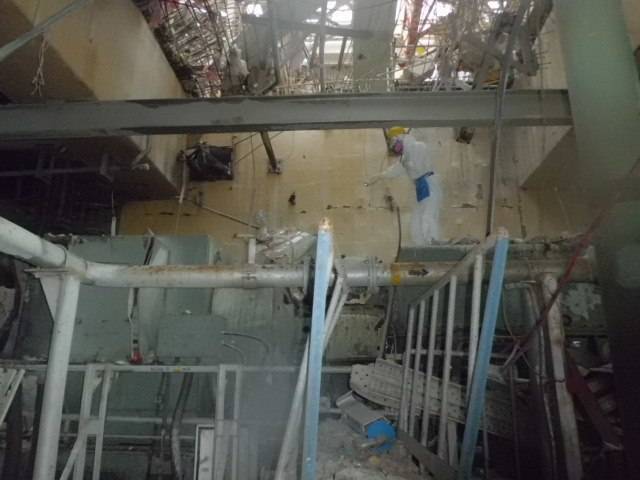
I don't understand Tepco's recent announcement, that no cracks was found in the concrete wall surrounding the SFP of Unit 4.
I thought it to be a ~horizontal crack in that wall, the man in this previously released photo is pointing his hand gadget at. I still can't see what else it could be.

 
May26-12, 04:58 PM   #13364
 
Quote by MadderDoc View Post
I assume we are also in the same ballpark, method-wise. The measurements are made from the thought that they represent the movements of a detonation shock/flame front. Can you think of them as perhaps representing something else?
Same method, yes. But no... can't think of anything else.
That would imply measuring to ill-defined points in the shadow of the building and the developing plumes, it doesn't seem immediately promising to me. What would that measurement be good for?
It's unclear, yes. But it would give you another measure of how fast the shock front was. Does it take one frame to reach that other corner, or two?
 
May26-12, 05:48 PM   #13365
 
Quote by MadderDoc View Post
I'd say the strong impression is one of building collapse, i.e. the roof appears to come down, so that the building seems to be shrinking in the vertical direction.
Indeed. Looking at the roof-anchor in the picture (true?), the roof collapsed in the south region also in the first stage of the explosion. The big vertical mushroom afterwards "cleaned" that area then.


After 14 months - is there any consensus if there were at least one or two explosions??
There are indications for two different events in my opinion. The hydrogen burns in the east side of unit 3, where it must have been in high concentrations after the leakage near the lid. In the west-side the hydrogen consentrations should have been lower, but with more oxygen there a bit more explosive (the west-wall was blown away, the east-wall remains partially).

Like at the lid of a cooking pot, the hydrogen escapes in an angle when under high pressure. Sorry for my english, look at my next picture:


Could this be an explanation for the fireballs (1A, 1B) in south-east and north-east? The enormous mushroom developed in the geometrical middle between those two fireballs from the perspective of the video. This is at the same time the location of the SPF. The heavy vertical blast (2) seems to be a secondary event, initialized by 1A and 1B. If it is not related to the SPF itself (but I think so), the only explanation that comes to my mind is the more explosive H2/O2-Concentration in the west-side of unit 3.
 
May27-12, 02:32 AM   #13366
 
Recognitions:
Gold Membership Gold Member
Uagrepus, thanks for your well-argued reply. I read it mainly thinking yes,yes, yes. Rather than going into some detail of difference, I'll add the thought, that the sudden development of a leak in the primary containment top (say, a manhole in the PCV lid sprang open) might go a long way explaining the whole thing. The expected outcome of such occurrence would be a jet of H2 and steam, shortly followed by a whoosh of steam and superheated water, all making its way, up, through whatever passageway it could find through the concrete shield plugs and gate areas.

(To that. add the fair assumption in consistence with consensus, that previous hydrogen leakage had made a chemical hydrogen bomb out of the building, and it suddenly exploded)
 
May27-12, 08:57 AM   #13367
 
Recognitions:
Gold Membership Gold Member
Quote by zapperzero View Post
Same method, yes. But no... can't think of anything else.
The method assumes that the burning airmass is stationary. How did the airmass get there?
It's unclear, yes. But it would give you another measure of how fast the shock front was. Does it take one frame to reach that other corner, or two?
I can't see how it can be done to be of any use. Mind the perspective.
 
May27-12, 09:48 AM   #13368
 
Quote by MadderDoc View Post
I don't understand Tepco's recent announcement, that no cracks was found in the concrete wall surrounding the SFP of Unit 4.
I thought it to be a ~horizontal crack in that wall, the man in this previously released photo is pointing his hand gadget at. I still can't see what else it could be.
Given that the published title of that photo was 'The original place of installation of air-conditioning ducts', I assume he is pointing at where the ducts were originally present. I certainly don't see enough detail in that photo to even begin to assume that we see any cracks there.
 
May27-12, 10:17 AM   #13369
 
Recognitions:
Gold Membership Gold Member
Quote by SteveElbows View Post
Given that the published title of that photo was 'The original place of installation of air-conditioning ducts', I assume he is pointing at where the ducts were originally present. I certainly don't see enough detail in that photo to even begin to assume that we see any cracks there.
Wonderful :-) You are one rock of skepticism.

Here's another photo from another angle showing a bit more detail (in upper right in the photo), of the left end of the alleged crack:
 
May27-12, 10:36 AM   #13370
 
Quote by MadderDoc View Post
The method assumes that the burning airmass is stationary. How did the airmass get there?
It is only stationary in that the center remains fixed. Otherwise, the shock front would be pushing hydrogen-laden air ahead of it and leaving steam behind, until there was no more hydrogen left.

I can't see how it can be done to be of any use. Mind the perspective.
Yes, it's not very clear.
 
May27-12, 10:43 AM   #13371
 
Recognitions:
Gold Membership Gold Member
Quote by zapperzero View Post
It is only stationary in that the center remains fixed. Otherwise, the shock front would be pushing hydrogen-laden air ahead of it and leaving steam behind, until there was no more hydrogen left.
Should measurement then not be from the center, to the edge, rather than from edge to edge? Does air in front of a detonation shockwave 'know' that the shockwave is coming?
 
May27-12, 11:28 AM   #13372
 
Quote by MadderDoc View Post
Here's another photo from another angle showing a bit more detail (in upper right in the photo), of the left end of the alleged crack:
[IMG]
Where were these photos taken? The recent announcement was only about checking the walls around and supporting the fuel pools as I recall.
 
May27-12, 12:55 PM   #13373
 
Recently I have been speaking on the thread about reactor 2 releases, about this TEPCO report on total radiation estimates. We heard about the totals, but there are some interesting details in the full report. It doesn't sound like TEPCO are going to translate the full document, so this is an appeal for help in translating interesting bits.

http://www.tepco.co.jp/cc/press/betu...20524j0105.pdf

A good starting point would be the table on page 9 which shows estimated releases of different substances during a range of different time periods/events. Not hard to understand most of it without proper translation, apart from the notes column.

Anyway I think this table should be of particular interest because for once it does not stop looking at detail after the explosions have finished, the dates March 16th to March 29th are represented here! For example reactor 3 gets some credit for some notable releases on march 16th and march 19th.

Those with an interest in weather may like many of the diagrams later in the report, and MadderDoc may be amused to note that when they talk about non-vent releases from containment, they use a thermal image of reactor 3 to acknowledge the issue. There are some diagrams of the engineering detail of potential weak-spots but they aren't very good resolution and we've seen at least some of them before.
 
May27-12, 02:01 PM   #13374
 
Recognitions:
Gold Membership Gold Member
Quote by Rive View Post
Where were these photos taken? The recent announcement was only about checking the walls around and supporting the fuel pools as I recall.
They are from the west wall of the pool, 4th floor, the same wall section which the recent announcement is showing a lower portion of in a sharp angle, the photo bottom right in
http://2.bp.blogspot.com/-e4hpgfA9WP...SFPMay25-7.JPG

(The photos are from the original survey of Unit 4 damages done in Nov. 2011, source:
http://photo.tepco.co.jp/en/date/201...11110_01e.html)
 
May28-12, 01:44 AM   #13375
 
Recognitions:
Gold Membership Gold Member
Quote by SteveElbows View Post
<..>http://www.tepco.co.jp/cc/press/betu...20524j0105.pdf<..>
Anyway I think this table should be of particular interest because for once it does not stop looking at detail after the explosions have finished, the dates March 16th to March 29th are represented here! For example reactor 3 gets some credit for some notable releases on march 16th and march 19th.

Those with an interest in weather may like many of the diagrams later in the report, and MadderDoc may be amused to note that when they talk about non-vent releases from containment, they use a thermal image of reactor 3 to acknowledge the issue. There are some diagrams of the engineering detail of potential weak-spots but they aren't very good resolution and we've seen at least some of them before.
Actually those engineering details I found pretty interesting, or at least, new. Indeed there was a scent of what the Tepco cat could tell.

Otherwise, I got just the scent of the bones of the same old whale, the data from the monitoring posts. Apparently Tepco has set out to put a label and some figures on any major signal from that data series, however the soup of words that came out of it defies their own reasonable efforts to translate or express it in plain English in such manner as to be well taken internationally.
 
May28-12, 05:04 AM   #13376
 
The previously mentioned press visit videos are now out: http://photo.tepco.co.jp/en/date/201...20526-01e.html

They have found a water inflow to the U3 buildings: http://www.tepco.co.jp/en/nu/fukushi...20526_01-e.pdf

And a survey about U1, without any immediate revelations: http://www.tepco.co.jp/en/nu/fukushi...20525_06-e.pdf

Some fuel will be removed from U4 pool in July: http://www3.nhk.or.jp/daily/english/20120528_09.html
 
May28-12, 05:26 AM   #13377
 
Quote by MadderDoc View Post
(The photos are from the original survey of Unit 4 damages done in Nov. 2011, source:
http://photo.tepco.co.jp/en/date/201...11110_01e.html)
It's hard to put these pictures together, but the curved wall on this photo: http://gyldengrisgaard.dk/fuku_docs/111110_06.jpg
suggests that the wall section here: http://photo.tepco.co.jp/library/111110/111110_12.jpg belongs to the 'neck' between the pool and the well.

This section is marked as 'checked' in the 'soundness' document. And you are right, that line on the wall looks like a crack.

The only thing I can think is that the crack was smaller than 1mm and there was no danger of rebar corrosion... They can be right with these but even so it won't make me happy.
 
May28-12, 06:34 AM   #13378
 
Recognitions:
Gold Membership Gold Member
Quote by Rive View Post
It's hard to put these pictures together, but the curved wall on this photo: http://gyldengrisgaard.dk/fuku_docs/111110_06.jpg
suggests that the wall section here: http://photo.tepco.co.jp/library/111110/111110_12.jpg belongs to the 'neck' between the pool and the well.
This section is marked as 'checked' in the 'soundness' document. And you are right, that line on the wall looks like a crack.


The only thing I can think is that the crack was smaller than 1mm and there was no danger of rebar corrosion... They can be right with these but even so it won't make me happy.
You are right about the location. The pixel resolution of these images is about 10 mm and we see rust stain originating from one area of the crack. The crack in the wall was visible already in the first images I saw from the 4th floor of Unit 4, but it didn't really bother me, since cracks in a steel reinforced concrete building after an explosion was sort of what I expected to see. I take note of it only because the recent announcement seems inconsistent with already acquired knowledge. My brain works like that, sorry. Here's a detail from the first image of the wall as it looked in June 2011:

source Tepco, at http://photo.tepco.co.jp/en/date/201...10611-03e.html


Footage from the most recent press tour shows scaffolding and a ladder leading to the area of the crack, I guess they may have been puttying it.
 
May28-12, 07:07 AM   #13379
 
Quote by MadderDoc View Post
The pixel resolution of these images is about 10 mm and we see rust stain originating from one area of the crack.
The image resolution does not matter much for this one: on a photo every crack will look much wider than it really is due the painting/surface pieces of the concrete will be dislocated much wider range than the distance between the main bodies. This can be measured with probes only.

The rust also can be originated from rebars or anything close to the surface. Its presence does not mean that the structure is in danger in depth.

I think this is the point where we won't get enough information from the pictures to move further. However it's worrying that these cracks are not mentioned in the documents, even if they are thought to be safe/too small/irrelevant.

Ps.: about the press visit video: funny, now they have some heavy machinery on the top level and much more stuff 'missing' there than on the previous photos...
 
New Reply

Tags
japan, nuclear
Thread Tools


Similar Threads for: Japan Earthquake: nuclear plants
Thread Forum Replies
8.9 earthquake in Japan: tsunami warnings Current Events 671
New Nuclear Plants Nuclear Engineering 9
Gen IV Nuclear Plants Nuclear Engineering 10
New Nuclear Plants Nuclear Engineering 14
Astronomer Predicts Major Earthquake for Japan General Discussion 65