| New Reply |
Conduction in reverse biasing too?? Is it the case with transistor?? |
Share Thread | Thread Tools |
| Jun10-12, 11:37 PM | #1 |
|
|
Conduction in reverse biasing too?? Is it the case with transistor??
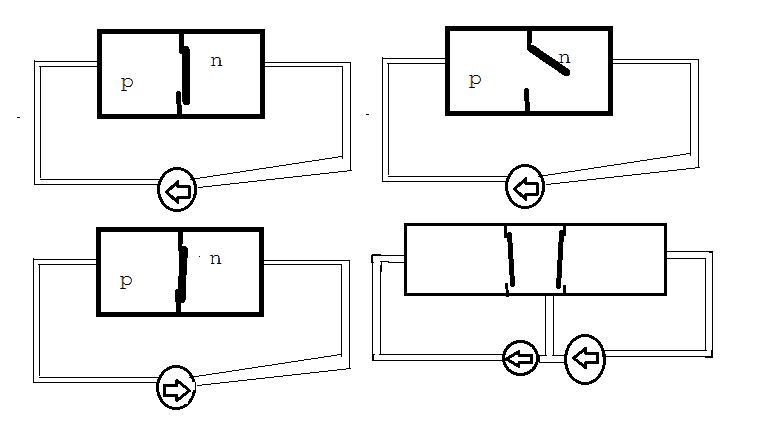
I have a mechanical analogy of diode in which a socket is provided with a one way valve. (figure 1st below). The arrow inside the circle shows the direction of motor pump. When there is enough pressure to lift the valve (barrier potential) the socket will let water go without any resistance( ideal). this would exactly work out like a diode in a circuit.
Now i connect such two sockets to form a "PNP" jnction. (BJT). In the common base connection the collector-base junction is is reverse biased. My fluid flow analogy says the water should flow through the first valve whereas the second valve should essentially not let fluid flow. But they say " Large current flow through that valve (collector= base)" Where has my analogy gone wrong?? What actually causes the fluid (current) flow at a higher rate through the second valve (Collector-base jucntion)?? Thanks in advance |
| Jun11-12, 02:25 AM | #2 |
|
Recognitions:
|
These things used to be all the rage:
Fluid "Transistor" Circuits ... Modern Mechanics June 1960 :) BTW: You cannot link to an image on your C: drive unless you run a file server. Better upload it someplace. |
| Jun11-12, 10:52 AM | #3 |
|
|
the collector-base junction is reversed biased in a normal common-emitter circuit and that's the point! that's how current is controlled which (with a large Vc) get's you a current-controlled current source.
for charge-carriers coming from the emitter (electrons in the NPN case), if the transistor [itex]\beta[/itex] is about 99, that means for every 100 electrons that cross the (forward-biased) emitter-base junction, only 1 of those electrons "recombines" with a hole in the base, and since the base is very thin, the other 99 electrons make it all the way to the other side of the base (the collector-base junction) and when they see that juicy, large, and positive Vcb, they just can't resist. normally, with a junction, reverse-biasing will cause that junction to be devoid of charge carriers on both sides of the junction and thus, it cannot conduct electricity. but the emitter supplies that charge and, if the base is thin (which results in a high current gain [itex]\beta[/itex]) much of that charge supplies what is otherwise missing at the collector-base junction. this is why soldering two diodes, back-to-back, won't work as a transistor. |
| Jun11-12, 12:17 PM | #4 |
|
|
Conduction in reverse biasing too?? Is it the case with transistor??Claude |
| Jun11-12, 01:32 PM | #5 |
|
|
This is where I have a problem in understanding.. How can 99 electrons make it all the way to the other side? Shouldn't they be resisted by the reverse biased voltage? And how do we get large positive Vcb?? |
| Jun11-12, 01:58 PM | #6 |
|
|
|
| Jun11-12, 02:50 PM | #7 |
|
|
Claude |
| Jun12-12, 12:03 AM | #8 |
|
|
so with your numbers, 1 out of 5000 electrons recombine in the base and 4999 present themselves to the c-b junction. and for every electron that recombines there is 49 holes that move to the b-e junction (and get recombined in the emitter)? |
| Jun12-12, 12:05 AM | #9 |
|
|
|
| Jun12-12, 08:22 AM | #10 |
|
|
Claude |
| Jun12-12, 12:29 PM | #11 |
|
|
|
| New Reply |
| Tags |
| amplification, analgoy, diode, transistor |
| Thread Tools | |
Similar Threads for: Conduction in reverse biasing too?? Is it the case with transistor??
|
||||
| Thread | Forum | Replies | ||
| Matched biasing transistor | Electrical Engineering | 15 | ||
| Reverse Biasing a Voltage Regulator | Electrical Engineering | 2 | ||
| Transistor biasing circuit | Electrical Engineering | 1 | ||
| Transistor biasing | Engineering, Comp Sci, & Technology Homework | 13 | ||
| transistor biasing | Electrical Engineering | 6 | ||