| New Reply |
Directly UPWIND faster than the wind |
Share Thread |
| Jun25-12, 03:03 PM | #18 |
|
|
Directly UPWIND faster than the wind |
| Jun25-12, 03:33 PM | #19 |
|
|
|
| Jun25-12, 03:59 PM | #20 |
|
|
If you build one you definitely have to let us know how it goes. You too can play a part in the grand hoax. :) |
| Jun25-12, 11:14 PM | #21 |
|
|
Can someone link me to where I can learn more about the physics behind this.. I find this quite intriguing.
|
| Jun26-12, 02:18 AM | #22 |
|
|
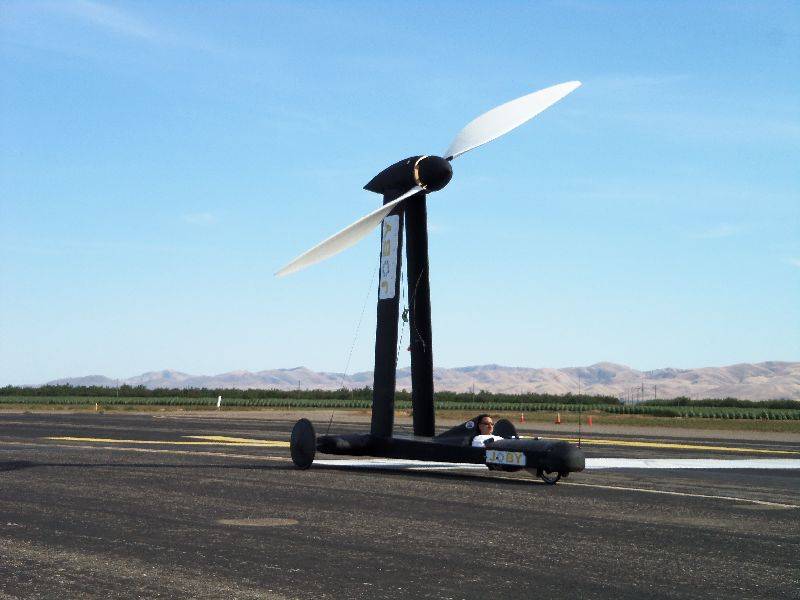
http://orbit.dtu.dk/fedora/objects/o...748519/content This video explains the basic mechanical principle, also for both directions: |
| Jun26-12, 03:55 PM | #23 |
|
|
These may be silly questions, but that never stopped me before.
When going upwind, is the speed measured in multiples of the wind? So if you are doing twice the wind speed, the ground speed is twice the wind? So does that mean the wind felt by the craft is three times wind speed? 10mph wind. 20 mph up wind. Wind from the crafts POV is 30 mph? |
| Jun26-12, 03:57 PM | #24 |
|
|
|
| Jun27-12, 03:07 AM | #25 |
|
|
Google "Apparent wind"
|
| Jun29-12, 07:09 PM | #26 |
|
|
Some questions were posed via PM that I'd like to respond to on the thread (I've already responded by PM as well)...
In both cases we use ratchets to let the prop or turbine spin freely if it gets ahead of the wheels. This relates to practical matters and allows us to prove we're not using stored energy. Ratchets are not a necessary part of the design. In the upwind case, the turbine is turned by the wind, and that in turn turns the wheels. There is no change in phase in this case. Whether a wind powered vehicle can "make its own wind" is a bit more of a philosophical question, but my inclination (without going into a lot of detail) is to say that it really can't. You could argue either side of this, but you don't get something for nothing as it might otherwise imply. |
| Jun29-12, 09:11 PM | #27 |
|
Recognitions:
|
|
| Jun29-12, 09:32 PM | #28 |
|
|
For the upwind cart, the turbine always turns the wheels. |
| Jun30-12, 04:28 AM | #29 |
|
|
There is an easy way to understand the feasibility of the upwind cart.. That's to understand that individual blades of the prop do not move directly upwind. They are "tacking" in 3D.
|
| Jun30-12, 04:48 AM | #30 |
|
|
Just wishful thinking. Then all the physics laws will violated by Youtube.
|
| Jun30-12, 08:25 AM | #31 |
|
|
To understand that the blades are on a continuous helical tack, it's of course important to understand that their gearing to the wheels replaces the constraint that would otherwise be provided by the keel of a sailboat. |
| Jun30-12, 02:26 PM | #32 |
|
|
What causes the cart to reach a maximum speed? If the faster it goes the more wind it 'feels', is there a limit to how fast a craft could eventually reach? |
| Jun30-12, 03:04 PM | #33 |
|
|
For instance, in the downwind case, a propeller pitched and geared to advance half as far through the air as the wheels go over the ground, will be limited by that to twice wind speed. Of course, since a propeller can never achieve "hard gearing" with the air to do that (there will always be "slip"), the limit will be less than that. An example of a very similar situation is: But in real terms, it is mostly aerodynamic drag force, as well as the other efficiencies, that catches up to the the thrust force and prevents further acceleration. |
| Jun30-12, 03:05 PM | #34 |
|
|
If that number is greater than 1.0, you have a vehicle that can theoretically go directly into the wind faster than the wind. If it's less than 1.0, you have a vehicle that can go directly downwind faster than the wind. The closer you get to 1.0 from either side, the greater a multiple of wind speed you can theoretically achieve (this can be worked out through simple kinematics). But... the closer you get to 1.0, the greater the required efficiency needed to make the vehicle work at all at that VSR. You can change the VSR by changing the gearing or the prop/turbine pitch. With the Blackbird, we do have the ability to change the prop/turbine pitch on the fly. We can change the gearing, but only while stopped. That being said, there is no theoretical limitation on maximum multiple of wind speed. It's just a matter of building a vehicle with high enough efficiency - and operating in a low enough wind. The reason you need to operate in a low wind if you want to achieve very high multiple of wind speed is that you start fighting compressibility effects of air at higher speeds. This will inherently reduce your efficiency, and therefore limit your multiple of wind speed. |
| New Reply |
| Tags |
| directly upwind |
Similar discussions for: Directly UPWIND faster than the wind
|
||||
| Thread | Forum | Replies | ||
| Wind Power Vehicle Traveling Down Wind Faster Than The Wind | General Physics | 305 | ||
| Sailing Downwind Faster Than The Wind | General Discussion | 1 | ||
| Sailing downwind faster than the wind: resolved? | General Physics | 172 | ||
| Downwind faster than the wind | General Physics | 73 | ||
| How can an vehicle move faster than the wind that is powering it? | General Physics | 175 | ||