Discussion Overview
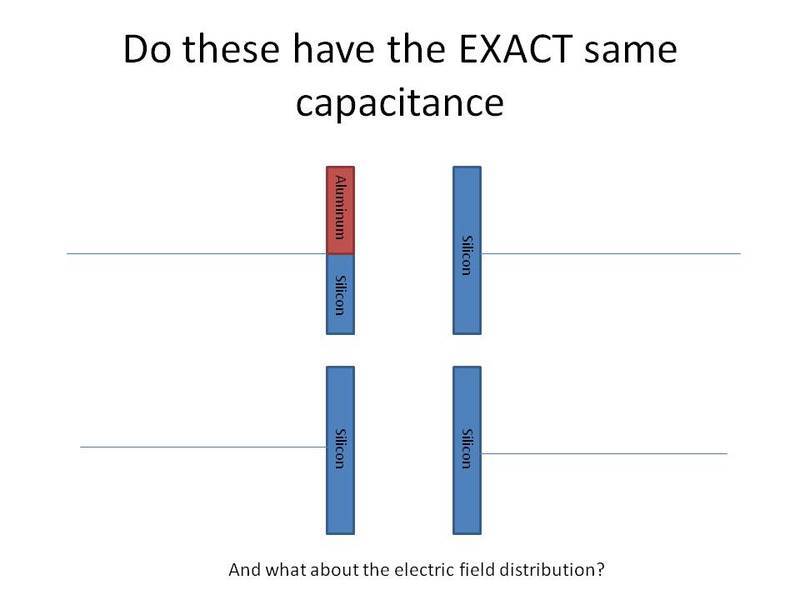
The discussion revolves around whether the material of the plates in a capacitor, excluding the dielectric, affects its capacitance, particularly at different frequencies and dimensions. Participants explore the implications of using various conductive materials, such as aluminum and silicon, on the electrostatic properties and performance of capacitors.
Discussion Character
- Exploratory
- Technical explanation
- Debate/contested
- Mathematical reasoning
Main Points Raised
- One participant questions if the plate material affects capacitance, particularly at the fringing level.
- Another participant argues that the conductive material does not affect capacitance as long as certain conditions regarding equipotential surfaces and electric field behavior are met.
- A participant raises a concern about aluminum being a "better conductor" and whether this affects electric field distribution and charge accumulation.
- It is noted that capacitance is an electrostatic quantity and that the behavior of charges at different frequencies can influence whether equipotential surfaces are maintained.
- A later reply suggests that while better conductors may extend the quasi-static approximation to higher frequencies, there are limits due to finite propagation velocity.
- One participant discusses the implications of series resistance in silicon compared to aluminum at micrometer dimensions and KHz frequencies, suggesting minimal difference in performance.
Areas of Agreement / Disagreement
Participants express differing views on the impact of plate material on capacitance, with some asserting that it does not matter under certain conditions, while others question this assumption. The discussion remains unresolved regarding the extent to which material properties influence capacitor performance at various frequencies.
Contextual Notes
Participants mention specific conditions and assumptions, such as frequency ranges and dimensions, that may affect their claims. The discussion includes rough estimates and calculations that have not been fully validated.