New Reply

Ghetto immersion heater

 
Share Thread
Oct8-12, 08:42 AM   #1
 

Ghetto immersion heater


Heres is an improvised immersion heater that was confiscated from inmates in a German prison:
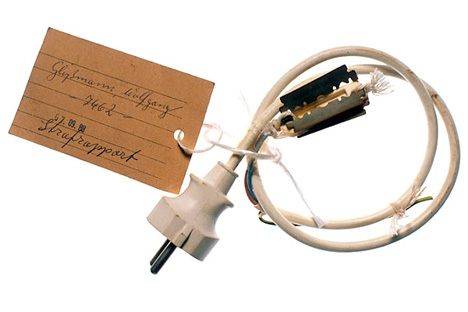
that looks like the absolute bare minimum immersion heater and is clearly dangerous as hell but I'm wondering how exactly it works. Its connected directly to a mains plug so there will be 240V AC current flowing through it. I see that the cord is stripped at the end, revealing a blue and a red wire. I'm guessing one wire is for current travelling down the cord (away from the plug socket) and the other wire is for carrying current back to the plug socket. The red and blue wires are then stripped and the exposed copper strands appear to connect to 3 razor blades. I don't know what that rope in the middle of the blades is for, maybe just a separator to prevent the blades from touching each other.

How exactly would a device like this work? Does current travel from the red wire, into one of the razor blades, then to the 2nd razor blade, then to the 3rd razor blade then to the blue wire which carries the current back to the mains socket? Also, how exactly does this device produce heat? I know that the heat is generated by the razor blades but razor blades are made of steel or some other highly conductive alloy so I wouldn't have expected much heat to be generated when current flows through. My understanding is that resistance is required to convert electrical current into heat.
PhysOrg.com engineering news on PhysOrg.com

>> Mathematical algorithms cut train delays
>> Researchers design software to detect changes in colour vision
>> Trend study identifies potential for humans and technology to interact in a manufacturing environment
Oct8-12, 11:16 AM   #2
 
Recognitions:
Science Advisor Science Advisor
Like the battery cigarette lighter you posted previously, it's simple resistive heating.

The thin high carbon steel razor blades will be considerably poorer conductors than the copper wires, so most of the heat will be generated at the blades. Also, as they heat their resistance will increase. As long as they stay immersed in the water they shouldn't burn, so as long as it doesn't blow a fuse it should work.

Making sure it didn't blow a fuse would probably have required some trial and error, but it looks like they are using two razor blades split into halves, and I suspect the four halves would be connected in series.
Oct8-12, 01:39 PM   #3
 
Kind of reminds me of an improvised 2 mega watt version I once saw being used to load test large generators on a ship. 3 phase 480 volts. They simply lowered the bare copper wires into the sea water. They controlled resistance thru the sea water by how far they lowered them into the water. I talked to the engineer from the generator manufacture. He said he was supposed to load test the generators, but his resistor bank was delayed in shipping. The captain was in a rush to get to sea, so he improvised.
Oct9-12, 07:04 AM   #4
 

Ghetto immersion heater


Quote by uart View Post
Making sure it didn't blow a fuse would probably have required some trial and error, but it looks like they are using two razor blades split into halves, and I suspect the four halves would be connected in series.
Thanks for the info. One thing that I don't get is how exactly AC current works in circuits. I know how DC works, the current travels from the negative terminal of the voltage source to the positive terminal which is why the circuit has to be complete for current to flow. AC current on the other hand flows back and forth so do you even need a circuit?

Quote by uart View Post
Like the battery cigarette lighter you posted previously, it's simple resistive heating.

The thin high carbon steel razor blades will be considerably poorer conductors than the copper wires, so most of the heat will be generated at the blades. Also, as they heat their resistance will increase. As long as they stay immersed in the water they shouldn't burn, so as long as it doesn't blow a fuse it should work.

Making sure it didn't blow a fuse would probably have required some trial and error, but it looks like they are using two razor blades split into halves, and I suspect the four halves would be connected in series.
Oct9-12, 07:10 AM   #5
 
Quote by CrimpJiggler View Post
Thanks for the info. One thing that I don't get is how exactly AC current works in circuits. I know how DC works, the current travels from the negative terminal of the voltage source to the positive terminal which is why the circuit has to be complete for current to flow. AC current on the other hand flows back and forth so do you even need a circuit?
AC flows at 60 hz per second....or theoretically goes back and forth like you are saying 60 times per second.

You definitely still need two wires in a AC circuit to conduct electricity....or at least a ground/nuetral connection.
Oct9-12, 09:31 AM   #6
 
Ah I see, so the second wire leads to the ground. I was going to ask what would happen if the neutral wire didn't lead to the ground, but rather lead nowhere so that the charge had nowhere to go once it reached the end of the wire but I think I know the answer to that. The build up of charge in the wire would inhibit the flow of current, wouldn't it. I know that in a DC circuit, current can't flow at all if the electrons have nowhere to go but with an AC power source, I'd say some current would still flow as the electrons rapidly (60 times per second, or 50 in Europe) flow into the wire then back towards the power source. But if the other end of the wire is grounded, then charge can flow through the wire uninhibited.
Oct9-12, 11:41 AM   #7
 
Recognitions:
Science Advisor Science Advisor
Quote by CrimpJiggler View Post
Ah I see, so the second wire leads to the ground. I was going to ask what would happen if the neutral wire didn't lead to the ground, but rather lead nowhere so that the charge had nowhere to go once it reached the end of the wire but I think I know the answer to that. The build up of charge in the wire would inhibit the flow of current, wouldn't it. I know that in a DC circuit, current can't flow at all if the electrons have nowhere to go but with an AC power source, I'd say some current would still flow as the electrons rapidly (60 times per second, or 50 in Europe) flow into the wire then back towards the power source. But if the other end of the wire is grounded, then charge can flow through the wire uninhibited.
Indirectly I think you are alluding to the circuit property called capacitance (capacitor). With low frequency A/C you'll generally get very little current flow without completing the circuit. Technically a circuit can be "completed" with stray capacitance even when there is not a completed path for the electrons to flow.

With low frequency AC like 50/60 Hz this type of current flow from "stray" capacitance is typically very small.
Oct9-12, 04:13 PM   #8
 
In other words, if you only have one wire connected to a load with AC or DC....you have nothing. No voltage, no current, no power.

You can either hook line to line or line to neutral when talking AC single phase.
Neutral and ground are tied into the same bus. But again...only one wire with no return path....and you have nothing.
New Reply

Similar discussions for: Ghetto immersion heater
Thread Forum Replies
Fanless convection heater versus oil filled heater General Physics 2
show that { (x,|x|);x is real number} IS NOT the image of an immersion Differential Geometry 0
Immersion heater probelm Introductory Physics Homework 5
Advantages of using an immersion heater General Physics 0