| Thread Closed |
combinatorics problem |
Share Thread | Thread Tools |
| Sep2-12, 01:37 AM | #1 |
| Sep2-12, 04:50 AM | #2 |
|
|
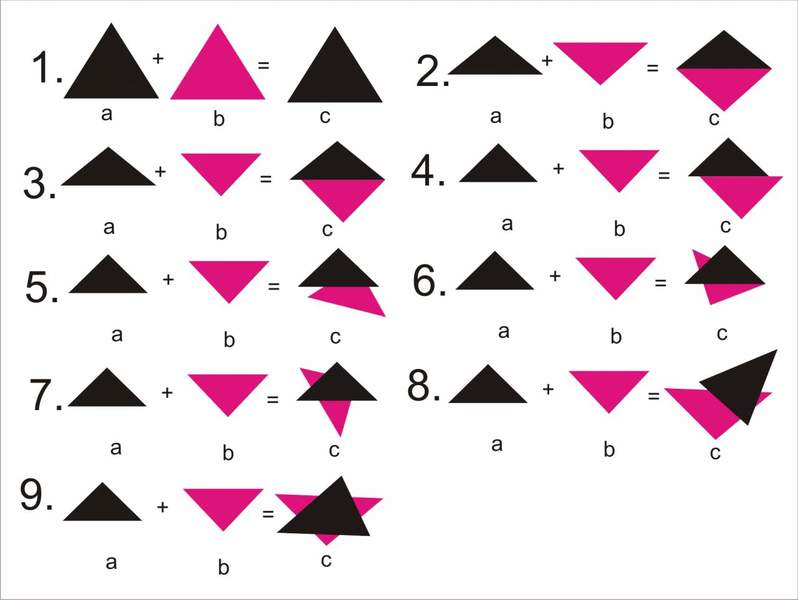
Yes, I see what you're doing. You're looking at all the different ways you can overlap two triangles to get various numbers of angles. I imagine there's some combinatorics going on. You could probably work out all the possibilities for overlapping any two polygons.
There's no contradiction between what you're doing and "current mathematics." Where are you going with this? |
| Sep8-12, 06:57 AM | #3 |
| Sep8-12, 07:54 AM | #4 |
|
|
combinatorics problem
So you have redefined "addition". Nothing wrong with that as long as you understand that this is NOT "standard" addition and does not refute "standard" addition. And, in fact, it is pretty tame compared to general group theory.
Are you thinking there might be useful applications of this? |
| Sep9-12, 10:45 AM | #5 |
|
|
1.3 + (.0)3 = 3 2.3 +(.1)3 = 4 3.3 +(.2)3 = 5 4.3+3 = 6 5.33Rd1(6)d2(7)+3 = 7 6.33Rd1(6)d2(8)+3 = 8 7.33Rd1(6)d2(9)+3 = 9 8.33Rd1(6)d2(10)+3 = 10 9.33Rd1(6)d2(12)+3 = 12 if you look at the history of mathematics, you will see that the new things in math should take some time to have a practical application -------------------------------------------- theorem - two (more) natural merge in the direction of longer AB experiment (realization theorem) http://docs.google.com/open?id=0BzkW...nh4SllhQkppVVU we get the following geometric objects 1. final (n, in Figure 1.2.3.) Along 2. infinite (n, in Figure 4.) along a one-way infinite -------------------------------------------------- asking - can you repeat back the title "ms.math" ( instead of combinatorics problem ) |
| Sep26-12, 12:27 PM | #6 |
|
|
theorem - infinite point dc longer be replaced {(0), (0,1), ... (0,1,2,3,4,5,6,7,8,9), ...} circular and set position.
evidence We got a new geometric object - along the numerical primes - http://docs.google.com/file/d/0BzkWG...hoUkJlRWs/edit |
| Oct12-12, 12:02 PM | #7 |
|
|
Theorem - the length between points 0 and all points (separately) on the number the longer the new relationship
proof - look along the numerical We got a set of natural numbers N = {0,1,2,3,4,5,6,7,8,9,10,11,12, ...}, example of the difference and the number of points on the number exceed: Item 5 and No. 5 are two different things, point 5 is the point number 5 is the length between points 0 and 5 points along the numerical |
| Oct29-12, 03:06 AM | #8 |
|
|
2.4 Mobile Number
Theorem-Natural numbers can be specified and other numerical point other than the point numeric 0th Proof - Value (length) numeric point (0) and numeric item (2) the number 2 Ratio (length) numeric point (1) and the numerical point of (3) is the number 2 Ratio (length) numeric point (2) and the numerical point of (4) is the number 2 ... |
| Nov2-12, 08:55 AM | #9 |
|
|
2.5 Gap numbers
Theorem- number and mobile number of no contact, ( number and mobile number without contact) and mobile number without con- clock, ..., in numeric longer. EVIDENCE - number 2 and mobile number 2 no contact, gets a gap of 2 (.1.) 2 number 2 and number mobile 2 no contact, getting the 2 (.2.) 2 number 2 and number mobile 2 no contact, getting the gap 2 (.3.) 2 ... (number 2 and mobile number 2 no contact) and mobile number 1 no contact, getting a gap of 2 (.1.) 2 (.1.) 1 https://docs.google.com/open?id=0Bzk...WYzN05RdGNvRnM ... Gap set of numbers GN={ a |(.bn.)cn | (a, bn, cn)[itex]\in[/itex] N, bn> 0} |
| Nov4-12, 07:16 AM | #10 |
|
|
2.6 Moving of gap number
Theorem-gap numbers can be entered and the second numerical point other than the point numeric 0 EVIDENCE-ratio (length) numeric point (0) and the numerical point of (4) is gap 2 (.1.) 1 Ratio (length) numeric point (1) and the numerical point of (5) is gap 2 (.1.) 1 Ratio (length) numeric point (2) and the numerical point of (6) is gap 2 (.1.) 1 ... |
| Nov11-12, 12:50 PM | #11 |
|
|
2.7 Points of number
Theorem - Number of numeric longer has a point, it could be the opposite write. EVIDENCE - Number 5 has a point: (.0), (.1), (.2), (.3) (.4) (.5). Opposite may write: (.. 0), (.. 1), (2 ..) (.. 3), (4 ..) (.. 5). Emptiness 2 (.3.) 1 has a point: (.0), (.1), (.2), (.3) (.4) (.5), (.6). can Write the opposite: (.0), (.. 1), (.. 2), (3 ..) (.. 4), (5 ..) (.. 6) |
| Nov18-12, 08:55 AM | #12 |
|
|
2.8 comparability of natural numbers
Theorem-Two (more) numbers are comparable to know Who is the greater (equal, smaller), which is the point of (.. 0) away from the numerical point of 0th EVIDENCE - Two issues: 5> 3 (item number 5 (.5) away from the point number 3 (.3)) 5 has a number of third 4 = 4 (item number 4 (.4) and the number of points 4 (.4) are equidistant) 4 is equal to 4 .2 <6 (item number 6 (.6) is distance from point number 2 (.2) 2 less than 6 . ). (= {>, =, <}, a). (b. Three issues: a). (b). (c ... |
| Nov18-12, 06:23 PM | #13 |
|
|
Hi, msmath, are you serious about any of the above? I find it all completely incoherent. Would you mind explaining in complete sentences what is going on, and what your motivation for this is?
|
| Nov22-12, 10:09 AM | #14 |
|
|
------------- 2.9 Addition Theorem-number (number of gaps) and mobile number (mobile Gap number) are in contact, the movable point number (mobile number gaps) (.0) Varies according to the number of counts (number of gaps) and connect. EVIDENCE - 3 + (.0) 3 = 3 or 3 + (.. 3) = 3. 3 + (.1) 3 = 4 or 3 + (.. 2) = 4 3 + (.2) 3 = 5 or 3 + (.. 1) 3 = 5 3 + (.3) 3 = 6 or 3 + (.. 0) 3 = 6 or 3 +3 = 6 https://docs.google.com/open?id=0Bzk...DVhTlVzY20tZWM With this solution we get the first 4 solutions, the other will have to wait!! |
| Nov22-12, 02:47 PM | #15 |
|
|
|
| Thread Closed |
| Thread Tools | |
Similar Threads for: combinatorics problem
|
||||
| Thread | Forum | Replies | ||
| A combinatorics Problem | Set Theory, Logic, Probability, Statistics | 0 | ||
| Combinatorics problem | Precalculus Mathematics Homework | 3 | ||
| Combinatorics problem | Calculus & Beyond Homework | 7 | ||
| Problem in Combinatorics | Calculus & Beyond Homework | 3 | ||
| Combinatorics problem | Calculus & Beyond Homework | 1 | ||